

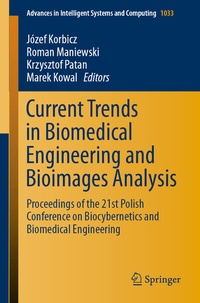
Current Trends in Biomedical Engineering and Bioimages Analysis
Description

This book gathers 30 papers presented at the 21st PCBBE, which was hosted by the University of Zielona Góra, Poland, and offered a valuable forum for exchanging ideas and presenting the latest developments in all areas of biomedical engineering. Biocybernetics and biomedical engineering are currently considered one of the most promising ways to improve health care and, consequently, the quality of life.
Innovative technical solutions can better meet physicians' needs and stimulate the development of medical diagnostics and therapy. We are currently witnessing a profound change in the role of medicine, which is becoming ubiquitous in everyday life thanks to technological advances. Further, the development of civilization manifests itself in efforts to unlock the secrets of the human body, and to mimic biological systems in engineering.
The biannual Polish Conference on Biocybernetics and Biomedical Engineering (PCBBE) has been held for nearly four decades andhas attracted scientists and professionals in the fields of engineering, medicine, physics, and computer science. Gathering the outcomes of this conference, the book introduces the reader to recent developments and achievements in biocybernetics and biomedical engineering.
More details
Other editions
Additional editions

Content
- Intro
- Preface
- Acknowledgment
- Contents
- Signal Processing
- Analysis of Amped Heart Rate Sensor Performance Under the Influence of Various External Factors and User Characteristics
- 1 Introduction
- 2 Factors Affecting Photoplethysmographic Measurements
- 3 Materials and Methods
- 3.1 Signal Acquisition with Amped Sensor
- 3.2 Experimental Design
- 4 Results and Discussion
- 5 Conclusions
- References
- Comparison of Indices Derived from Poincaré Maps on Electrocardiograms and Seismocardiograms
- 1 Introduction
- 2 Materials and Methods
- 2.1 Data Set
- 2.2 Signal Processing
- 2.3 Poincaré Map Analysis
- 3 Results
- 4 Conclusion and Discussion
- References
- Research of Ocular Hemodynamics by Optical Coherence Tomography and Transpalpebral Rheoophthalmography Methods
- 1 Introduction
- 2 Materials and Methods
- 3 Compliance with Ethical Requirements
- 4 Results
- 5 Conclusions
- References
- A New Method and Device for Differentiating Elastic and Resistive Properties of the Respiratory System
- Abstract
- 1 Introduction
- 2 Materials and Methods
- 2.1 The Idea of Added Compliance and Resistance Method (ACRM)
- 2.2 The Method of ACRM Validation
- 3 Results
- 4 Discussion and Conclusions
- Acknowledgements
- References
- Image Analysis
- Role of Let-7 Family miRNAs in Migration of Colorectal Cancer HCT 116 and Caco-2 Cells After Stimulation by the Adipokine Vaspin. Time-Lapse Live-Cell Microscopic Observations
- 1 Introduction
- 2 Materials and Methods
- 2.1 Cell Culture, Cytotoxicity and Migration Assays
- 2.2 Cell Transfection and Dual Luciferase Assay
- 2.3 miRNA Real Time PCR
- 2.4 Wound Healing Imaging
- 2.5 Images Pre-processing and Computational Analyses
- 3 Results
- 3.1 Transfection Efficiency
- 3.2 Let-7 miRNA and Gene Expression Regulation
- 3.3 HCT 116 Migration Assay
- 3.4 Cytotoxicity Assay of Vaspin in Caco-2 Cells
- 3.5 Hormonally-Stimulated Migration
- 4 Discussion
- 5 Conclusions
- References
- Fractal Dimension Analysis of PET-MRI Liver Images for Various ROI's Sizes
- 1 Introduction
- 2 Materials and Methods
- 2.1 Experimental Setup
- 2.2 Methods of Estimation the Fractal Dimension
- 3 Results
- 4 Conclusion
- References
- CNN Support to Diagnostics in Sjögren's Syndrome
- 1 Introduction
- 2 Materials and Methods
- 2.1 Ground Truth Annotations
- 2.2 Image Tiles Augmentation
- 2.3 CNN Training
- 2.4 Evaluation of Results
- 3 Results
- 3.1 Training
- 3.2 Classification Performance Measured Against Pathologist Ground Truth
- 4 Discussion
- 5 Conclusions and Future Work
- References
- On Stability of Feature Selection Based on MALDI Mass Spectrometry Imaging Data and Simulated Biopsy
- 1 Introduction
- 2 Data
- 2.1 MALDI-MSI Data
- 2.2 Dataset Preparation
- 2.3 Simulation of Biopsy Data
- 3 Feature Selection
- 3.1 t Test
- 3.2 Wilcoxon Rank-Sum Test
- 3.3 Sequential Forward Selection
- 4 Feature Ranking Stability
- 5 Choosing a Dataset for Feature Selection
- 6 Future Research
- References
- Virtual Reality as a Tool for Ophthalmic Examination
- 1 Introduction
- 2 Virtual Reality
- 3 Colour Blindness
- 4 Method
- 4.1 Rendering Colours on Smartphone
- 4.2 Technology and Software
- 4.3 Application Details
- 4.4 Experiments
- 5 Conclusion and Future Works
- References
- Texture Description for Classification of Fine Needle Aspirates
- 1 Introduction
- 2 Database Description
- 3 Methods
- 3.1 Texture Description
- 3.2 Morphological Features
- 3.3 Malignancy Classification
- 4 Results and Discussion
- 5 Conclusions and Further Work
- References
- Computer-Aided Medical Diagnosis
- Novel Digital Pathology Method for Computer-Aided Analysis of Histopathological Images Obtained from Dystrophic Muscle Biopsies
- Abstract
- 1 Introduction
- 2 Materials and Methods
- 3 Results
- 4 Conclusions
- Acknowledgements
- References
- Deep Neural Networks for Breast Cancer Diagnosis: Fine Needle Biopsy Scenario
- 1 Introduction
- 2 Related Work
- 3 Dataset
- 4 Experiments
- 5 Discussion
- 6 Conclusions
- References
- Fibroblast Segmentation in Microscopic Brightfield Images with Convolutional Neural Network
- 1 Introduction
- 2 Materials and Methods
- 2.1 Image Data
- 2.2 CNN Training and Validation
- 3 Results
- 4 Discussion
- 5 Conclusion
- References
- BioTest - Remote Platform for Hypothesis Testing and Analysis of Biomedical Data
- 1 Introduction
- 2 Materials and Methods
- 2.1 Supervised and Unsupervised Machine Learning Methods and Tools
- 2.2 A Tool for Aggregation of Gene Ontology Terms
- 3 Data Storage and High-Level Data Analysis
- 4 Example Results
- 5 Conclusion
- References
- Detection of Epileptic Seizures via Deep Long Short-Term Memory
- 1 Introduction
- 2 Seizure Database
- 3 Statistical Analysis
- 4 Long Short-Term Memory
- 5 Experiment
- 5.1 Statistical Analysis
- 5.2 Deep LSTM Classification
- 6 Concluding Remarks
- References
- Breast Cancer Computer-Aided Diagnosis System Using k-NN Algorithm Based on Hausdorff Distance
- 1 Introduction
- 2 Materials
- 3 Methods
- 4 Results
- 5 Conclusions
- References
- E-health and Telemedicine
- Taking Videoplethysmographic Measurements at Alternative Parts of the Body - Pilot Study
- Abstract
- 1 Introduction
- 2 Related Work
- 3 Materials and Methods
- 3.1 Study Conditions
- 3.2 Image and Signal Processing
- 4 Results
- 4.1 Results of Measurement Accuracy
- 4.2 Results of Measurement Reliability
- 4.3 Results of Pulse Wave Velocity
- 5 Discussion
- Acknowledgment
- References
- Multimodal Measurement Systems for Health and Behavior Analysis in Living Environment
- Abstract
- 1 Introduction
- 2 Sensors and Sensor Networks
- 2.1 Sensor Types and Characteristics
- 2.2 Intelligent Sensors
- 2.3 Imperceptible Sensors
- 2.4 Sensor Network
- 2.5 Sensor Information Safety
- 3 Digital Behavioral Record
- 3.1 Natural Representation of Behavior
- 3.2 Symbolic Representation of Behavior
- 4 Identifying and Predicting Human Actions
- Acknowledgment
- References
- Assessing the Influence of the Teaching Method on Cognitive Aspects in the Process of Mathematical Education Among Blind People
- 1 Introduction
- 1.1 Methods and Tools Supporting the Access to Information for the Blind
- 1.2 Challenges of Teaching and Learning Mathematics by Visually Impaired
- 2 Materials and Methods
- 2.1 Developed an Alternative Method of Teaching Mathematics
- 2.2 Cognitive Aspects and Proposed Method of Their Evaluation
- 2.3 Research Group, Control Group and Conducted Experiments
- 3 Results
- 4 Discussion
- References
- Modelling of Physiological Processes
- Modeling and Optimization of Radio-Chemotherapy
- 1 Introduction
- 2 Modeling of Anticancer Treatment
- 2.1 The Simplest Case
- 2.2 Modeling Pharmacokinetics and DNA Repair
- 3 Gompertz vs. Logistic Growth
- 4 Conclusions
- References
- Challenges with Conventional Ventilation of Infants with Inhomogeneous Lungs
- Abstract
- 1 Introduction
- 2 Methods
- 2.1 Numeric Model of Lungs
- 2.2 The Hybrid Simulator of Respiratory System and Setup
- 2.3 The Simulations
- 3 Results
- 4 Discussion and Conclusions
- References
- Modelling the Influence of the Electromagnetic Field on a User of a Bone Conduction Hearing Medical Implant
- Abstract
- 1 Introduction
- 2 Material and Methods
- 2.1 Numerical Model of HI-BB
- 2.2 Numerical Model of an HI-BB User
- 2.3 Models of EMF Sources
- 2.4 Characteristic of Exposure to EMF
- 2.5 Numerical Simulations
- 2.6 Criteria for Assessing Electromagnetic Hazards
- 3 Results
- 4 Conclusions
- Acknowledgments
- References
- Measurement of Dynamic Properties of Animal Liver to Identify the Material Model
- 1 Introduction
- 2 Materials and Methods
- 3 Results
- 4 Model Identifiaction
- 5 Conclusion
- References
- A Novel Real-Time Computer Model of the Coronary System Including a Physiological Feedback Between the Left Ventricular Muscles and Coronary Perfusion
- Abstract
- 1 Introduction
- 2 Materials and Methods
- 2.1 The Model of the Coronary System
- 2.2 The Coronary Model Parametrization
- 2.3 The Coronary Model Implantation in the Whole Numerical Cardiovascular Model
- 3 Results and Discussion
- 4 Conclusions
- Compliance with Ethical Standards
- References
- Other Bioengineering Studies
- Mechanical Properties of Porcine Aorta - Influence of Specimen Taken Orientation
- 1 Introduction
- 2 Materials and Methods
- 3 Results
- 4 Discussion
- 5 Conclusions
- References
- Experimental and Constitutive Approaches for a Study of Mechanical Properties of Animal Tendons
- 1 Introduction
- 2 Materials and Methods
- 3 Results
- 4 Discussion
- 5 Conclusions
- References
- A Workspace Analysis for a Planar Model of a Tibiofemoral Joint - A Preliminary Study
- Abstract
- 1 Introduction
- 2 Method
- 2.1 The Model of the TF Joint
- 2.2 The Workspace
- 3 Results and Discussion
- 3.1 Testing the Procedure: A One-Ligament and a Contact-Only Model
- 3.2 Simulations for the Complete TF Model
- 4 Conclusion
- References
- Investigation of Helmet-Head Interaction in the Aspect of Craniocerebral Tissue Protection
- 1 Introduction
- 2 Materials and Methods
- 2.1 Mechanical Properties of Materials Used for the Interior Lining of the Helmet
- 3 Research Results
- 4 Summary and Discussion
- References
- European Research on Magnetic Nanoparticles for Biomedical Applications: Standardisation Aspects
- Abstract
- 1 Introduction
- 2 Pre- and Co-normative EU Projects on Magnetic Nanoparticles
- 2.1 The Pre-normative EU NanoMag Project
- 2.2 EU Transdomain COST Action RADIOMAG
- 2.3 The EURAMET Project MagNaStand
- 3 Search of the EU CORDIS Database for Research Projects that are relevant for MNP Standardisation
- 3.1 Results of the Search of the CORDIS Database
- 4 An Online Survey of Researchers Involved in MNP Projects
- 4.1 Survey Results
- 4.2 Discussion of the Survey Results
- 5 Summary
- Acknowledgments
- References
- A Factorial Design for Assessment of the Effect of Selected Process Variables on the Impulse Electrostatic Droplet Formation
- Abstract
- 1 Introduction
- 2 Materials and Methods
- 2.1 Materials
- 2.2 Experimental System
- 2.3 Application of the Factorial Design Method in Discussed Case
- 3 Results and Discussion
- 3.1 Experimental Results
- 3.2 Response Surface Model
- 4 Conclusions
- References
- Author Index
