

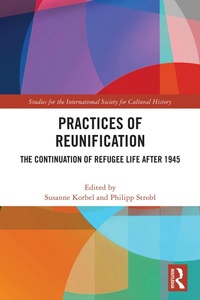
Practices of Reunification
The Continuation of Refugee Life After 1945
Published on 16. December 2025
216 pages
978-1-040-63928-3 (ISBN)
Description

The volume explores the role of refugees and Displaced Persons (DPs) in Europe after 1945. It expands conventional narratives about post-National Socialist societies, which are characterized by victim myths, narratives of Truemmerfrauen (rubble women), and the reconstruction of supposedly homogeneous societies.
Using analyses informed by new approaches in cultural studies and digital humanities, the authors enhance studies of refugees and DPs' ways of living and their interactions with their surrounding societies. Relying on microhistorical perspectives, the case studies are focusing on both, post-National Socialist societies and exile communities and thus contribute to a better understanding of everyday life. The book locates itself at the intersection of Migration Studies, Gender Studies, Emotion Studies, and the History of Knowledge and focuses on the following key questions: How did family members reconnect with individuals liberated from concentration camps? How did they communicate about the choice of new places to live? How did exile communities reorganize themselves after the end of the war?
This volume explores diverse experiences in the post-1945 world that have been shaping not only the European societies but have also been influencing our present legal and societal understandings and interpretations on a global scale.
Using analyses informed by new approaches in cultural studies and digital humanities, the authors enhance studies of refugees and DPs' ways of living and their interactions with their surrounding societies. Relying on microhistorical perspectives, the case studies are focusing on both, post-National Socialist societies and exile communities and thus contribute to a better understanding of everyday life. The book locates itself at the intersection of Migration Studies, Gender Studies, Emotion Studies, and the History of Knowledge and focuses on the following key questions: How did family members reconnect with individuals liberated from concentration camps? How did they communicate about the choice of new places to live? How did exile communities reorganize themselves after the end of the war?
This volume explores diverse experiences in the post-1945 world that have been shaping not only the European societies but have also been influencing our present legal and societal understandings and interpretations on a global scale.
More details
Series
Language
English
Place of publication
London
United Kingdom
Publishing group
Taylor & Francis Ltd
Target group
College/higher education
Product notice
Reflowable
File size
0,57 MB
ISBN-13
978-1-040-63928-3 (9781040639283)
Copyright in bibliographic data and cover images is held by Nielsen Book Services Limited or by the publishers or by their respective licensors: all rights reserved.
Schweitzer Classification
Other editions
Additional editions
Susanne Korbel | Philipp Strobl
Practices of Reunification
The Continuation of Refugee Life After 1945
Book
approx. 12/2025
1st Edition
Routledge
€206.10
Not yet published
Persons
Susanne Korbel is a senior post-doc at the University of Graz. Among her most important publications are: Auf die Tour! Juedinnen und Juden in Singspielhalle, Kabarett und Variete zwischen Habsburgermonarchie und Amerika um 1900 (2021), and the Leo Baeck Insitute Essay Price winning article "Spaces of Gendered Jewish and Non-Jewish Encounters."
Philipp Strobl is a historian in the Department of Contemporary History at the University of Vienna. His research focuses on the intersection of knowledge history and migration history. He has published extensively in these fields, including monographs, edited volumes, and articles on migrating knowledge and its impact on societies in Europe, the United States, and Australia. His most recent book, A History of Displaced Knowledge, was recently published by Brill in the Studies in Global Migration History series. He also edited a special issue titled Lost Knowledge and Migration for the Journal of Migration History.
Philipp Strobl is a historian in the Department of Contemporary History at the University of Vienna. His research focuses on the intersection of knowledge history and migration history. He has published extensively in these fields, including monographs, edited volumes, and articles on migrating knowledge and its impact on societies in Europe, the United States, and Australia. His most recent book, A History of Displaced Knowledge, was recently published by Brill in the Studies in Global Migration History series. He also edited a special issue titled Lost Knowledge and Migration for the Journal of Migration History.
Content
Introduction
Susanne Korbel and Philipp Strobl
Part I: Agency and Networks of Continuation
Chapter 1
1945: Surviving and Living in a Divided World
Michael Gehler
Chapter 2
To Save the Saviors: Reorganizing the Jewish Anarchists Humanitarian Network in Europe, 1945-1950
Maria Tarasova Chomard
Chapter 3
Postwar Journeys of Jewish and Polish Refugees from Poland (1940s-1950s)
Anna Cichopek-Gajraj
Chapter 4
Health As an Obstacle to Resettlement: Jewish Displaced Persons with Disabilities and Health Issues in Pursuit for Self-Determination after the Shoah 1948-1951
Johannes Glack
Part II: Practices of Reunifcation
Chapter 5
To Those Near and Far: Reconnecting with Family Members after the Holocaust
Rachel Blumenthal
Chapter 6
Beyond the Camp - New Beginnings and Continuities for Jewish DPs in Munich
Klaus Hagen
Chapter 7
Luke Wijnberg: The Possibilities of a Single Story
Andrea Wuerth
Susanne Korbel and Philipp Strobl
Part I: Agency and Networks of Continuation
Chapter 1
1945: Surviving and Living in a Divided World
Michael Gehler
Chapter 2
To Save the Saviors: Reorganizing the Jewish Anarchists Humanitarian Network in Europe, 1945-1950
Maria Tarasova Chomard
Chapter 3
Postwar Journeys of Jewish and Polish Refugees from Poland (1940s-1950s)
Anna Cichopek-Gajraj
Chapter 4
Health As an Obstacle to Resettlement: Jewish Displaced Persons with Disabilities and Health Issues in Pursuit for Self-Determination after the Shoah 1948-1951
Johannes Glack
Part II: Practices of Reunifcation
Chapter 5
To Those Near and Far: Reconnecting with Family Members after the Holocaust
Rachel Blumenthal
Chapter 6
Beyond the Camp - New Beginnings and Continuities for Jewish DPs in Munich
Klaus Hagen
Chapter 7
Luke Wijnberg: The Possibilities of a Single Story
Andrea Wuerth
