

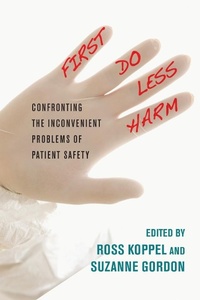
First, Do Less Harm
Confronting the Inconvenient Problems of Patient Safety
Published on 15. May 2012
304 pages
978-0-8014-6454-6 (ISBN)
Description

Each year, hospital-acquired infections, prescribing and treatment errors, lost documents and test reports, communication failures, and other problems have caused thousands of deaths in the United States, added millions of days to patients' hospital stays, and cost Americans tens of billions of dollars. Despite (and sometimes because of) new medical information technology and numerous well-intentioned initiatives to address these problems, threats to patient safety remain and in some areas are on the rise.
In First, Do Less Harm, twelve health care professionals and researchers plus two former patients look at patient safety from a variety of perspectives, finding many of the proposed solutions to be inadequate or impractical. Several contributors to this book attribute the failure to confront patient safety concerns to the influence of the "market model" on medicine and emphasize the need for hospital-wide teamwork and greater involvement from frontline workers (from janitors and aides to nurses and physicians) in planning, implementing, and evaluating effective safety initiatives.
Several chapters in First, Do Less Harm focus on the critical role of interprofessional and occupational practice in patient safety. Rather than focusing on the usual suspects-physicians, safety champions, or high level management-these chapters expand the list of "stakeholders" and patient safety advocates to include nurses, patient care assistants, and other staff, as well as the health care unions that may represent them. First, Do Less Harm also highlights workplace issues that negatively affect safety: including sleeplessness, excessive workloads, outsourcing of hospital cleaning, and lack of teamwork between physicians and other health care staff. In two chapters, experts explain why the promise of health care information technology to fix safety problems remains unrealized, with examples that are at once humorous and frightening. A book that will be required reading for physicians, nurses, hospital administrators, public health officers, quality and risk managers, healthcare educators, economists, and policymakers, First, Do Less Harm concludes with a list of twenty-seven paradoxes and challenges facing everyone interested in making care safe for both patients and those who care for them.
In First, Do Less Harm, twelve health care professionals and researchers plus two former patients look at patient safety from a variety of perspectives, finding many of the proposed solutions to be inadequate or impractical. Several contributors to this book attribute the failure to confront patient safety concerns to the influence of the "market model" on medicine and emphasize the need for hospital-wide teamwork and greater involvement from frontline workers (from janitors and aides to nurses and physicians) in planning, implementing, and evaluating effective safety initiatives.
Several chapters in First, Do Less Harm focus on the critical role of interprofessional and occupational practice in patient safety. Rather than focusing on the usual suspects-physicians, safety champions, or high level management-these chapters expand the list of "stakeholders" and patient safety advocates to include nurses, patient care assistants, and other staff, as well as the health care unions that may represent them. First, Do Less Harm also highlights workplace issues that negatively affect safety: including sleeplessness, excessive workloads, outsourcing of hospital cleaning, and lack of teamwork between physicians and other health care staff. In two chapters, experts explain why the promise of health care information technology to fix safety problems remains unrealized, with examples that are at once humorous and frightening. A book that will be required reading for physicians, nurses, hospital administrators, public health officers, quality and risk managers, healthcare educators, economists, and policymakers, First, Do Less Harm concludes with a list of twenty-seven paradoxes and challenges facing everyone interested in making care safe for both patients and those who care for them.
More details
Series
Language
English
Place of publication
New York
United States
Publishing group
Cornell University Press
Product notice
Reflowable
Illustrations
1 chart/graph - 1 Charts
ISBN-13
978-0-8014-6454-6 (9780801464546)
Copyright in bibliographic data and cover images is held by Nielsen Book Services Limited or by the publishers or by their respective licensors: all rights reserved.
Schweitzer Classification
Other editions
Additional editions
Ross Koppel | Suzanne Gordon
First, Do Less Harm
Confronting the Inconvenient Problems of Patient Safety
Book
05/2012
ILR Press
€28.50
Article not available at the moment
Persons
Ross Koppel is on the faculty of the Sociology Department and School of Medicine at the University of Pennsylvania, holds a faculty position at the RAND Corporation, and is the internal evaluator at Harvard Medical School as well as holding other professional affiliations. He is the author of several seminal publications on health IT in JAMA and other leading scientific journals. Suzanne Gordon is Visiting Professor at the University of Maryland School of Nursing and was program leader of the Robert Wood Johnson-funded Nurse Manager in Action Program. She is the author of Life Support and Nursing against the Odds, coauthor of Safety in Numbers and From Silence to Voice, editor of When Chicken Soup Isn't Enough, and coeditor of The Complexities of Care, all from Cornell.
Content
Introduction
1. The Data Model That Nearly Killed Me
2. Too Mean to Clean: How We Forgot to Clean Our Hospitals
3. What Goes without Saying in Patient Safety
4. Health Care Information Technology to the Rescue
5. A Day in the Life of a Nurse
6. Excluded Actors in Patient Safety
7. Nursing as Patient Safety Net: Systems Issues and Future Directions
8. Physicians, Sleep Deprivation, and Safety
9. Sleep-deprived Nurses: Sleep and Schedule Challenges in Nursing
10. Wounds That Don't Heal: Nurses' Experience with Medication Errors
11. On Teams, Teamwork, and Team Intelligence
Conclusion: Twenty-seven Paradoxes, Ironies, and Challenges
of Patient Safety
1. The Data Model That Nearly Killed Me
2. Too Mean to Clean: How We Forgot to Clean Our Hospitals
3. What Goes without Saying in Patient Safety
4. Health Care Information Technology to the Rescue
5. A Day in the Life of a Nurse
6. Excluded Actors in Patient Safety
7. Nursing as Patient Safety Net: Systems Issues and Future Directions
8. Physicians, Sleep Deprivation, and Safety
9. Sleep-deprived Nurses: Sleep and Schedule Challenges in Nursing
10. Wounds That Don't Heal: Nurses' Experience with Medication Errors
11. On Teams, Teamwork, and Team Intelligence
Conclusion: Twenty-seven Paradoxes, Ironies, and Challenges
of Patient Safety
