

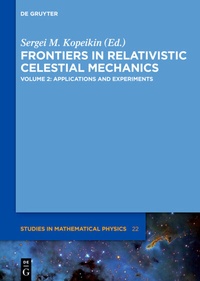
Applications and Experiments
Vol. 2: Applications and Experiments
1st Edition
Published on 20. August 2014
XXIX, 288 pages
978-3-11-034566-7 (ISBN)
Description

Relativistic celestial mechanics - investigating the motion celestial bodies under the influence of general relativity - is a major tool of modern experimental gravitational physics. With a wide range of prominent authors from the field, this two-volume series consists of reviews on a multitude of advanced topics in the area of relativistic celestial mechanics - starting from more classical topics such as the regime of asymptotically-flat spacetime, light propagation and celestial ephemerides, but also including its role in cosmology and alternative theories of gravity as well as modern experiments in this area. This second volume of a two-volume series covers applications of the theory as well as experimental verifications. From tools to determine light travel times in curved space-time to laser ranging between earth and moon and between satellites, and impacts on the definition of time scales and clock comparison techniques, a variety of effects is discussed. On the occasion of his 80-th birthday, these two volumes honor V. A. Brumberg - one of the pioneers in modern relativistic celestial mechanics. Contributions include: J. Simon, A. Fienga: Victor Brumberg and the French school of analytical celestial mechanics T. Fukushima: Elliptic functions and elliptic integrals for celestial mechanics and dynamical astronomy P. Teyssandier: New tools for determining the light travel time in static, spherically symmetric spacetimes beyond the order G2 J. Müller, L. Biskupek, F. Hofmann and E. Mai: Lunar laser ranging and relativity N. Wex: Testing relativistic celestial mechanics with radio pulsars I. Ciufolini et al.: Dragging of inertial frames, fundamental physics, and satellite laser ranging G. Petit, P. Wolf, P. Delva: Atomic time, clocks, and clock comparisons in relativistic spacetime: a review
More details
Series
Language
English
Place of publication
Berlin/Boston
Germany
Target group
Professional and scholarly
US School Grade: College Graduate Student
Illustrations
45 farbige Abbildungen, 30 s/w Abbildungen
30 b/w and 45 col. ill.
File size
4,92 MB
ISBN-13
978-3-11-034566-7 (9783110345667)
DOI
http://www.degruyter.com/isbn/9783110345667
Schweitzer Classification
Other editions
Additional editions
Sergei M. Kopeikin
Frontiers in Relativistic Celestial Mechanics / Applications and Experiments
Book
08/2014
1st Edition
De Gruyter
€229.00
Article exhausted; check different version
E-Book
08/2014
1st Edition
De Gruyter
€210.00
Available for download
Sergei M. Kopeikin
Applications and Experiments
Book
06/2014
1st Edition
De Gruyter
€210.00
Shipment within 7-9 days
Persons
Content
- Intro
- Contents
- List of figures
- List of tables
- Preface
- New tools for determining the light travel time in static, spherically symmetric spacetimes beyond the order G2
- 1 Introduction
- 2 Notations and conventions
- 3 Generalities
- 4 Specific assumptions on the metric and the light rays
- 4.1 Post-Minkowskian expansion of the metric
- 4.2 Time transfer function for a quasi-Minkowskian light ray
- 5 Fundamental properties of functions T(n)
- 5.1 Recurrence relation satisfied by functions T(n)
- 5.2 Analyticity of the functions T(n)
- 6 First procedure: determination of the T(n)'s from the recurrence relation for n = 1, 2, 3
- 7 Second procedure: determination of the T(n)'s from the geodesic equations
- 7.1 Null geodesic equations
- 7.2 Post-Minkowskian expansion of the impact parameter
- 7.3 Implementation of the method
- 8 Simplification of the second procedure
- 8.1 Use of a constraint equation
- 8.2 Explicit calculation of T(1), T(2), and T(3)
- 9 Direction of light propagation up to order G3
- 10 Light ray emitted at infinity
- 11 Enhanced terms in T(1), T(2), and T(3)
- 12 Application to some Solar System experiments
- 13 Concluding remarks
- References
- Testing relativistic gravity with radio pulsars
- 1 Introduction
- 1.1 Radio pulsars and pulsar timing
- 1.2 Binary pulsar motion in gravity theories
- 1.3 Gravitational spin effects in binary pulsars
- 1.4 Phenomenological approach to relativistic effects in binary pulsar observations
- 2 Gravitational wave damping
- 2.1 The Hulse-Taylor pulsar
- 2.2 The Double Pulsar - The best test for Einstein's quadrupole formula, and more
- 2.3 PSR J1738+0333 - The best test for scalar-tensor gravity
- 2.4 PSR J0348+0432 - A massive pulsar in a relativistic orbit
- 2.5 Implications for gravitational wave astronomy
- 3 Geodetic precession
- 3.1 PSR B1534+12
- 3.2 The Double Pulsar
- 4 The strong equivalence principle
- 4.1 The Damour-Schäfer test
- 4.2 Direct tests
- 5 Local Lorentz invariance of gravity
- 5.1 Constraints on a1 from binary pulsars
- 5.2 Constraints on a2 from binary and solitary pulsars
- 5.3 Constraints on a3 from binary pulsars
- 6 Local position invariance of gravity
- 7 A varying gravitational constant
- 8 Summary and outlook
- References
- Lunar laser ranging and relativity
- 1 Introduction
- 2 Model
- 2.1 Overview
- 2.2 Ephemerides
- 3 Analysis
- 3.1 Software package LUNAR
- 3.2 Newtonian parameters
- 4 Results for relativistic parameters
- 4.1 Gravitational constant
- 4.2 Equivalence principle
- 4.3 Yukawa term
- 4.4 Geodetic precession
- 4.5 Metric parameter ß
- 4.6 Preferred-frame parameters a1, a2
- 5 Summary and outlook
- References
- Dragging of inertial frames, fundamental physics, and satellite laser ranging
- 1 Introduction
- 2 Dragging of inertial frames
- 3 Tests of string theory and the LAGEOS and LARES space experiments
- 4 LAGEOS and Gravity Probe B: two independent space experiments measuring frame dragging
- 5 The LARES mission
- 5.1 The LARES satellite
- 5.2 The LARES satellite and geodesic motion
- 5.3 Preliminary orbital analyses
- 5.4 Error analyses
- 5.5 Monte Carlo simulations
- 6 Conclusions
- References
- Elliptic functions and elliptic integrals for celestial mechanics and dynamical astronomy
- 1 Introduction
- 2 Notations
- 2.1 Glossary
- 2.2 First input argument: ?, u and x
- 2.3 Second input argument: k, u and x
- 2.4 Sign of n
- 2.5 Third input argument: n and a
- 2.6 Ordering of arguments
- 2.7 Omission of parameters
- 3 Elliptic functions
- 3.1 General elliptic function
- 3.2 Weierstrass elliptic function
- 3.3 Jacobian elliptic functions
- 3.4 Jacobi's amplitude function
- 3.5 Differential equations of Jacobian elliptic functions
- 3.6 Addition theorem of Jacobian elliptic functions
- 3.7 Jacobi's form of incomplete elliptic integrals
- 3.8 Addition theorem of incomplete elliptic integrals
- 3.9 Jacobi's original form of incomplete elliptic integral of the third kind
- 4 Elliptic integrals
- 4.1 General elliptic integral
- 4.2 Legendre's form of incomplete elliptic integrals
- 4.3 Associate incomplete elliptic integrals
- 4.4 Complete elliptic integrals
- 4.5 Generalized elliptic integrals
- 4.6 Symmetric elliptic integrals
- 5 Numerical computation of elliptic functions and elliptic integrals
- 5.1 Overview
- 5.2 Transformation method
- 5.3 Example of transformation method
- 5.4 Simultaneous computation of Jacobian elliptic functions
- 5.5 Better computation of Jacobian elliptic functions
- 5.6 Computation of Jacobi's form of incomplete elliptic integrals
- 5.7 Computation of Legendre's form of incomplete elliptic integral of the first kind
- 5.8 Computation of other incomplete elliptic integrals
- 5.9 Computation of complete elliptic integrals other than II(n|m) and J(n|m)
- 5.10 Computation of complete elliptic integrals of the third kind
- 5.11 CPU time comparison
- 5.12 Software
- 6 Conclusion
- References
- Victor Brumberg and the French school of analytical celestial mechanics
- 1 Introduction
- 2 Analytical formulism for planetary perturbations
- 2.1 Development of the perturbative function
- 2.2 Calculation of the Hansen coefficients
- 3 General planetary theory (GPT)
- 3.1 Introduction
- 3.2 General theory by V. Brumberg
- 4 Planetary theories with the aid of the expansions of elliptic functions
- 4.1 Notations
- 4.2 Expansion of the right-hand members of the equations: A change of the time variable
- 4.3 Application to planetary problems
- 5 Reference frames, time scales, and units for planetary ephemerides
- 5.1 Victor Brumberg's contributions
- 5.2 Planetary ephemerides
- 5.3 Conclusions
- References
- Atomic time, clocks, and clock comparisons in relativistic spacetime: a review
- 1 Introduction
- 2 Atomic time and atomic clocks
- 2.1 Atomic time scales
- 2.2 Atomic clocks
- 3 Relativistic framework for time and frequency comparisons
- 3.1 Introduction
- 3.2 Simultaneity and synchronization
- 3.3 Relativistic definitions of spacetime coordinate systems
- 3.4 Time scales in the barycentric and geocentric systems
- 3.5 Relativistic theory for time transformations in the Solar System (BCRS)
- 4 Relativistic treatment for time and frequency comparisons in the vicinity of the Earth (GCRS)
- 4.1 One-way time transfer
- 4.2 Two-way time transfer using artificial satellites
- 4.3 Frequency comparisons
- 5 Time and frequency transfer techniques
- 5.1 Established time and frequency transfer techniques: GNSS and two-way time transfer
- 5.2 Some novel two-way techniques
- 6 Clocks in relativistic geodesy
- 6.1 Review of chronometric geodesy
- 6.2 The chronometric geoid
- 7 Conclusions and prospects
- References
- Index
