

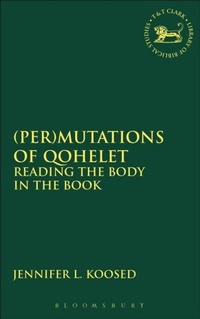
(Per)mutations of Qohelet
Reading the Body in the Book
1st Edition
Published on 1. July 2006
152 pages
978-0-567-40111-3 (ISBN)
Description

(Per)mutations of Qohelet explores the question, Who is Qohelet? Rather than peering behind or through the text to answer this question in terms of authorship, Koosed analyzes the identity that is created through the words on the page. The text is not a transparent medium connecting reader with author; instead, it is an opaque body - it has weight, substance, skin. Koosed begins with an analysis of the ways in which words construct identities and the reasons why words can affect us so profoundly, relying primarily on the work of Judith Butler and Elaine Scarry. She then explores autobiography and how the genre of autobiography - as reconfigured by Roland Barthes and Jacques Derrida - relates to Qohelet. These two chapters then set the framework for what follows: an analysis of the various bodily organs and sensations contained within the book of Qohelet. The body is embedded in the text through the naming of body parts (eye, hand, heart). And this same body is encoded in form, structure, and syntax, so that the text becomes a body with organs, systems, and even a life of its own. The book is a body and the book speaks of bodies. It speaks of the body's organs and senses; it concerns itself with the pleasures and pains of the body, the gendered body, the dying body. Finally, the ritual body is highlighted in the final passage of this enigmatic book.
More details
Series
Edition
1. Auflage
Language
English
Place of publication
London
United Kingdom
Publishing group
Bloomsbury Publishing PLC
Target group
Professional and scholarly
ISBN-13
978-0-567-40111-3 (9780567401113)
Copyright in bibliographic data and cover images is held by Nielsen Book Services Limited or by the publishers or by their respective licensors: all rights reserved.
Schweitzer Classification
Other editions
Additional editions
Book
05/2006
T.& T.Clark Ltd
€142.50
Shipment within 3-4 weeks
Person
Jennifer L. Koosed (Ph.D., Vanderbilt University) is associate professor of Religion at Albright College in Reading, Pennsylvania.She is the author of (Per)muations of Qohelet: Reading the Body in the Book (Continuum, 2006).
Content
1)Introducing Qohelet
The first chapter is an explication of the methods I employ through out my reading.
2)Calling Qohelet Names
The second chapter examines the language of autobiography (the persistent first-person singular pronoun) in Qohelet and the genre designations that have emerged from this marker.
3)Fragments of Qohelet's Body
The book of Qohelet forms a picture of the speaker through the language of selfhood and also through the construction of Qohelet's body. This chapter begins the probing of the body by reading the two body parts that are repeatedly named in the book: the heart and the eye.
4)Qohelet in Pleasure and Pain
Chapter four addresses the questions of contradictions and whether or not the book is optimistic or pessimistic by again focusing on the body - the body in pleasure and in pain. This chapter argues that resolving the contradictions is not a question of either/or, but it is the vacillation between them that produces desire in the reader
5)Qohelet in Love and (Gender) Trouble
The fifth chapter looks at how the gendered body is made manifest in Qohelet through an interpretation of the Qoh 7:26-29. This passage is a misogynist statement on women; yet, the gendered body in Qohelet is neither coherent nor stable.
6)Decomposing Qohelet
The structure of Qohelet has always been a problem for interpreters. I argue that the structure is in a state of decay, which enacts the decaying of the aging and dying body in the book of Qohelet. Qoh 3:1-8 and 12:1-8 are the focus in this chapter.
7)Reading the Epilogue Through This Body
The final verses of Qohelet (12:9-14 or sometimes just 12:13-14) are consistently attributed to another hand. My last chapter argues that all such theories rest on an interpreter's assumptions about coherent identities producing unified texts. Instead of a contradiction that indicates multiple authorship, I argue that ritual participation can co-exist with radical, questioning theology.
8)Departures
The first chapter is an explication of the methods I employ through out my reading.
2)Calling Qohelet Names
The second chapter examines the language of autobiography (the persistent first-person singular pronoun) in Qohelet and the genre designations that have emerged from this marker.
3)Fragments of Qohelet's Body
The book of Qohelet forms a picture of the speaker through the language of selfhood and also through the construction of Qohelet's body. This chapter begins the probing of the body by reading the two body parts that are repeatedly named in the book: the heart and the eye.
4)Qohelet in Pleasure and Pain
Chapter four addresses the questions of contradictions and whether or not the book is optimistic or pessimistic by again focusing on the body - the body in pleasure and in pain. This chapter argues that resolving the contradictions is not a question of either/or, but it is the vacillation between them that produces desire in the reader
5)Qohelet in Love and (Gender) Trouble
The fifth chapter looks at how the gendered body is made manifest in Qohelet through an interpretation of the Qoh 7:26-29. This passage is a misogynist statement on women; yet, the gendered body in Qohelet is neither coherent nor stable.
6)Decomposing Qohelet
The structure of Qohelet has always been a problem for interpreters. I argue that the structure is in a state of decay, which enacts the decaying of the aging and dying body in the book of Qohelet. Qoh 3:1-8 and 12:1-8 are the focus in this chapter.
7)Reading the Epilogue Through This Body
The final verses of Qohelet (12:9-14 or sometimes just 12:13-14) are consistently attributed to another hand. My last chapter argues that all such theories rest on an interpreter's assumptions about coherent identities producing unified texts. Instead of a contradiction that indicates multiple authorship, I argue that ritual participation can co-exist with radical, questioning theology.
8)Departures
