

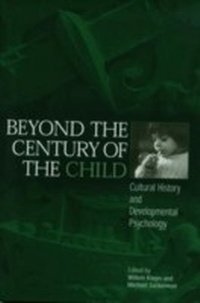
Beyond the Century of the Child
Cultural History and Developmental Psychology
1st Edition
Published on 30. October 2012
304 pages
978-0-8122-0823-8 (ISBN)
Description

In 1900, Ellen Key wrote the international bestseller The Century of the Child. In this enormously influential book, she proposed that the world's children should be the central work of society during the twentieth century. Although she never thought that her "century of the child" would become a reality, in fact it had much more resonance than she could have imagined.
The idea of the child as a product of a protective and coddling society has given rise to major theories and arguments since Key's time. For the past half century, the study of the child has been dominated by two towering figures, the psychologist Jean Piaget and the historian Philippe AriEs. Interest in the subject has been driven in large measure by AriEs's argument that adults failed even to have a concept of childhood before the thirteenth century, and that from the thirteenth century to the seventeenth there was an increasing "childishness" in the representations of children and an increasing separation between the adult world and that of the child. Piaget proposed that children's logic and modes of thinking are entirely different from those of adults. In the twentieth century this distance between the spheres of children and adults made possible the distinctive study of child development and also specific legislation to protect children from exploitation, abuse, and neglect. Recent students of childhood have challenged the ideas those titans promoted; they ask whether the distancing process has gone too far and has begun to reverse itself.
In a series of essays, Beyond the Century of the Child considers the history of childhood from the Middle Ages to modern times, from America and Europe to China and Japan, bringing together leading psychologists and historians to question whether we unnecessarily infantilized children and unwittingly created a detrimental wall between the worlds of children and adults. Together these scholars address the question whether, a hundred years after Ellen Key wrote her international sensation, the century of the child has in fact come to an end.
The idea of the child as a product of a protective and coddling society has given rise to major theories and arguments since Key's time. For the past half century, the study of the child has been dominated by two towering figures, the psychologist Jean Piaget and the historian Philippe AriEs. Interest in the subject has been driven in large measure by AriEs's argument that adults failed even to have a concept of childhood before the thirteenth century, and that from the thirteenth century to the seventeenth there was an increasing "childishness" in the representations of children and an increasing separation between the adult world and that of the child. Piaget proposed that children's logic and modes of thinking are entirely different from those of adults. In the twentieth century this distance between the spheres of children and adults made possible the distinctive study of child development and also specific legislation to protect children from exploitation, abuse, and neglect. Recent students of childhood have challenged the ideas those titans promoted; they ask whether the distancing process has gone too far and has begun to reverse itself.
In a series of essays, Beyond the Century of the Child considers the history of childhood from the Middle Ages to modern times, from America and Europe to China and Japan, bringing together leading psychologists and historians to question whether we unnecessarily infantilized children and unwittingly created a detrimental wall between the worlds of children and adults. Together these scholars address the question whether, a hundred years after Ellen Key wrote her international sensation, the century of the child has in fact come to an end.
Reviews / Votes
"This volume offers readers a brilliant and thought-provoking symposium on historical aspects of childhood, of conceptions and arrangements of childhood, and of the study of child development itself." (American Journal of Psychology)More details
Language
English
Place of publication
Pennsylvania
United States
Target group
College/higher education
US School Grade: College Graduate Student
ISBN-13
978-0-8122-0823-8 (9780812208238)
Copyright in bibliographic data and cover images is held by Nielsen Book Services Limited or by the publishers or by their respective licensors: all rights reserved.
Schweitzer Classification
Other editions
Additional editions
Willem Koops | Michael Zuckerman
Beyond the Century of the Child
Cultural History and Developmental Psychology
Book
02/2003
University of Pennsylvania Press
€70.00
Shipment within 10-20 days
Persons
Willem Koops is Professor of Developmental Psychology and Dean of the Department of Social Sciences at Utrecht University. Michael Zuckerman is Professor of History at the University of Pennsylvania and author of Almost Chosen People: Oblique Biographies in the American Grain.
Content
1. Imaging Childhood
-Willem Koops
2. The Child in the Middle Ages and the Renaissance
-Barbara A. Hanawalt
3. Early Modern Childhood in the Dutch Context
-Els Kloek
4. Patterns of Childrearing in America
-Karin Calvert
5. The Birth of the Virtual Child: A Victorian Progeny
-John R. Gillis
6. Historical Perspectives on Twentieth-Century American Childhood
-Peter Stearns
7. The History of Children and Youth in Japan
-Hideo Kojima
8. Childhood, Formal Education, and Ideology in China, Then and Now
-Michael Nylan
9. On Infantilization and Participation: Pedagogical Lessons from the Century of the Child
-Micha de Winter
10. The Nephew of an Experimentalist: Ambivalences in Developmental Thinking
-Gerrit Breeuwsma
11. Developmental Psychology in a World of Designed Institutions
-Sheldon H. White
Epilogue: The Millennium of Childhood That Stretches Before Us
Michael Zuckerman
-Willem Koops
2. The Child in the Middle Ages and the Renaissance
-Barbara A. Hanawalt
3. Early Modern Childhood in the Dutch Context
-Els Kloek
4. Patterns of Childrearing in America
-Karin Calvert
5. The Birth of the Virtual Child: A Victorian Progeny
-John R. Gillis
6. Historical Perspectives on Twentieth-Century American Childhood
-Peter Stearns
7. The History of Children and Youth in Japan
-Hideo Kojima
8. Childhood, Formal Education, and Ideology in China, Then and Now
-Michael Nylan
9. On Infantilization and Participation: Pedagogical Lessons from the Century of the Child
-Micha de Winter
10. The Nephew of an Experimentalist: Ambivalences in Developmental Thinking
-Gerrit Breeuwsma
11. Developmental Psychology in a World of Designed Institutions
-Sheldon H. White
Epilogue: The Millennium of Childhood That Stretches Before Us
Michael Zuckerman
