

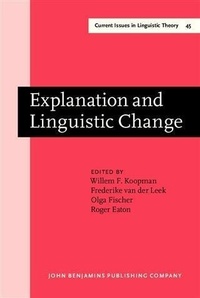
Explanation and Linguistic Change
1st Edition
Published on 1. January 1986
VIII, 300 pages
978-90-272-7945-3 (ISBN)
Description

This volume presents the outcome of a workshop, held in Amsterdam in 1985, on the nature, even possibility, of explanation in Historical Linguistics: why changes take place and others do not, and why they occur at a particular time and place. The workshop, and this volume, aim to explore questions such as i) are the factors which explain the actuation of a change different from those that explain its implementation?; ii) is it possible to give a typology of changes?; iii) should linguistic explanation hope to meet the same requirements as explanation in the pure sciences?; iv) are all linguistic changes necessarily the product of variation?; v) should there be a formal theory of change apart from a general thoery of grammar?
More details
Other editions
Additional editions
Willem F. Koopman | Frederike van der Leek | Olga Fischer
Explanation and Linguistic Change
Book
01/1986
John Benjamins Publishing Co
€127.20
Shipment within 10-15 days
Content
- Intro
- EXPLANATION AND LINGUISTIC CHANGE
- Editorial page
- Title page
- Copyright page
- Table of contents
- PREFACE
- INTRODUCTION
- REFERENCES
- THE LANGUAGE LIFEGAME: PREDICTION, EXPLANATION AND LINGUISTIC CHANGE
- 1.0. Introduction
- 2.0. The relationship between synchronic and diachronic theories
- 3.0. Reasons for language universals
- 4.0. The language lifegame
- 5.0. Snowballs
- 5.1. Snowball (1): development of pidgins
- 5.2. Snowball (2): destruction of verb-final constraint
- 6.0. Summary and conclusion
- NOTES
- REFERENCES
- HEADLESS RELATIVES IN THE HISTORY OF DUTCH
- ABBREVIATED SOURCES.
- NOTE
- BIBLIOGRAPHY
- MODERN DUTCH COULD BE MIDDLE DUTCHER THAN YOU THINK (AND VICE VERSA)
- 1. Introduction
- 2. Bossuyt's proposal
- 3. Second thoughts on P2 integration
- 4. The internal structure of the headless relative
- 4.1. Stacking
- 4.2. The position of the complementizer
- 4.3. A head for a headless relative
- 4.4. Conclusion
- 5. Final remarks
- FOOTNOTES
- REFERENCES
- A BRIEF REPLY TO MR. WEERMAN.
- A 'CASE' FOR THE OLD ENGLISH IMPERSONAL
- 0. Introduction
- 1. The case of the OE impersonal
- 2. Case alternation with OE personal verbs
- 3. Theories of Case
- 4. Case and the lexicon
- 5. Conclusion
- NOTES
- REFERENCES
- REQUISITES FOR REINTERPRETATION
- 1. Introduction
- 2. The case of modern Dutch -se
- 2.1. The female inhabitatives in synchronic analyses
- 2.2. The female inhabitatives as a separate pattern
- I semantics
- II morphological valence
- III syntactic valence
- 2.3. On the genesis of female inhabitatives in -se_
- 2.4. Reinterpretation and its consequences for the synchronic system
- 3. The case of Sranan e
- 3.1. The original system
- 3.2 Recent deviations from the original system
- 3.3 Interpretation of the deviations
- 4. Requisites for reinterpretation
- NOTES
- BIBLIOGRAPHY
- LANGUAGE, SPEAKERS, HISTORY AND DRIFT*
- 1. Preliminaries
- 2, Alternative ontologies
- 3. Psychological reductionism and history
- 4. Programmatic interlude: Some questions
- 5. Arguments for the autonomy of history, 1: Conspiracies
- 6. Problems for psychologism: Sapir on 'drift'
- 7. Arguments for the autonomy of history, 2: Centres of gravity
- 8. Arguments for the autonomy of history, 3: Convergent drift
- 9. The ontological dilemma: A new pair of spectacles?
- NOTES
- REFERENCES
- NUMBER NEUTRALIZATION IN OLD ENGLISH: FAILURE OF FUNCTIONALISM?
- 1. Outline of the functionalist view
- 2. Number neutralization in Old English: The system
- 3. Number neutralization in Old English: Change and variation
- 4. The functionalist view qualified
- REFERENCES
- THE STATUS OF THE FUNCTIONAL APPROACH
- NOTES
- REFERENCES
- ON SH*TTING THE DOOR IN EARLY MODERN ENGLISH: A REPLY TO PROFESSOR SAMUELS
- NOTE
- REFERENCE
- A BRIEF REJOINDER TO PROFESSOR LASS
- 'EXPLANATION' BY LINGUISTIC MAPS
- REFERENCES
- OLD ENGLISH DIALECTS: WHAT'S TO EXPLAIN
- WHAT'S AN EXPLANATION?
- NOTE
- REFERENCES
- SUBJECT INDEX
