

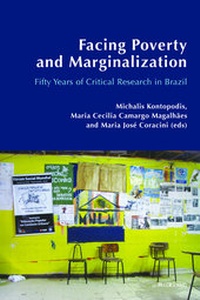
Facing Poverty and Marginalization
Description

A long history of poverty, discrimination, colonialism and struggle for social justice has provided, over the last fifty years, the context for the development of a vast amount of critical scholarship targeting marginalization in Brazil: Freireian pedagogics, theology of liberation, critical sociology, anthropology and ethnomathematics, critical social psychology and discourse analysis. Most of this scholarship has unfortunately been accessible only to the Portuguese-speaking readership. This volume presents, for the first time to an international audience, the novel understandings of critical research that have emerged in this frame. While Brazil is entering a new phase of socio-economic and political turmoil, distinguished representatives of the various critical research traditions from all over Brazil explore the voices and practices of those who are usually hardly heard: the helpless, the mentally ill, the landless, the homeless, the voiceless youth, delinquents, indigenous people, the powerless. The volume proposes original theoretical tools and arguments that can inspire social-scientific discussions on facing poverty and marginalization not only with regard to Brazil, but also other parts of the world. It is the first book of its kind in English and a unique tool for undergraduate and graduate students, researchers and specialists across the social sciences.
More details
Other editions
Additional editions
Persons
Michalis Kontopodis is Senior Lecturer in Education Studies at the University of Sheffield. He has held post-doc positions and visiting scholarships at Humboldt University Berlin, University of Amsterdam, Pontifícia Universidade Católica de São Paulo, Jawaharlal Nehru University and City University New York. His research explores global educational and social inequalities, marginalization and social movements.
Maria Cecília Camargo Magalhães is Professor at the Department of Applied Linguistics and Language Studies at the Pontifícia Universidade Católica de São Paulo, Brazil. She is well known for her research on critical thinking, collaboration and intervention-oriented research.
Maria José Coracini is Professor at the Department of Applied Linguistics at the Universidade Estadual de Campinas (UNICAMP) and researcher of the Conselho Nacional de Desenvolvimento Científico e Tecnológico in Brazil. Her numerous publications explore the links between identity, otherness, migration and reading/writing in mother and foreign tongues.
Content
- Cover
- Contents
- (Post)Critical Global Studies: A Note from the Series Editors
- Introduction: Fifty Years of Critical Research in Brazil
- A Long History of Critical Research .
- The Present Volume: A Glimpse into Brazilian "Margins"
- Acknowledgements
- References
- 1. Life at the Landfill: Portraying Exclusion and Resistance in the Documentary Estamira by Marcos Prado
- Introduction
- Theoretical Background: French Discourse Analysis
- The Context: Rio de Janeiro and the Documentary
- Scene One: Mission
- Scene Two: Vision
- Scene Three: Religious Discourse
- (In-)Famous (Mis-)Fortunes: Estamira's Resistance
- References
- 2. Struggling for Housing: The November 20 Occupation in Porto Alegre
- Introduction
- History of the National Movement of Struggle for Housing (MNLM)
- Setting the Scene of the November 20 Occupation
- 2014 FIFA World Cup: Mega Events and Democracy
- Coexistence and Dialogue as Methodological Foundations for Action Research
- Empowerment and Struggle
- Final Considerations: The Broader Sense of Popular Education
- References
- 3. Educating in Itinerancy: Countryside Life and Novel Forms of Schooling
- Introduction
- Schooling in the Encampment
- Itinerant School and Countryside Education
- Fighting for Legal Recognition
- Outlook: Current Issues and Challenges
- References
- 4. Indigenous Children and Identity Politics: Numeracy Practices among the Kaiabi from Xingu, Mato Grosso
- Introduction
- The Kaiabi at Xingu Indigenous Park
- Numbers for the Kaiabi Math Book
- Indigenous Schooling and Identity Politics
- References
- 5. "Special" and "Normal" in Students' Voices: Meaning Production at a State-Funded School in Campinas
- Cultural Development as Appropriation of Social Practices
- Methodological Issues: Signs, Words, Discourse
- Exploring School Practices: Our Empirical Field
- Situation 1: "Special" within the Institutional Setting
- Situation II: The "Normal" Conditions of Living
- Overview and Open Questions
- References
- 6. The Dis-order of Discourse: Young People Confined in CASA (São Paulo) and a Poet Considered Insane in Colônia Juliano More (Rio de Janeiro)
- "Living" in CASA
- "There is No Time to Lose"
- Post Mortem Poetry by Stela do Patrocínio
- Outlook: From Infamy to Resistance
- References
- 7. In-Famous Cyberhomelessness: The "Homeless" Writer Tião Nicomedes
- "Homeless" Subjectivity
- Tião: The Writer, Blogger and "Homeless" Person
- A Different Easter .
- Final Considerations
- References
- Instead of an Epilogue. Youth "in Movement" in Contemporary Brazil: Sharing Intense Moments with José, Carlos, Raquel, and Werá Mirim
- José at Escola Porto Alegre
- Carlos at a Settlement of the Landless Rural Workers' Movement at Espírito Santo
- Raquel at an Occupied Housing Project of the National Movement of the Struggle for Housing (MNLM) in Porto Alegre
- Werá Mirim in a Guarani Community
- Outlook: Social Movements, Affective Scapes and Outside Politics
- Acknowledgements
- References
- Notes on Contributors
- Index
