

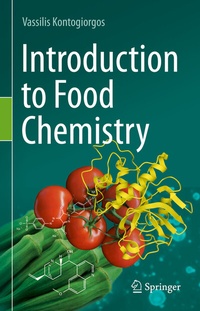
Introduction to Food Chemistry
Description

The complexity of food chemistry makes it a challenging subject for students studying in a food science course. Although there are excellent food chemistry books available in the market they have two major flaws: they are either encyclopedic or they are not pitched correctly to undergraduate food science students. The first problem creates difficulties for students to identify what is important and how much they need to know. The second problem arises when the book is written by authors that are not food scientists (e.g., chemists), they are not academics that are engaged with teaching or they are not sufficiently qualified to teach. In this case, it is difficult to find links between the chemistry of foods and its relevance to applications or, quite frequently, future employment prospects of the student.
Introduction to Food Chemistry bridges this gap in the relevant literature, as it employs the latest pedagogical theories in textbook writing to presentthe subject to students with broad range of cognitive skills. This book presents specific learning objectives for each chapter and is self-contained so students will not need to search for essential information outside the textbook.
To support learning, the book has:
- Didactic elements with information being conveyed with 3D-figures, color-coded schemes and graphs, annotations on figures that link it to the text descriptions
- Built-in pedagogy and learning activities at the end of each chapter that are linked to the learning objectives.
- Keywords and concepts for online search to instigate curiosity for further studies.
- Conversational writing style without losing academic rigor
To support lecturers, the book has:
- Helps focus teaching preparation on key aspects of food chemistry relevant to both industry and modern research.
- Aids the preparation of exams, assignments and othertypes of assessment or learning activities.
For lecturers in search of a singular source to aid in their introductory food chemistry courses, look no further than Introduction to Food Chemistry.
More details
Other editions
New editions
Additional editions
Person
Dr Kontogiorgos is a food scientist by training. He received all his degrees in Food Science from the Aristotle University of Thessaloniki, Greece (BSc and MSc) and the University of Guelph, Canada (PhD).
He has worked as an NSERC research fellow at the Agriculture and Agri-Food Canada (Canada) and as a faculty member at the Department of Biological Sciences, University of Huddersfield (UK) before joining the School of Agriculture and Food Sciences at the University of Queensland (Australia) as a teaching and research academic in food chemistry.
Dr Kontogiorgos research interests are focused on food carbohydrate chemistry and food structuring. He is an associate editor of Food Hydrocolloids and Food Biophysics and a Fellow of the Higher Education Academy (FHEA, UK).