

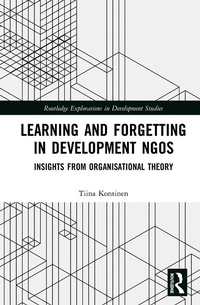
Learning and Forgetting in Development NGOs
Insights from Organisational Theory
1st Edition
Published on 27. June 2018
178 pages
978-1-351-61168-8 (ISBN)
Description

Learning and Forgetting in Development NGOs draws on a range of theoretical approaches and empirical evidence to explore how development organisations learn or fail to learn from experience. Despite the overwhelming discourses of NGOs as learning organisations, little is known about the phenomenon of learning within NGOs. As constantly changing buzzwords and institutional approaches abound and old ideas and concepts are "re-discovered", development NGOs are often accused of trying to reinvent the wheel as they struggle to escape from the challenges of development amnesia.
Based on detailed empirical data on the everyday practices and accounts of development practitioners, this book moves between the boundaries of organisational institutionalism, learning theories, management and ethnographies of NGOs practices to investigate the many faces of organisational learning in an attempt to counteract development amnesia. Learning and Forgetting in Development NGOs will be an essential guide for students, scholars and development practitioners with an interest in development management and organisational theory.
Based on detailed empirical data on the everyday practices and accounts of development practitioners, this book moves between the boundaries of organisational institutionalism, learning theories, management and ethnographies of NGOs practices to investigate the many faces of organisational learning in an attempt to counteract development amnesia. Learning and Forgetting in Development NGOs will be an essential guide for students, scholars and development practitioners with an interest in development management and organisational theory.
Reviews / Votes
"Drawing on more than twenty years of research in the field of non-governmental development organisations, Tiina Kontinen has written an important book for everyone interested in the workings of NGOs. This is perhaps the first detailed account to consider not only how NGOs learn, but also why they forget. Skilfully combining insights from organisational theory and anthropology, this is a highly original and readable account of a subject that offers vital new theoretical insights while also providing essential reading for any NGO practitioner." - David Lewis, Professor of Social Policy and Development, London School of Economics & Political Science, UK"This is a timely account of NGOs through the lens of organisational theory. Kontinen's study shows how learning is at the heart of everyday practice in NGOs as they interact with wider institutional environments. This book offers a fresh perspective on the everyday practices through which NGOs continually seek to remake themselves while staying fundamentally the same." - Maia Green, Professor of Anthropology, University of Manchester, UK
"Drawing on organization theory this book gives much needed insights into learning in development. Based on rich empirical examples, Kontinen analyses different ways of learning as well as dynamics of forgetting and ignorance in development NGOs. With a thoughtful use of organization theory she shows how learning forms or is blocked through everyday practices and through the ways in which the operations are organized. These insights are fundamental for understanding how NGOs can contribute to development and change." - Kerstin Sahlin, Professor of Public Management, Department of Business Studies, Uppsala University, Sweden
"This book is of great interest to development studies scholars as well as organisational sciences scholars. The combination of theoretical concepts from both fields works very well and is enlightening. The book provides truly interesting insights into linkages between learning and power, and - equally important - unlearning and (strategic) ignorance, based on the author's many years of experience within and engagement with civil society organizations." - Marja Spierenburg, Professor in Cultural Anthropology and Development Studies, Radboud University Nijmegen, The Netherlands
More details
Series
Edition
1. Auflage
Language
English
Place of publication
London
United Kingdom
Publishing group
Taylor & Francis Ltd
Target group
College/higher education
Professional and scholarly
Product notice
Reflowable
Illustrations
3 Tables, black and white; 2 Line drawings, black and white; 2 Illustrations, black and white
ISBN-13
978-1-351-61168-8 (9781351611688)
Copyright in bibliographic data and cover images is held by Nielsen Book Services Limited or by the publishers or by their respective licensors: all rights reserved.
Schweitzer Classification
Other editions
Additional editions
Book
09/2020
1st Edition
Routledge
€54.46
Shipment within 15-20 days
Book
06/2018
1st Edition
Routledge
€215.41
Shipment within 10-20 days
Person
Tiina Kontinen is an Academy of Finland Research Fellow at the Department of Social Sciences and Philosophy, University of Jyvaeskylae, Finland.
Content
1. Introduction 2. Categorising learning in development: Towards organisational institutionalism 3. Learning as a search for a shared meaning for empowerment 4. Learning as change in organisational epistemology 5. Unlearning, forgetting and ignorance 6. Learning as legitimation and synchronisation 7. Conclusions
