

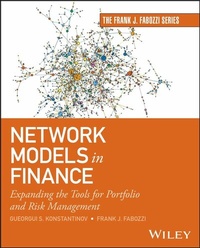
Network Models in Finance
Description

Expansive overview of theory and practical implementation of networks in investment management
Guided by graph theory, Network Models in Finance: Expanding the Tools for Portfolio and Risk Management provides a comprehensive overview of networks in investment management, delivering strong knowledge of various types of networks, important characteristics, estimation, and their implementation in portfolio and risk management. With insights into the complexities of financial markets with respect to how individual entities interact within the financial system, this book enables readers to construct diversified portfolios by understanding the link between price/return movements of different asset classes and factors, perform better risk management through understanding systematic, systemic risk and counterparty risk, and monitor changes in the financial system that indicate a potential financial crisis.
With a practitioner-oriented approach, this book includes coverage of:
- Practical examples of broad financial data to show the vast possibilities to visualize, describe, and investigate markets in a completely new way
- Interactions, Causal relationships and optimization within a network-based framework and direct applications of networks compared to traditional methods in finance
- Various types of algorithms enhanced by programming language codes that readers can implement and use for their own data
Network Models in Finance: Expanding the Tools for Portfolio and Risk Management is an essential read for asset managers and investors seeking to make use of networks in research, trading, and portfolio management.
More details
Other editions
Additional editions
Persons
GUEORGUI S. KONSTANTINOV, PHD, has over 17 years' experience in portfolio management, managing global bond portfolios and currencies for institutional investors and pension funds. He is an advisory board member of the Journal of Portfolio Management and the coauthor of Quantitative Global Bond Portfolio Management.
FRANK J. FABOZZI, PHD, is Professor of Practice at John Hopkins University's Carey Business School. He has authored over 100 books and edited The Handbook of Fixed Income Securities and The Handbook of Mortgage-Backed Securities. He holds the CFA and CPA professional designations.
Content
Preface ix
Acknowledgments xv
About the Authors xvii
PART ONE
CHAPTER 1 Introduction 3
CHAPTER 2 The Basic Structure of a Network 29
CHAPTER 3 Network Properties 45
CHAPTER 4 Network Centrality Metrics 71
PART TWO
CHAPTER 5 Network Modeling 95
CHAPTER 6 Foundations for Building Portfolio Networks - Link Prediction and Association Models 117
CHAPTER 7 Foundations for Building Portfolio Networks - Statistical and Econometric Models 141
CHAPTER 8 Building Portfolio Networks - Probabilistic Models 163
CHAPTER 9 Network Processes in Asset Management 181
CHAPTER 10 Portfolio Allocation With Networks 227
PART THREE
CHAPTER 11 Systematic and Systemic Risk, Spillover, and Contagion 261
CHAPTER 12 Networks in Risk Management 277
References 313
Index 327
