

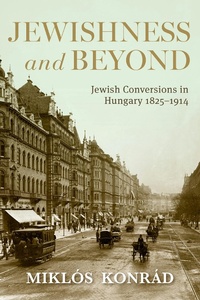
Jewishness and Beyond
Description

Throughout the nineteenth century, Hungary's government steadily dismantled obstacles that kept its rapidly expanding Jewish communities from enjoying the full benefits of citizenship. The state's concerted efforts to "Magyarize" Jews promoted Hungarian language, culture, and sensibilities, but did not officially require Jews to abandon their faith. Nevertheless, tens of thousands of Hungarian Jews converted to Christianity during this era, with conversion rates continuing to rise even as Judaism gained full legal equality.
Jewishness and Beyond addresses the apparent contradiction between these two trends. Despite the egalitarian promises and laws of Hungary's liberal nationalist government, the administration and traditional elites as a whole maintained a persistent bias against Jews that spurred particularly high conversion rates among the community's upper echelons. While Christians never forgot converted Jews' origins and increasingly thought of them in racialized terms, they also valued and generally rewarded conversion and the symbolic gesture of baptism. Conversion was an uneven and ever-shifting process in which gender and occupation played key roles, and where the actual percentage of converts within the total Hungarian Jewish population contrasted sharply with both Christian and Jewish perceptions of its frequency and spread.
Jewishness and Beyond, which can be read as an introduction to the identity dilemmas of Hungarian Jews in the age of emancipation, reveals the motivations and strategies behind the conversions of Hungarian Jews, the complex reactions within and outside of their communities, and converts' own grappling with conversion's expected and unforeseen outcomes.
More details
Other editions
Additional editions
Persons
Miklós Konrád is Senior Research Fellow at the Institute of History at the Research Centre for the Humanities and at the Ignác Goldziher Jewish Historical and Cultural Research Institute in Budapest, Hungary.
Content
Acknowledgments
Note on Names and Statistical Figures
Abbreviations
Introduction
1. The Historical Context of the Conversions of Hungarian Jews
2. Numbers of Conversions, Chronological Patterns, and Social Reactions
3. Profiles of Hungarian Jewish Converts
4. Paths to Conversion-Portraits
5. After Conversion
Afterword
Bibliography
Index
