

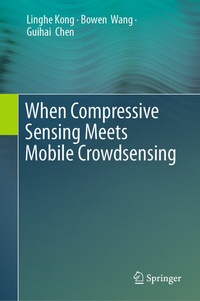
When Compressive Sensing Meets Mobile Crowdsensing
Description

This book provides a comprehensive introduction to applying compressive sensing to improve data quality in the context of mobile crowdsensing. It addresses the following main topics: recovering missing data, efficiently collecting data, preserving user privacy, and detecting false data.
Mobile crowdsensing, as an emerging sensing paradigm, enables the masses to take part in data collection tasks with the aid of powerful mobile devices. However, mobile crowdsensing platforms have yet to be widely adopted in practice, the major concern being the quality of the data collected. There are numerous causes: some locations may generate redundant data, while others may not be covered at all, since the participants are rarely systematically coordinated; privacy is a concern for some people, who don't wish to share their real-time locations, and therefore some key information may be missing; further, some participants may upload fake data in order to fraudulently gain rewards. Toaddress these problematic aspects, compressive sensing, which works by accurately recovering a sparse signal using very few samples, has proven to offer an effective solution.
More details
Other editions
Additional editions
Persons
Linghe Kong is currently a Research Professor at the Department of Computer Science and Engineering, Shanghai Jiao Tong University. He previously served as a postdoctoral fellow at Columbia University and McGill University. He completed his Ph.D. at Shanghai Jiao Tong University, his Master's degree at Telecom SudParis, and his Bachelor's degree at Xidian University. His research interests include wireless networks, mobile computing, the Internet of Things, and big data. He has published more than 80 papers and received Best Paper Awards at the conferences IEEE ICPADS 2016 and EAI CloudComp 2016. He serves as an associate or guest editor for IEEE Communications Magazine, Oxford Computer Journal, Springer Telecommunication Systems, and KSII Transactions on Internet and Information Systems, and is a senior member of the IEEE.
Bowen Wang is currently a software engineer in ByteDance Ltd. From 2016 to 2019, he was a postgraduate student in Computer Science from Shanghai Jiao Tong University. He received his bachelor Degree in Mechanical Engineering from Shanghai Jiao Tong University. His research interests include mobile crowdsensing, wireless network and mobile computing.
Guihai Chen earned his B.S. degree from Nanjing University in 1984, M.E. degree from Southeast University in 1987, and Ph.D. degree from the University of Hong Kong in 1997. He is a distinguished professor of Shanghai Jiao Tong University, China. He had been invited as a visiting professor by many universities including Kyushu Institute of Technology, Japan in 1998, University of Queensland, Australia in 2000, and Wayne State University, USA during September 2001 to August 2003. He has a wide range of research interests with focus on sensor network, peer-to-peer computing, high performance computer architecture and combinatorics.
Content
Introduction.- Mathematical Theory of Compressive Sensing.- Basic Compressive Sensing for Data Reconstruction.- Bayesian Compressive Sensing for Task Allocation.- Adaptive Compressive Sensing for Incentive Mechanism.- Encoded Compressive Sensing for Privacy Preservation.- Iterative Compressive Sensing for Fault Detection.- Conclusion.
