

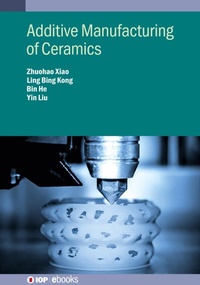
Additive Manufacturing of Ceramics
Description

This book is aimed to offer a comprehensive review on the achievements in the field of processing of ceramic-based materials with complex geometry, by utilizing additive manufacturing (AM) or 3D printing technologies. In AM of ceramics, the geometrical design is well incorporated with the design of materials. Therefore, ceramic-based products with desired performances could be readily obtained, while manufacturing time duration and hence their cost will be effectively reduced. Although significant progress has been achieved, there are issues to be addressed. For example, the dimensional accuracy and surface finish of the final products have still to be improved, owing to the layer-by-layer fabrication process. Various practical applications of the technologies are described in detail, with intensive discussion on their respective advantages and shortcomings.
More details
Other editions
Additional editions
Persons
Ling Bing Kong is a Professor at Shenzhen Technology University. In addition to publishing 360 journal papers and 6 books, he serves as a referee for more than 50 international journals and is an editorial board member and guest editor for several journals.
Zhuohao Xiao is an Professor and the Director of the Journal Office at Jingdezhen Ceramic University. He is a Member of the Chinese Ceramic Society, Chinese Mechanical Engineering Society, and China Instrument and Control Society.
Yin Liu is a Professor at the Huainan Union University. His research interests include inorganic functional materials, magnetic nanomaterials, functional ceramics, new energy materials and resource recycling.
Bin He is a Professor at Shenzhen Technology University and the Head of Department of Materials Science and Engineering. His research interests include diamond and related materials, thin film technologies, ultra-wide bandgap semiconductor, nanostructures and related applications.
Content
Chapter 1: Introduction
Chapter 2: Stereolithographic (SLA) approaches * 2.1. Brief introduction * 2.2. Working principles of stereolithographic approaches * 2.3. Fabrication and characterization of stereolithographically printed ceramics * 2.4. Concluding remarks
Chapter 3: Inkjet Printing * 3.1. Brief description * 3.2. Principles of inkjet printing * 3.3. Methods for preparation of printing inks * 3.4. Inkjet printing of ceramic materials * 3.5. Concluding remarks
Chapter 4: Selective laser sintering/melting (SLS/SLM) * 4.1. Brief overview * 4.2. Fundamental considerations * 4.3. Ceramic materials processed with SLS/SLM * 4.4. Concluding remarks
Chapter 5: Extrusion freeforming fabrication (EFF)
- 5.1. Introduction
- 5.2. Types of extrusion methods and extrusion mechanisms
- 5.3. Examples of materials
- 5.4. Concluding remarks
Chapter 6: Laminated object manufacturing (LOM) * 6.1. Introduction * 6.2. Characteristics of LOM process * 6.3. LOM printed ceramic materials and structures * 6.4. Conclusions and perspectives
Chapter 7: Applications of 3D printed ceramics * 7.1. Brief introduction * 7.2. Applications of 3D printed ceramics * 7.3. Concluding remarks
