

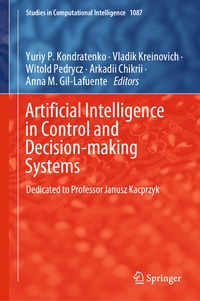
Artificial Intelligence in Control and Decision-making Systems
Description

This book presents an authoritative collection of contributions reporting on computational intelligence, fuzzy systems as well as artificial intelligence techniques for modeling, optimization, control and decision-making together with applications and case studies in engineering, management and economic sciences.
Dedicated to the Academician of the Polish Academy of Sciences, Professor Janusz Kacprzyk in recognition of his pioneering work, the book reports on theories, methods and new challenges in artificial intelligence, thus offering not only a timely reference guide but also a source of new ideas and inspirations for graduate students and researchers alike.
The book consists of the 18 chapters, presented by distinguished and experienced authors from 16 different countries (Australia, Brazil, Canada, Chile, Germany, Hungary, Israel, Italy, China, R.N.Macedonia, Saudi Arabia, Spain, Turkey, United States, Ukraine, and Vietnam). All chapters are grouped into three parts: Computational Intelligence and Fuzzy Systems, Artificial Intelligence Techniques in Modelling and Optimization, and Computational Intelligence in Control and Decision Support Processes.
The book reflects recent developments and new directions in artificial intelligence, including computation method of the interval hull to solutions of interval and fuzzy interval linear systems, fuzzy-Petri-networks in supervisory control of Markov processes in robotic systems, fuzzy approaches for linguistic data summaries, first-approximation analysis for choosing fuzzy or neural systems and type-1 or type-2 fuzzy sets, matrix resolving functions in game dynamic problems, evolving stacking neuro-fuzzy probabilistic networks and their combined learning in online pattern recognition tasks, structural optimization of fuzzy control and decision-making systems, neural and granular fuzzy adaptive modeling, state and action abstraction for search and reinforcement learning algorithms.
Among the most successful and perspective implementations in practical areas of human activity are tentative algorithms for neurological disorders, human-centric question-answering system, OWA operators in pensions, evaluation of the perception of public safety through fuzzy and multi-criteria approach, a multicriteria hierarchical approach to investment location choice, intelligent traffic signal control and generative adversarial networks in cybersecurity.
More details
Other editions
Additional editions
Content
Robotized FMS and Robotic Systems.- Using Fuzzy Set Approaches for Linguistic Data Summaries.- Fuzzy or Neural, Type-1 or Type-2 - When Each Is Better: First-Approximation Analysis.
