

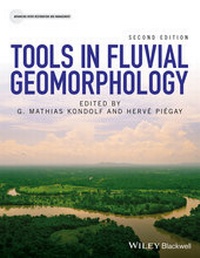
Tools in Fluvial Geomorphology
Description

More details
Other editions
Additional editions
Persons
Content
List of contributors xi
Series Foreword xv
Preface to the Second Edition xvii
Section I: Background
1 Tools in fluvial geomorphology: problem statement and recent practice 3
G. Mathias Kondolf and Hervé Piégay
1.1 Introduction 3
1.2 Tools and fluvial geomorphology: the terms 4
1.3 What is a tool in fluvial geomorphology? 4
1.4 Overview and trends of tools used in the field 9
1.5 Scope and organization of this book 9
Acknowledgements 11
References 11
Section II: The Temporal Framework: Dating and Assessing Geomorphological Trends
2 Surficial geological tools in fluvial geomorphology 15
Robert B. Jacobson, Jim E. O'Connor and Takashi Oguchi
2.1 Introduction 15
2.2 Overview of surficial geological approaches 15
2.3 Applications of surficial geological approaches to geomorphic interpretation 27
2.4 Summary and conclusions 33
References 34
3 Archaeology and human artefacts 40
Anthony G. Brown François Petit and L. Allen James
3.1 Introduction 40
3.2 General considerations in using archaeological evidence in geomorphology 40
3.3 Archaeological tools 41
3.4 Legacy sediment 44
3.5 Using archaeological data: case studies 45
3.6 Conclusions 51
References 52
4 Using historical data in fluvial geomorphology 56
Robert C. Grabowski and Angela M. Gurnell
4.1 Introduction 56
4.2 The documentary record 57
4.3 The cartographic record 63
4.4 The topographic record 66
4.5 The modern historical record: remote-sensing 69
4.6 Conclusion 71
Acknowledgements 71
References 71
Section III: The Spatial Framework: Emphasizing Spatial Structure and Nested Character of Fluvial Forms
5 System approaches in fluvial geomorphology 79
Hervé Piégay
5.1 System, fluvial system, hydrosystem 79
5.2 Components of the fluvial system 83
5.3 Fluvial system, a conceptual tool for geomorphologists 84
5.4 Examples of applications 95
5.5 Conclusions 98
Acknowledgements 98
References 100
6 Analysis of remotely sensed data for fluvial geomorphology and river science 103
David Gilvear and Robert Bryant
6.1 Introduction 103
6.2 The physical basis 103
6.3 River geomorphology and in-channel processes 115
6.4 Floodplain geomorphology and fluvial processes 119
6.5 Conclusions 122
Acknowledgements 122
References 128
7 Geomorphic classification of rivers and streams 133
G. Mathias Kondolf, Hervé Piégay, Laurent Schmitt and David R. Montgomery
7.1 Introduction 133
7.2 Classifications for fluvial understanding 138
7.3 Interactions between geomorphic classifications and ecology 143
7.4 Geomorphic classification and quality of river environments 144
7.5 Applying geomorphic classification schemes to fluvial systems 148
Acknowledgements 153
References 153
8 Modelling catchment processes 159
Peter W. Downs and Rafael Real de Asua
8.1 Introduction 159
8.2 Approaches to catchment processes modelling 160
8.3 Conceptual models 160
8.4 Problem-centred interpretative models 161
8.5 Data-driven empirical models 163
8.6 Numerical models 164
8.7 Tools for developing a catchment process model: representation and accuracy considerations 168
8.8 Prospect 173
Acknowledgements 174
References 175
Section IV: Chemical Physical and Biological Evidence: Dating, Emphasizing Spatial Structure and Fluvial Processes
9 Using environmental radionuclides, mineral magnetism and sediment geochemistry for tracing and dating fine fluvial sediments 183
Des Walling and Ian Foster
9.1 Introduction 183
9.2 The tools 183
9.3 Applications 187
9.4 Case study 200
9.5 The prospect 201
References 202
10 Vegetation as a tool in the interpretation of fluvial geomorphic processes and landforms 210
Cliff R. Hupp, Simon Dufour and Gudrun Bornette
10.1 Introduction 210
10.2 Scientific background: plant ecological-fluvial geomorphic relations 210
10.3 Vegetation as a tool: an overview 211
10.4 Dendrogeomorphology in fluvial systems 216
10.5 Description of fluvial landforms through vegetation 220
10.6 Communities as an indicator of disturbance regime 223
10.7 Conclusions 225
References 226
Section V: Analysis of Processes and Forms: Water and Sediment Interactions
11 Channel form and adjustment: characterization, measurement, interpretation and analysis 237
Andrew Simon, Janine Castro and Massimo Rinaldi
11.1 Introduction 237
11.2 Characterization and measurement 237
11.3 Interpretation and analysis 249
11.4 Conclusions 254
References 254
12 Flow measurement and characterization 260
Peter J. Whiting
12.1 Introduction 260
12.2 Velocity measurement 260
12.3 Discharge measurements 265
12.4 Indirect methods of discharge estimation 270
12.5 Flow hydrographs and analysis of flow records 271
12.6 Issues in selecting methods 273
12.7 Conclusion 275
References 275
13 Measuring bed sediment 278
G. Mathias Kondolf and Thomas E. Lisle
13.1 Introduction 278
13.2 Attributes and reporting of sediment size distributions 278
13.3 Particle shape and roundness 282
13.4 Surface versus subsurface layers in gravel bed rivers 283
13.5 Sampling sand and finer grained sediment 283
13.6 Sampling and describing the surface of gravel beds 284
13.7 Subsurface sampling methods 289
13.8 Sample size requirements 290
13.9 Comparability of pebble counts and bulk samples 293
13.10 Sampling strategy 293
13.11 Applications of bed sediment sampling related to aquatic habitat 295
13.12 Case study: determining changes in fine sediment content during flushing flows, Trinity River, California 297
13.13 Case study: application of V* to French and Bear Creeks, California 298
13.14 Conclusion: selecting an appropriate sampling method 299
Acknowledgement 302
References 302
14 Coarse particle tracing in fluvial geomorphology 306
Marwan A. Hassan and André G. Roy
14.1 Introduction 306
14.2 Tracing methods 312
14.3 Conclusion 319
Acknowledgements 319
References 319
15 Sediment transport 324
D. Murray Hicks and Basil Gomez
15.1 Introduction 324
15.2 Basic concepts 324
15.3 Suspended load sampling and monitoring 326
15.4 Bedload sampling, measurement and prediction 335
15.5 Total load 342
15.6 Estimating sediment yields from reservoir sedimentation 342
15.7 Key points for designing a sediment measurement programme - a summary 343
15.8 Case example: sediment budget for Upper Clutha River, New Zealand 345
Acknowledgements 347
References 347
16 Sediment budgets as an organizing framework in fluvial geomorphology 357
Leslie M. Reid and Thomas Dunne
16.1 Introduction 357
16.2 Understanding and assessing components of the sediment system 360
16.3 Designing a sediment budget 366
16.4 Examples 373
16.5 Conclusions 375
References 375
Section VI: Discriminating Simulating and Modelling Processes and Trends
17 Models in fluvial geomorphology 383
Marco J. Van de Wiel, Yannick Y. Rousseau and Stephen E. Darby
17.1 Introduction 383
17.2 Conceptual models 385
17.3 Statistical models 385
17.4 Analytical models 387
17.5 Numerical models 389
17.6 Use of remote sensing and GIS in fluvial geomorphological modelling 393
17.7 Physical models 394
17.8 Overview of the modelling process 394
17.9 Modelling applications in fluvial geomorphology 395
17.10 Generic framework for fluvial geomorphological modelling applications 397
17.11 Case study: meander dynamics 399
17.12 Conclusion 402
Acknowledgements 403
References 403
18 Modelling flow, sediment transport and morphodynamics in rivers, 412
Jonathan M. Nelson, Richard R. McDonald, Yasuyuki Shimizu, Ichiro Kimura, Mohamed Nabi and Kazutake Asahi
18.1 Introduction 412
18.2 Flow conservation laws 413
18.3 Sediment-transport relations 419
18.4 Numerical methods 421
18.5 One-dimensional models 422
18.6 Two-dimensional models 423
18.7 Three-dimensional models 426
18.8 Bank evolution models 432
18.9 Bedform models 432
18.10 Practical considerations 435
18.11 Conclusions and future directions 439
References 439
19 Modelling fluvial morphodynamics 442
James E. Pizzuto
19.1 Introduction 442
19.2 Modelling longitudinal profiles 443
19.3 Modelling hydraulic geometry of rivers 445
19.4 Modelling channel planforms 447
19.5 Modelling floodplain sedimentation and erosion 450
19.6 Conclusion 451
References 452
20 Experimental studies and practical challenges in fluvial geomorphology 456
François Métivier, Chris Paola, Jessica L. Kozarek and Michal Tal
20.1 Introduction 456
20.2 Experimental methods and facilities 457
20.3 Example experimental studies 463
20.4 Scaling issues and application of experimental results 469
20.5 Additional areas for experimentation 470
20.6 Conclusion 472
Acknowledgements 472
References 472
21 Statistics and fluvial geomorphology 476
Hervé Piégay and Lise Vaudor
21.1 Introduction 476
21.2 Bivariate statistics to explore patterns of forms and their drivers 478
21.3 Exploration of datasets using multivariate statistics 482
21.4 Describing, explaining and predicting through probabilities and distributions 487
21.5 Describing explaining and predicting variables in space and time 491
21.6 Relevance and limitations of statistical tools 496
21.7 Conclusion 502
Acknowledgements 503
References 503
Section VII: Conclusion: Applying the Tools
22 Integrating geomorphological tools to address practical problems in river management and restoration 509
Hervé Piégay, G. Mathias Kondolf and David A. Sear
22.1 Introduction 509
22.2 Motivations for applying fluvial geomorphology 509
22.3 Meeting the demand: geomorphological training and application 510
22.4 The role of geomorphology in planning and management 511
22.5 Current geomorphological practices 512
22.6 Case study: preventing erosion risks, from top-down to bottom-up approaches 520
22.7 Case study: pre-appraisal approach for sediment reintroduction in the Rhine: evaluating risks of restoring processes 522
22.8 Case study: the River Wylye: a post-project monitoring framework to establish the performance of a range of rehabilitation schemes 524
22.9 Conclusion 527
Acknowledgements 529
References 529
Index 533
Chapter 1
Tools in fluvial geomorphology: problem statement and recent practice
G. Mathias Kondolf1 and Hervé Piégay2
1University of California, Berkeley, CA, USA
2Université de Lyon, UMR 5600 CNRS, Lyon, France
Let the punishment fit the crime.Popular saying invoked by the late M.G. Wolman during drafting of the first edition of Tools in Fluvial Geomorphology to capture the idea that the tools should be selected based on the problem to be solved.
1.1 Introduction
As noted by Wolman (1995), in his essay Play: the handmaiden of work, much geomorphological research is applied. The spatial and temporal scales of geomorphic analysis can provide insights for the management of risk from natural hazards, solving problems in river engineering (Giardino and Marston 1999) and river ecology (Brookes and Shields 1996), with recent developments in river restoration in terms of assessment, design and monitoring (Morandi et al. 2014). As do all scientists, fluvial geomorphologists employ tools in their research, but the range of tools is probably broader in this field than others because of its position at the intersection of geology, geography and river engineering, which draws upon fields such as hydrology, chemistry, physics, ecology and human and natural history. Increasingly, the tools of fluvial geomorphology have been adopted, used and sometimes modified by non-geomorphologists, such as scientists in allied fields seeking to incorporate geomorphic approaches in their work, managers who prescribe a specific tool be used in a given study, and consultants seeking to package geomorphology in an easy-to-swallow capsule for their clients.
Frequently, a lack of geomorphic perspective shows in the questions posed, which are often at spatial and temporal scales smaller than the underlying cause of the problem. For example, to address complaints about bank erosion problem, we have frequently seen costly structures built to alter flow patterns within the channel. Although the designers may have employed hydraulic formulae to design the structures, they may have neglected to look at geomorphic processes at the basin scale, even at reach scale, so that the driving factors are not well identified. Intervening on the symptoms rather than on the underlying disease itself is usually not the best option to solve problems. In such a case, controlling bank erosion through mechanical means will at best provide only temporary and local relief from a system-wide trend. Moreover, it is now well understood that bank erosion and deposition are essential processes to create the complex and diverse channel (Florsheim et al. 2008) and floodplain (Stanford et al. 2005) habitats needed by many valued species. Thus, what is seen locally as a problem by a riparian landowner may simply be part of the naturally dynamic river behaviour that supports river ecology, and if bank erosion has increased due to catchment-wide changes, even applying geomorphic tools at the site scale only will ultimately prove ineffective (or at least not sustainable) and ecologically detrimental, because the question was poorly posed at the outset without any robust diagnosis and geomorphic expertise based on the range of available tools.
The purpose of this book is to review the range of tools employed by geomorphologists and to link clearly the choice of tools to the question posed, thereby providing guidance to scientists in allied fields and to practitioners about the sorts of methods available to address questions in the field and the relative advantages and disadvantages of each. This book is the result of a collective effort, involving contributors with diverse ages, disciplinary expertise, professional experience and geographic origins to illustrate the range of tools in the field and their application to problems in other fields or management problems. This second edition has incorporated substantial updates, involving new authors with significant contributions to the field over the past decade.
1.2 Tools and fluvial geomorphology: the terms
Webster's Dictionary defines a tool as anything used for accomplishing a task or purpose (Random House 1996). By a tool, we refer comprehensively to concepts, theories, methods and techniques. The distinction among these terms is not always clear, depending on the level of thinking and abstraction. Moreover, definitions vary somewhat with dictionaries (e.g. Merriam 1959 versus Random House 1996) and definitions of one term may include the other terms. In our usage, a concept is defined as a mental representation of a reality and a theory is an explicit formulation of relationships among concepts. Both are tools because they provide the framework within which problems are approached and techniques and methods deployed. A method involves an approach, a set of steps taken to solve a problem and would often include more than one technique. As suggested by Webster's Dictionary (Random House 1996), it is an orderly procedure, or process, regular way or manner of doing something. Techniques are the most concrete and specific tools, referring to discrete actions that yield measurements, observations or analyses.
As an illustration, a researcher can base his approach on the fluvial system theory and, within this general framework, one of the field's seminal concepts, the notion of bankfull discharge as being the dominant/geomorphic discharge. To test the relation between bankfull discharge and dominant discharge, he can proceed step by step, identifying a general methodological protocol, first to determine what is the bankfull discharge, then its frequency. He may survey channel slope and cross-sectional geometry and measure water flow and velocity, or, if field measurements of flow were not possible, he might estimate flow characteristics from the surveyed geometry and hydraulic equations. In the general case, measuring flow in the field can be undertaken using several methods, such as applying a portable weir, salt dilution or current meter method, but the former are normally better suited for lower flows than the bankfull discharge being studied. The current meter method could be based on various techniques, such as those to measure flow depth and velocity (e.g. using Pryce AA or other current meters, wading with top-setting wading rods or suspending the meter from a cableway or bridge), mechanically improving the cross-section for measurement, accounting for flow angles and sources of turbulence when placing the current meter in the water and estimating the precision of the measurement. Also, given that channel capacity should be related to the long-term flow frequency (Wharton et al. 1989), the researcher would normally analyse long-term gauging data (if available for the river being studied), or synthesize from nearby gauges in the region.
Whereas some tools are specific to fluvial geomorphology, others are borrowed from sister disciplines and some (such as mathematical modelling, statistical analysis and inductive or hypothetico-deductive reasoning) are used by virtually all sciences (Bauer 1996; Osterkamp and Hupp 1996). Compared with many other disciplines, fluvial geomorphology has had a strong basis in field observation and measurement. Even with increased reliance on remote sensing and laboratory analysis, the field component is likely to remain critically important to fluvial geomorphology. In this book, our aim is not to describe generic tools, but to focus on tools currently used by fluvial geomorphologists.
We define fluvial geomorphology in its broadest sense, considering channel forms and processes and interactions among channel, floodplain, network and catchment. A catchment-scale perspective, at least at a network level, is needed to understand channel form and adjustments over time. Of particular relevance are links among various components of the fluvial system, controlling the transfer of water and sediment, states of equilibrium or disequilibrium, reflecting changes in climate, tectonic activity and human effects, over time-scales from Pleistocene (or earlier) to the present. Accordingly, to understand rivers can involve multiple questions and require the application of multiple methods and data sources. As a consequence, we consider fluvial geomorphology at different spatial and temporal scales, within a nested systems perspective (Schumm 1977). Analysis of fluvial geomorphology can involve the application of various approaches from reductionism to a holistic perspective, two extremes of a continuum of underlying scientific approach along which the scientist can choose tools according to the question posed.
1.3 What is a tool in fluvial geomorphology?
Roots and tools
Fluvial geomorphology being at the frontier of several disciplines, the choice of tools is fairly large and benefits from the multiple influences of the training of the investigators. The geologically trained fluvial geomorphologist may be more likely to apply tools such as new techniques of dating such as OSL (optical stimulated luminescence) or isotopes (U/Th isotopic ratios, 14C, 137Cs and 210Pb) and techniques that provide subsurface information (e.g. ground-penetrating radar). By contrast, the investigator trained in river hydraulics and physics is more likely to apply tools such as numerical modelling, flume experiment and mechanics. Some geographers focus on spatial complexity, interactions of fluvial forms and processes according to the characters of the basin or bioclimatic regions within which they are observed, the influence of human activities, vegetation cover, or geological settings, employing tools such as remote...
