

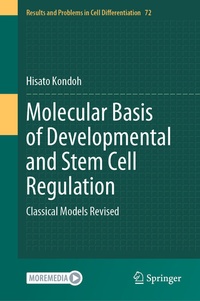
Molecular Basis of Developmental and Stem Cell Regulation
Description

This book provides a comprehensive overview of the molecular basis of developmental and stem cell regulation. It revisits some of the classical models of developmental biology and puts them in context with the findings of modern stem cell research and developmental biology.
Biomedical research is embarking on a new era due to new tools, which are exemplified by stem cell technologies, single-cell transcriptome analysis, and live imaging at a single-cell resolution. Publications based on cutting-edge technologies do often not provide the readers with deep biological backgrounds. This causes the risk that precious data are reduced to highly specific descriptions without sufficient biological contexts.
Contemporary developmental biology on the other hand as written in many textbooks, is to a significant extent based on conceptions backdated many decades ago, and is not necessarily supported by recent findings. Yet, the prevailing classical notions tend to mislead modern biomedical researches.
This book not only presents current models for developmental processes but also reinterprets and re-evaluates classic observations, thus linking classical and modern worlds of developmental biology. Spanning from molecular mechanisms to highly embryological matters it provides a bridge between these different disciplines.
Written for advanced students of developmental and stem cell biology, researchers and teaching scholars, this book provides a new road map to modern developmental biology and stem cell biology.
More details
Other editions
Additional editions
Person
Hisato Kondoh received his B.Sc. and Ph.D. from Kyoto University and conducted his postdoctoral study at the University of Wisconsin-Madison, USA. He initially received training in gene regulation and signal transduction in bacteria. However, it was his turning point when he was appointed to an assistant professor at Kyoto University in 1979, and started the investigation of crystallin gene regulation in lens development. In 1988, he became a full professor at the Department of Molecular Biology in Nagoya University School of Sciences and widened his scope to transcription factors (TFs) regulating developmental processes. In 1993, he moved to the Institute for Molecular and Cellular Biology, Osaka University (serving as Director from 1998 to 2002), and in 2003 joined the Graduate School of Frontier Biosciences, Osaka University (serving as Dean from 2006 to 2008). In 2014, he moved to Kyoto Sangyo University and served as a Professor at the Faculty of Life Sciences, andin 2021 to Biohistory Research Hall and served as the Director of Biology, continuing his research since 1995 when he first reported the TF SOX2 as the principal regulator of lens development, SOX2 function and its regulation in early embryogenesis have been the focus of his study. His current interest is the gene regulatory networks underlying the different pluripotent states and the derivation of various somatic lineages. For several years, he has attempted to combine the information on gene regulatory networks with cell changes, cell movements, and cell-cell interactions in the corresponding stages of embryos, as revealed by live imaging. Through these studies, he realized that old models in developmental biology need extensive revision, which is also essential for the advancement of stem cell biology.
