

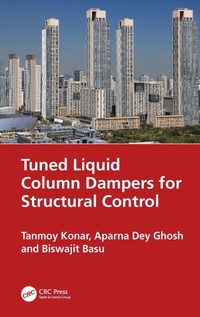
Tuned Liquid Column Dampers for Structural Control
Published on 1. May 2025
280 pages
978-1-040-33762-2 (ISBN)
Description

Structural vibrations from excitations such as wind, earthquakes, waves and pedestrian movements can be controlled using tuned liquid dampers such as tuned liquid column dampers (TLCDs). They benefit from low installation cost, ease of maintenance and amenability to tuning. TLCDs offer high volumetric efficiency and a specific and quantifiable damping mechanism.
This guide outlines passive, active, semi-active and hybrid forms of TLCD. It systematically covers basic operational principles, mathematical modelling, analysis methodologies of damper-structure systems, in frequency and in time domain, design issues and experimental studies, and structural implementations. There is also detailed coverage of innovative design variations that enhance applicability and performance.
This book is aimed at researchers in structural control, advanced students, and vibration specialists in industry.
This guide outlines passive, active, semi-active and hybrid forms of TLCD. It systematically covers basic operational principles, mathematical modelling, analysis methodologies of damper-structure systems, in frequency and in time domain, design issues and experimental studies, and structural implementations. There is also detailed coverage of innovative design variations that enhance applicability and performance.
This book is aimed at researchers in structural control, advanced students, and vibration specialists in industry.
More details
Language
English
Place of publication
London
United Kingdom
Publishing group
Taylor & Francis Ltd
Target group
College/higher education
Professional and scholarly
Illustrations
22 Tables, black and white; 136 Line drawings, black and white; 18 Halftones, black and white; 154 Illustrations, black and white
File size
49,45 MB
ISBN-13
978-1-040-33762-2 (9781040337622)
Copyright in bibliographic data and cover images is held by Nielsen Book Services Limited or by the publishers or by their respective licensors: all rights reserved.
Schweitzer Classification
Other editions
Additional editions
Tanmoy Konar | Aparna Dey Ghosh | Biswajit Basu
Tuned Liquid Column Dampers for Structural Control
Book
approx. 07/2026
1st Edition
CRC Press
€74.50
Not yet published
Tanmoy Konar | Aparna Dey Ghosh | Biswajit Basu
Tuned Liquid Column Dampers for Structural Control
Book
04/2025
1st Edition
CRC Press
€243.60
Shipment within 10-20 days
Persons
Tanmoy Konar is an engineer in the West Bengal Police Housing and Infrastructure Development Corporation with extensive practical experience, especially in the design of buildings. He has regularly worked on different configurations of liquid dampers and has developed several novel damping mechanisms for the same.
Aparna Ghosh is a Professor at the Department of Civil Engineering, Indian Institute of Engineering Science and Technology, Shibpur, India. Prof. Dey Ghosh has a comprehensive knowledge of passive structural vibration control systems and her work on the tuned liquid column damper has served as the cornerstone for further research on the subject. She also has experience as a consulting design engineer in the power plant and steel plant sectors.
Biswajit Basu is a Professor at Trinity College Dublin, Ireland. Prof. Basu is an internationally acclaimed researcher with expertise in a wide range of subjects, such as, nonlinear hydrodynamics, time-frequency analysis and signal processing, stochastic dynamics and control, oceanic flow modelling and simulation, offshore renewable energy and algorithms for quantum computing.
Aparna Ghosh is a Professor at the Department of Civil Engineering, Indian Institute of Engineering Science and Technology, Shibpur, India. Prof. Dey Ghosh has a comprehensive knowledge of passive structural vibration control systems and her work on the tuned liquid column damper has served as the cornerstone for further research on the subject. She also has experience as a consulting design engineer in the power plant and steel plant sectors.
Biswajit Basu is a Professor at Trinity College Dublin, Ireland. Prof. Basu is an internationally acclaimed researcher with expertise in a wide range of subjects, such as, nonlinear hydrodynamics, time-frequency analysis and signal processing, stochastic dynamics and control, oceanic flow modelling and simulation, offshore renewable energy and algorithms for quantum computing.
Content
1. Introduction 2. Tuned Liquid Column Dampers - Working Mechanism and Design Considerations 3. Different configurations of the Tuned Liquid Column Damper 4. Control of Wind Excited Structures by TLCD 5. Seismic Vibration Control of Structures by TLCD 6. TLCD for Control of structures subjected to other types of excitations 7. Active and Semi-Active Tuned Liquid Column Damper 9. Practical Implementation of TLCD
