

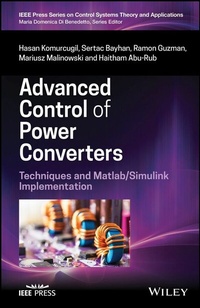
Advanced Control of Power Converters
Description

Unique resource presenting advanced nonlinear control methods for power converters, plus simulation, controller design, analyses, and case studies
Advanced Control of Power Converters equips readers with the latest knowledge of three control methods developed for power converters: nonlinear control methods such as sliding mode control, Lyapunov-function-based control, and model predictive control. Readers will learn about the design of each control method, and simulation case studies and results will be presented and discussed to point out the behavior of each control method in different applications. In this way, readers wishing to learn these control methods can gain insight on how to design and simulate each control method easily.
The book is organized into three clear sections: introduction of classical and advanced control methods, design of advanced control methods, and case studies. Each control method is supported by simulation examples along with Simulink models which are provided on a separate website.
Contributed to by five highly qualified authors, Advanced Control of Power Converters covers sample topics such as:
* Mathematical modeling of single- and three-phase grid-connected inverter with LCL filter, three-phase dynamic voltage restorer, design of sliding mode control and switching frequency computation under single- and double-band hysteresis modulations
* Modeling of single-phase UPS inverter and three-phase rectifier and their Lyapunov-function-based control design for global stability assurance
* Design of model predictive control for single-phase T-type rectifier, three-phase shunt active power filter, three-phase quasi-Z-source inverter, three-phase rectifier, distributed generation inverters in islanded ac microgrids
* How to realize the Simulink models in sliding mode control, Lyapunov-function-based control and model predictive control
* How to build and run a real-time model as well as rapid prototyping of power converter by using OPAL-RT simulator
Advanced Control of Power Converters is an ideal resource on the subject for researchers, engineering professionals, and undergraduate/graduate students in electrical engineering and mechatronics; as an advanced level book, and it is expected that readers will have prior knowledge of power converters and control systems.
More details
Other editions
Additional editions

Persons
Hasan Komurcugil is Professor at the Eastern Mediterranean University, Turkey. His research interests include nonlinear control methods of power converters such as sliding mode control, Lyapunov-function-based control, and model predictive control.
Sertac Bayhan is Senior Scientist and Associate Professor at Hamad Bin Khalifa University, Qatar. His research interests include power electronics and its applications in renewable energy, electric vehicle supply equipment, microgrids, and smart grid.
Ramon Guzman is Associate Professor at the Technical University of Catalonia, Spain. His research interests include sliding mode control and model predictive control of three phase power converters.
Mariusz Malinowski is Professor at the Warsaw University of Technology, Poland. His current research interests include the control and modulation of grid-side converters, multilevel converters, smart grids, and power-generation systems based on renewable energies.
Haitham Abu-Rub is Professor at Texas A&M University at Qatar, and is the Managing Director of the Smart Grid Center at the same university. His research interests include energy conversion systems, including electric drives, power electronic converters, renewable energy, and smart grid.
Content
About the Authors xiii
List of Abbreviations xvii
Preface xix
Acknowledgment xxi
About the Companion Website xxiii
1 Introduction 1
1.1 General Remarks 1
1.2 Basic Closed-Loop Control for Power Converters 3
1.3 Mathematical Modeling of Power Converters 4
1.4 Basic Control Objectives 6
1.4.1 Closed-Loop Stability 6
1.4.2 Settling Time 10
1.4.3 Steady-State Error 11
1.4.4 Robustness to Parameter Variations and Disturbances 12
1.5 Performance Evaluation 12
1.5.1 Simulation-Based Method 12
1.5.2 Experimental Method 13
1.6 Contents of the Book 13
References 15
2 Introduction to Advanced Control Methods 17
2.1 Classical Control Methods for Power Converters 17
2.2 Sliding Mode Control 18
2.3 Lyapunov Function-Based Control 22
2.3.1 Lyapunov's Linearization Method 23
2.3.2 Lyapunov's Direct Method 24
2.4 Model Predictive Control 27
2.4.1 Functional Principle 27
2.4.2 Basic Concept 28
2.4.3 Cost Function 29
References 30
3 Design of Sliding Mode Control for Power Converters 33
3.1 Introduction 33
3.2 Sliding Mode Control of DC-DC Buck and Cuk Converters 33
3.3 Sliding Mode Control Design Procedure 44
3.3.1 Selection of Sliding Surface Function 44
3.3.2 Control Input Design 46
3.4 Chattering Mitigation Techniques 48
3.4.1 Hysteresis Function Technique 48
3.4.2 Boundary Layer Technique 49
3.4.3 State Observer Technique 50
3.5 Modulation Techniques 51
3.5.1 Hysteresis Modulation Technique 51
3.5.2 Sinusoidal Pulse Width Modulation Technique 52
3.5.3 Space Vector Modulation Technique 53
3.6 Other Types of Sliding Mode Control 54
3.6.1 Terminal Sliding Mode Control 54
3.6.2 Second-Order Sliding Mode Control 54
References 55
4 Design of Lyapunov Function-Based Control for Power Converters 59
4.1 Introduction 59
4.2 Lyapunov-Function-Based Control Design Using Direct Method 59
4.3 Lyapunov Function-Based Control of DC-DC Buck Converter 62
4.4 Lyapunov Function-Based Control of DC-DC Boost Converter 67
References 71
5 Design of Model Predictive Control 73
5.1 Introduction 73
5.2 Predictive Control Methods 73
5.3 FCS Model Predictive Control 75
5.3.1 Design Procedure 76
5.3.2 Tutorial 1: Implementation of FCS-MPC for Three-Phase VSI 80
5.4 CCS Model Predictive Control 86
5.4.1 Incremental Models 86
5.4.2 Predictive Model 88
5.4.3 Cost Function in CCSMPC 92
5.4.4 Cost Function Minimization 93
5.4.5 Receding Control Horizon Principle 96
5.4.6 Closed-Loop of an MPC System 97
5.4.7 Discrete Linear Quadratic Regulators 97
5.4.8 Formulation of the Constraints in MPC 99
5.4.9 Optimization with Equality Constraints 103
5.4.10 Optimization with Inequality Constraints 105
5.4.11 MPC for Multi-Input Multi-Output Systems 108
5.4.12 Tutorial 2: MPC Design For a Grid-Connected VSI in dq Frame 109
5.5 Design and Implementation Issues 112
5.5.1 Cost Function Selection 112
5.5.1.1 Examples for Primary Control Objectives 113
5.5.1.2 Examples for Secondary Control Objectives 114
5.5.2 Weighting Factor Design 114
5.5.2.1 Empirical Selection Method 115
5.5.2.2 Equal-Weighted Cost-Function-Based Selection Method 116
5.5.2.3 Lookup Table-Based Selection Method 117
References 118
6 MATLAB/Simulink Tutorial on Physical Modeling and Experimental Setup 121
6.1 Introduction 121
6.2 Building Simulation Model for Power Converters 121
6.2.1 Building Simulation Model for Single-Phase Grid-Connected Inverter Based on Sliding Mode Control 122
6.2.2 Building Simulation Model for Three-Phase Rectifier Based on Lyapunov-Function-Based Control 126
6.2.3 Building Simulation Model for Quasi-Z Source Three-Phase Four-Leg Inverter Based on Model Predictive Control 131
6.2.4 Building Simulation Model for Distributed Generations in Islanded AC Microgrid 137
6.3 Building Real-Time Model for a Single-Phase T-Type Rectifier 142
6.4 Building Rapid Control Prototyping for a Single-Phase T-Type Rectifier 154
6.4.1 Components in the Experimental Testbed 155
6.4.1.1 Grid Simulator 155
6.4.1.2 A Single-Phase T-Type Rectifier Prototype 156
6.4.1.3 Measurement Board 157
6.4.1.4 Programmable Load 158
6.4.1.5 Controller 158
6.4.2 Building Control Structure on OP- 5707 158
References 162
7 Sliding Mode Control of Various Power Converters 163
7.1 Introduction 163
7.2 Single-Phase Grid-Connected Inverter with LCL Filter 163
7.2.1 Mathematical Modeling of Grid-Connected Inverter with LCL Filter 164
7.2.2 Sliding Mode Control 165
7.2.3 PWM Signal Generation Using Hysteresis Modulation 168
7.2.3.1 Single-Band Hysteresis Function 168
7.2.3.2 Double-Band Hysteresis Function 168
7.2.4 Switching Frequency Computation 170
7.2.4.1 Switching Frequency Computation with Single-Band Hysteresis Modulation 170
7.2.4.2 Switching Frequency Computation with Double-Band Hysteresis Modulation 171
7.2.5 Selection of Control Gains 172
7.2.6 Simulation Study 174
7.2.7 Experimental Study 177
7.3 Three-Phase Grid-Connected Inverter with LCL Filter 180
7.3.1 Physical Model Equations for a Three-Phase Grid-Connected VSI with an LCL Filter 181
7.3.2 Control System 182
7.3.2.1 Reduced State-Space Model of the Converter 183
7.3.2.2 Model Discretization and KF Adaptive Equation 187
7.3.2.3 Sliding Surfaces with Active Damping Capability 188
7.3.3 Stability Analysis 189
7.3.3.1 Discrete-Time Equivalent Control Deduction 189
7.3.3.2 Closed-Loop System Equations 191
7.3.3.3 Test of Robustness Against Parameters Uncertainties 192
7.3.4 Experimental Study 192
7.3.4.1 Test of Robustness Against Grid Inductance Variations 192
7.3.4.2 Test of Stability in Case of Grid Harmonics Near the Resonance Frequency 196
7.3.4.3 Test of the VSI Against Sudden Changes in the Reference Current 196
7.3.4.4 Test of the VSI Under Distorted Grid 198
7.3.4.5 Test of the VSI Under Voltage Sags 198
7.3.5 Computational Load and Performances of the Control Algorithm 199
7.4 Three-Phase AC-DC Rectifier 200
7.4.1 Nonlinear Model of the Unity Power Factor Rectifier 200
7.4.2 Problem Formulation 202
7.4.3 Axis-Decoupling Based on an Estimator 203
7.4.4 Control System 205
7.4.4.1 Kalman Filter 206
7.4.4.2 Practical Considerations: Election of Q and R Matrices 208
7.4.4.3 Practical Considerations: Computational Burden Reduction 208
7.4.5 Sliding Mode Control 209
7.4.5.1 Inner Control Loop 209
7.4.5.2 Outer Control Loop 210
7.4.6 Hysteresis Band Generator with Switching Decision Algorithm 212
7.4.7 Experimental Study 215
7.5 Three-Phase Transformerless Dynamic Voltage Restorer 224
7.5.1 Mathematical Modeling of Transformerless Dynamic Voltage Restorer 224
7.5.2 Design of Sliding Mode Control for TDVR 225
7.5.3 Time-Varying Switching Frequency with Single-Band Hysteresis 227
7.5.4 Constant Switching Frequency with Boundary Layer 229
7.5.5 Simulation Study 231
7.5.6 Experimental Study 233
7.6 Three-Phase Shunt Active Power Filter 240
7.6.1 Nonlinear Model of the SAPF 240
7.6.2 Problem Formulation 242
7.6.3 Control System 243
7.6.3.1 State Model of the Converter 243
7.6.3.2 Kalman Filter 245
7.6.3.3 Sliding Mode Control 246
7.6.3.4 Hysteresis Band Generator with SDA 247
7.6.4 Experimental Study 248
7.6.4.1 Response of the SAPF to Load Variations 249
7.6.4.2 SAPF Performances Under a Distorted Grid 253
7.6.4.3 SAPF Performances Under Grid Voltage Sags 254
7.6.4.4 Spectrum of the Control Signal 254
References 257
8 Design of Lyapunov Function-Based Control of Various Power Converters 261
8.1 Introduction 261
8.2 Single-Phase Grid-Connected Inverter with LCL Filter 261
8.2.1 Mathematical Modeling and Controller Design 261
8.2.2 Controller Modification with Capacitor Voltage Feedback 264
8.2.3 Inverter-Side Current Reference Generation Using Proportional- Resonant Controller 264
8.2.4 Grid Current Transfer Function 266
8.2.5 Harmonic Attenuation and Harmonic Impedance 267
8.2.6 Results 270
8.3 Single-Phase Quasi-Z-Source Grid-Connected Inverter with LCL Filter 277
8.3.1 Quasi-Z-Source Network Modeling 277
8.3.2 Grid-Connected Inverter Modeling 280
8.3.3 Control of Quasi-Z-Source Network 281
8.3.4 Control of Grid-Connected Inverter 281
8.3.5 Reference Generation Using Cascaded PR Control 282
8.3.6 Results 283
8.4 Single-Phase Uninterruptible Power Supply Inverter 287
8.4.1 Mathematical Modeling of Uninterruptible Power Supply Inverter 287
8.4.2 Controller Design 288
8.4.3 Criteria for Selecting Control Parameters 290
8.4.4 Results 292
8.5 Three-Phase Voltage-Source AC-DC Rectifier 298
8.5.1 Mathematical Modeling of Rectifier 298
8.5.2 Controller Design 301
8.5.3 Results 304
References 307
9 Model Predictive Control of Various Converters 309
9.1 CCS MPC Method for a Three-Phase Grid-Connected VSI 309
9.1.1 Model Predictive Control Design 310
9.1.1.1 VSI Incremental Model with an Embedded Integrator 310
9.1.1.2 Predictive Model of the Converter 311
9.1.1.3 Cost Function Minimization 312
9.1.1.4 Inclusion of Constraints 313
9.1.2 MATLAB ® /Simulink ® Implementation 315
9.1.3 Simulation Studies 322
9.2 Model Predictive Control Method for Single-Phase Three-Level Shunt Active Filter 325
9.2.1 Modeling of Shunt Active Filter (SAPF) 325
9.2.2 The Energy-Function-Based MPC 328
9.2.2.1 Design of Energy-Function-Based MPC 328
9.2.2.2 Discrete-Time Model 331
9.2.3 Experimental Studies 332
9.2.3.1 Steady-State and Dynamic Response Tests 333
9.2.3.2 Comparison with Classical MPC Method 337
9.3 Model Predictive Control of Quasi-Z Source Three-Phase Four-Leg Inverter 341
9.3.1 qZS Four-Leg Inverter Model 341
9.3.2 MPC Algorithm 345
9.3.2.1 Determination of References 345
9.3.2.2 Discrete-Time Models of the System 346
9.3.2.3 Cost Function Optimization 347
9.3.2.4 Control Algorithm 347
9.3.3 Simulation Results 349
9.4 Weighting Factorless Model Predictive Control for DC-DC SEPIC Converters 352
9.4.1 Principle of Control Strategy 352
9.4.1.1 Conventional Model Predictive Current Control 355
9.4.1.2 Cost Function Analysis of Conventional MPC 356
9.4.1.3 Cost Function Design of Presented MPC in [11] 358
9.4.1.4 Output Voltage Control 361
9.4.2 Experimental Results 362
9.4.2.1 Switching Frequency Control Test 362
9.4.2.2 Dynamic Response Test Under Input Voltage Variation 363
9.4.2.3 Dynamic Response Test Under Load Change 366
9.4.2.4 Influence of Parameter Mismatch 367
9.5 Model Predictive Droop Control of Distributed Generation Inverters in Islanded AC Microgrid 370
9.5.1 Conventional Droop Control 370
9.5.2 Control Technique 373
9.5.2.1 Reference Voltage Generation Through Droop Control 373
9.5.2.2 Model Predictive Control 374
9.5.3 Simulation Results 376
9.6 FCS-MPC for a Three-Phase Shunt Active Power Filter 378
9.6.1 System Modeling 381
9.6.2 Control Technique 383
9.6.3 FCS-MPC with Reduced States 384
9.6.3.1 Vector Selection Based on Vector Operation 384
9.6.3.2 Cost Function Minimization Procedure 387
9.6.3.3 Kalman Filter 387
9.6.4 Experimental Results 389
9.7 FCS-MPC for a Single-Phase T-Type Rectifier 395
9.7.1 Modeling of Single-Phase T-Type Rectifier 395
9.7.2 Model Predictive Control 397
9.7.2.1 Sensorless Grid Voltage Estimation 397
9.7.2.2 Reference Current Generation 400
9.7.2.3 MPC for the T-Type Rectifier 400
9.7.2.4 MPC for the Power Decoupling Circuit 402
9.7.3 Experimental Studies 404
9.7.3.1 Steady-State Analysis 404
9.7.3.2 Robustness Analysis 404
9.8 Predictive Torque Control of Brushless Doubly Fed Induction Generator Fed by a Matrix Converter 408
9.8.1 Overview of the System Model 411
9.8.1.1 Topology Overview 411
9.8.1.2 Mathematical Model of the CDFIG 412
9.8.1.3 Mathematical Model of the Matrix Converter 414
9.8.2 Predictive Torque Control of CDFIG 415
9.8.2.1 Outer Loop 416
9.8.2.2 Internal Model of the Controller 416
9.8.2.3 Cost Function Minimization 418
9.8.3 Simulation Results 418
9.9 An Enhanced Finite Control Set Model Predictive Control Method with Self-Balancing Capacitor Voltages for Three-Level T-Type Rectifiers 420
9.9.1 Overview of the System Model 422
9.9.2 Problem Definition 424
9.9.3 Derivation of Lyapunov-Energy Function 425
9.9.4 Discrete-Time Model 428
9.9.5 Experimental Studies 429
References 431
Index 435
1
Introduction
1.1 General Remarks
Power electronics converters are widely utilized in almost every aspect of todays' modernized world including computers, smart home systems, electric vehicles (EVs), trains, marine, aircrafts, microgrids, robots, renewable energy conversion and integration, and many industrial applications. The main function of a power converter is to convert the electrical power from one form to the other [1]. In general, there are four different categories of power converters: DC-DC, AC-DC, DC-AC, and AC-AC. In each category, various converter topologies have been developed to meet the desired conversion and application objectives. For instance, when the photovoltaic (PV) energy is to be converted and injected into the grid, a DC-DC boost converter is connected between the PV panel and DC-AC inverter to ensure a constant inverter input voltage and to possibly track the panel's maximum power point. The necessity of DC-DC boost converter in such application arises due to the buck operation of the inverter (i.e. DC input voltage is greater than the amplitude of its AC voltage). On the other hand, an AC-DC converter (usually referred to as rectifier) is used in an electric vehicle (EV) charging system to convert the grid's AC voltage to DC such that the battery can be charged. Another example is the use of series active filter (usually referred to as dynamic voltage restorer) in the protection of sensitive loads (i.e. medical equipment in the hospitals, data centers, and so on) against voltage sags, and voltage swells in the grid voltage. When such voltage variations occur in the grid, the series active filter, which is built using a DC-AC inverter, generates and injects the required compensation voltage to the point of common coupling such that the sensitive load voltage is always kept at the desired value. Similar examples can be given for the other converter categories.
Thus, considering the importance of today's energy demand and the need for clean and reliable resources, the use of power electronics has increased tremendously. As such, the performance of the power converters used in these applications has gained utmost importance. In most of the power electronics-related applications, closed-loop control is essential to keep the voltage or current at reference values under various conditions, which include load changes, grid voltage deterioration (voltage sags, voltage swells, and distorted grid voltages), and parameter variations, which occur because of aging and operating conditions. More importantly, the stability of closed-loop system should not be jeopardized under these situations. For this reason, the design of a closed-loop system that responds to these challenges is an essential and difficult task. First of all, it should be noted that the design of closed-loop control for power electronics converters requires a deep knowledge in many areas such as circuit analysis, advanced mathematics, modeling, control systems, and power electronics. In this regard, this chapter starts with the introduction of simplest closed-loop control for power converters. Then, mathematical modeling, basic control objectives, and performance evaluation are explained briefly. Hence, the reader is urged to refresh or gain further basic information in the areas of control theory and power electronics converters from the literature.
This book is primarily concerned with advanced nonlinear control of power converters. A closed-loop control is referred to as nonlinear control if it contains at least one nonlinear component. Nonlinear control of power converters received attention of many researchers in the last two decades. The main reason of this popularity comes from the advantages over linear control methods, which lack guaranteed stability in large operation range of the converters; facing hard nonlinearities (saturation, dead-zone, backlash, and hysteresis), which cannot be approximated linearly; and having model uncertainties, which are assumed to be known when designing the linear controller. Whereas the nonlinear control is able to cope with the problems mentioned above. In this book, sliding mode control, Lyapunov function-based control, and model predictive control methodologies are explained for power converters. Although these nonlinear control methods are not new, their application in power converter control was limited in the past due to the required extensive computations. Since last decade, the advent of fast implementation platforms such as digital signal processors and field programmable gate arrays (FPGAs) relieved the computation burden issue. Therefore, compiling the design and application of the nonlinear control methods mentioned above in a single book is very beneficial for the interested readers.
1.2 Basic Closed-Loop Control for Power Converters
A basic single input single output (SISO) closed-loop power converter control system is illustrated in Figure 1.1. Here, the main aim is to control the power converter in order to accomplish specific desired control objectives (see Section 1.4). Clearly, the output signal (i.e. voltage or current) is measured and compared with the reference one to produce an error signal. This error signal is applied to the controller. Then, the controller generates modulation signal from which the pulse width modulation (PWM) signals are generated. These signals are applied to the gates of switching devices (i.e. insulated gate bipolar transistors [IGBTs], metal oxide semiconductor field effect transistors [MOSFETs], etc.) in the power converter. Upon the application of PWM signals, the switching devices are turned on and off. The value of voltage (or current) in the converter is changed by these switching actions. If the controller is well designed, the error signal is continually reduced until the output signal tracks the reference signal in the steady state. On the other hand, the number of loops in a control system may be more than one depending on the converter topology and the application area.
Figure 1.1 Basic closed-loop power converter control system. (a) With modulation, (b) without modulation.
Numerous control approaches have been developed for the power converters. Each control approach has its own advantages and disadvantages concerning with the controller complexity and cost, dynamic response, steady-state error, robustness to parameter variations, and closed-loop stability. It is worth to mention that the discussion in this book is based on the introduction, design and application of sliding mode control, Lyapunov function-based control, and model predictive control methods used in various power converters. While the sliding mode control and Lyapunov function-based control methods require a modulation block as shown in Figure 1.1a, the finite control set model predictive control (FCS-MPC) method does not require a modulation as shown in Figure 1.1b. The design of sliding mode control, Lyapunov function-based control, and model predictive control are explained in Chapters 3, 4, and 5, respectively. The following sections intend to present background information regarding the steps that should be taken into consideration when designing a controller. Even though these steps are well known in the modern control systems area, the readers, who are not fully familiar with these, will gain a knowledge before learning each of these control methods.
1.3 Mathematical Modeling of Power Converters
Usually, an accurate mathematical model of the converter is necessary when there is a need to design its controller. As it will be discussed in Chapter 3, the sliding mode control does not require mathematical modeling of the converter. Whereas the Lyapunov function-based control and model predictive control approaches rely on the mathematical model of the power converter as will be explained in Chapters 4 and 5, respectively. However, a perfect mathematical model, which represents all dynamics of the converter, is not possible in practice due to the certain noises (i.e. measurement noise) and possible failure conditions. There are two types of mathematical models in the continuous time: linear models and nonlinear models. The behavior of a linear converter system is usually described by linear differential equations written in the state-space form as follows:
(1.1)where x represents the state vector, u represents the input vector, y represents the output vector, and A, B, C, and D represent the matrices with appropriate dimension. Such models are suitable to be used with the root-locus method, state-space method, and frequency domain design methods such as Bode plot and Nyquist method. As will be discussed in Chapter 4, the Lyapunov function-based control method uses the linear converter system model in (1.1). On the other hand, the model predictive control method (see Chapters 5 and 9) uses discrete-time version of the continuous-time model in (1.1) as given below:
(1.2)where Ad, Bd, Cd, and Dd are discretized matrices of A, B, C, and D, respectively. The sampling instants are represented by k and k + 1. It is worth to mention...
