

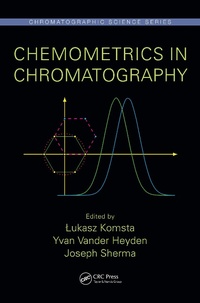
Chemometrics in Chromatography
1st Edition
Published on 2. February 2018
526 pages
978-1-4987-7254-9 (ISBN)
Description

Chemometrics uses advanced mathematical and statistical algorithms to provide maximum chemical information by analyzing chemical data, and obtain knowledge of chemical systems. Chemometrics significantly extends the possibilities of chromatography and with the technological advances of the personal computer and continuous development of open-source software, many laboratories are interested in incorporating chemometrics into their chromatographic methods. This book is an up-to-date reference that presents the most important information about each area of chemometrics used in chromatography, demonstrating its effective use when applied to a chromatographic separation.
Reviews / Votes
"So why is this book a must purchase? It consists of seven sections, sub-divided into a number of chapters. Just the first three sections make this a book to purchase...this is a great book for all chromatographers. It will make you look and consider your experimental designs and the data you collect. Some of the methods described are not standard in your chromatographic data system. But with today's high-performance computers and the vast amount of open source software I am sure the average lab scientist can easily implement the well-described methods in the book."- Chromatographia, August 2019
More details
Series
Edition
1. Auflage
Language
English
Place of publication
London
United Kingdom
Publishing group
Taylor & Francis Ltd
Target group
College/higher education
Illustrations
41 Tables, black and white; 32 Line drawings, color; 108 Line drawings, black and white
File size
12,46 MB
ISBN-13
978-1-4987-7254-9 (9781498772549)
Copyright in bibliographic data and cover images is held by Nielsen Book Services Limited or by the publishers or by their respective licensors: all rights reserved.
Schweitzer Classification
Other editions
Additional editions
Lukasz Komsta | Yvan Vander Heyden | Joseph Sherma
Chemometrics in Chromatography
Book
06/2020
1st Edition
CRC Press
€114.30
Shipment within 15-20 days
Lukasz Komsta | Yvan Vander Heyden | Joseph Sherma
Chemometrics in Chromatography
Book
02/2018
1st Edition
CRC Press
€350.60
Shipment within 15-20 days
Persons
Lukasz Komsta, Yvan Vander Heyden, Joseph Sherma
Content
TABLE OF CONTENTS
Preface
Method development and optimization
Experimental design in chromatographic method development and validation (Lukasz Komsta, Yvan Vander Heyden)
Chromatographic response functions (Regina M. B. O. Duarte, Joao T. V. Matos, Armando C. Duarte)
Chemometric strategies to characterize stationary phases (Charlene Galea, Debby Mangelings, Yvan Vander Heyden)
Chromatographic applications of genetic algorithms and other nature-inspired optimization methods (Mohammad Goodarzi, Yvan Vander Heyden)
Univariate analysis
Statistics and validation in quantitative chromatographic analysis (Eliangiringa Kaale, Danstan Shewiyo, David Jenkins)
Statistical evaluation of calibration curves in chromatography (Sven Declerck, Johan Viaene, Ines Salsinha, Yvan Vander Heyden)
Data preprocessing and unsupervised analysis
Introduction to multivariate data treatment (Lukasz Komsta, Yvan Vander Heyden)
Introduction to exploratory and clustering techniques (Ivana Stanimirova, Michal Daszykowski)
Denoising of signals, signal enhancement and baseline correction in chromatographic science (Zhi-Min Zhang, Hong-Mei Lu, Yi-Zeng Liang)
Alignment of one- and two-dimensional chromatographic signals (Michal Daszykowski)
Peak purity and resolution of chromatographic data (Silvia Mas, Anna de Juan)
Modeling of peak shape and asymmetry (Jose Ramon Torres, Juan Jose Baeza-Baeza, Maria Celia Garcia-Alvarez-Coque,)
Missing and censored data in chromatography (Ivana Stanimirova)
Classification, discrimination and calibration
Linear supervised techniques (Lukasz Komsta, Yvan Vander Heyden)
Discriminant analysis, and classification of chromatographic data (Alessandra Biancolillo, Federico Marini)
Nonlinear supervised techniques (Geert Postma, Lionel Blanchet, Frederik-Jan van Schooten, Lutgarde Buydens)
Retention modelling
Introduction to quantitative structure-retention relationships (QSRRs) (Krzesimir Ciura, Piotr Kawczak, Joanna Nowakowska, Tomasz Baczek)
Topological Indices in modelling chromatographic retention (Malgorzata Dolowy, Katarzyna Bober, Alina Pyka-Pajak)
Application overviews
Introduction to fingerprinting in chromatography (Johan Viaene and Yvan Vander Heyden)
Chemometric strategies in analysis of chromatographic-mass spectrometry data (Samantha Riccadonna, Pietro Franceschi)
Chemometric strategies in chromatographic analysis of pharmaceuticals (Erdal Dinc)
Miscellaneous
Bayesian methods in chromatographic science (David Brynn Hibbert)
Multi-way methods in chromatography (Lukasz Komsta, Yvan Vander Heyden)
Recurrent relationships in separation science (Igor Zenkevich)
Image processing in separation science (Bahram Hemmateenejad, Elaheh Talebanpour Bayat, Elmira Rafatmah, Zahra Shojaeifard, Nabioallah Mobaraki, Saeed Yousefinejad)
Preface
Method development and optimization
Experimental design in chromatographic method development and validation (Lukasz Komsta, Yvan Vander Heyden)
Chromatographic response functions (Regina M. B. O. Duarte, Joao T. V. Matos, Armando C. Duarte)
Chemometric strategies to characterize stationary phases (Charlene Galea, Debby Mangelings, Yvan Vander Heyden)
Chromatographic applications of genetic algorithms and other nature-inspired optimization methods (Mohammad Goodarzi, Yvan Vander Heyden)
Univariate analysis
Statistics and validation in quantitative chromatographic analysis (Eliangiringa Kaale, Danstan Shewiyo, David Jenkins)
Statistical evaluation of calibration curves in chromatography (Sven Declerck, Johan Viaene, Ines Salsinha, Yvan Vander Heyden)
Data preprocessing and unsupervised analysis
Introduction to multivariate data treatment (Lukasz Komsta, Yvan Vander Heyden)
Introduction to exploratory and clustering techniques (Ivana Stanimirova, Michal Daszykowski)
Denoising of signals, signal enhancement and baseline correction in chromatographic science (Zhi-Min Zhang, Hong-Mei Lu, Yi-Zeng Liang)
Alignment of one- and two-dimensional chromatographic signals (Michal Daszykowski)
Peak purity and resolution of chromatographic data (Silvia Mas, Anna de Juan)
Modeling of peak shape and asymmetry (Jose Ramon Torres, Juan Jose Baeza-Baeza, Maria Celia Garcia-Alvarez-Coque,)
Missing and censored data in chromatography (Ivana Stanimirova)
Classification, discrimination and calibration
Linear supervised techniques (Lukasz Komsta, Yvan Vander Heyden)
Discriminant analysis, and classification of chromatographic data (Alessandra Biancolillo, Federico Marini)
Nonlinear supervised techniques (Geert Postma, Lionel Blanchet, Frederik-Jan van Schooten, Lutgarde Buydens)
Retention modelling
Introduction to quantitative structure-retention relationships (QSRRs) (Krzesimir Ciura, Piotr Kawczak, Joanna Nowakowska, Tomasz Baczek)
Topological Indices in modelling chromatographic retention (Malgorzata Dolowy, Katarzyna Bober, Alina Pyka-Pajak)
Application overviews
Introduction to fingerprinting in chromatography (Johan Viaene and Yvan Vander Heyden)
Chemometric strategies in analysis of chromatographic-mass spectrometry data (Samantha Riccadonna, Pietro Franceschi)
Chemometric strategies in chromatographic analysis of pharmaceuticals (Erdal Dinc)
Miscellaneous
Bayesian methods in chromatographic science (David Brynn Hibbert)
Multi-way methods in chromatography (Lukasz Komsta, Yvan Vander Heyden)
Recurrent relationships in separation science (Igor Zenkevich)
Image processing in separation science (Bahram Hemmateenejad, Elaheh Talebanpour Bayat, Elmira Rafatmah, Zahra Shojaeifard, Nabioallah Mobaraki, Saeed Yousefinejad)
