

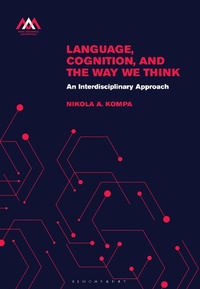
Language, Cognition, and the Way We Think
An Interdisciplinary Approach
1st Edition
Published on 25. July 2024
216 pages
978-1-350-17686-7 (ISBN)
Description

The cognitive potency of the human mind can be fully appreciated only if it is conceived of as a linguistic mind. This is the starting point of Nikola Kompa's investigation into the relationship between language and cognition.
Underpinned by philosophical ideas from Plato to Ockham, and from Locke to Vygotsky, Kompa uses theories within the philosophy of language, mind, and cognitive science and draws on neuro-psychology and psycholinguistic studies to explore core ideas about language and cognition. How did language transform our ancestors into creatures of considerable cognitive and social accomplishment? How does language augment cognition? Is language only a means of communicating our ideas or is a means of thinking itself? Her study has repercussions for a broad range of questions, from how humans differ from other animals and what a cognitive architecture looks like if it approximates the achievements of the human mind, to questions of education and cross-cultural communication.
Theorizing and forming hypotheses about how language and cognition might have coevolved, how the availability of (symbolic) labels enhance various cognitive functions, what the cognitive function of inner speech might be and how inner speech and thought relate to each other, Kompa addresses the perennial philosophical question of what the benefits of having a language might be, and brings into sharper relief the intimate connection between linguistic and other cognitive functions. Informed by recent discussions on language evolution, labels, and inner speech, this timely contribution helps us understand more about how language changes the way we think.
Underpinned by philosophical ideas from Plato to Ockham, and from Locke to Vygotsky, Kompa uses theories within the philosophy of language, mind, and cognitive science and draws on neuro-psychology and psycholinguistic studies to explore core ideas about language and cognition. How did language transform our ancestors into creatures of considerable cognitive and social accomplishment? How does language augment cognition? Is language only a means of communicating our ideas or is a means of thinking itself? Her study has repercussions for a broad range of questions, from how humans differ from other animals and what a cognitive architecture looks like if it approximates the achievements of the human mind, to questions of education and cross-cultural communication.
Theorizing and forming hypotheses about how language and cognition might have coevolved, how the availability of (symbolic) labels enhance various cognitive functions, what the cognitive function of inner speech might be and how inner speech and thought relate to each other, Kompa addresses the perennial philosophical question of what the benefits of having a language might be, and brings into sharper relief the intimate connection between linguistic and other cognitive functions. Informed by recent discussions on language evolution, labels, and inner speech, this timely contribution helps us understand more about how language changes the way we think.
More details
Series
Edition
1. Auflage
Language
English
Place of publication
London
United Kingdom
Publishing group
Bloomsbury Publishing PLC
Target group
Professional and scholarly
ISBN-13
978-1-350-17686-7 (9781350176867)
Copyright in bibliographic data and cover images is held by Nielsen Book Services Limited or by the publishers or by their respective licensors: all rights reserved.
Schweitzer Classification
Other editions
Additional editions
Book
03/2026
Bloomsbury Academic
€44.80
Shipment within 15-20 days
Person
Nikola A. Kompa is Professor in the Institute of Philosophy at Osnabrück University, Germany.
Content
Prologue
1. Language and Cognition
A Bit of History
The Co-evolution of Language and Cognition
Language as a Cognitive Scaffold
2. Inner Speech
Scattered Historical Remarks
What is Inner Speech?
The Cognitive Role of Inner Speech
Epilogue
Bibliography
Index
1. Language and Cognition
A Bit of History
The Co-evolution of Language and Cognition
Language as a Cognitive Scaffold
2. Inner Speech
Scattered Historical Remarks
What is Inner Speech?
The Cognitive Role of Inner Speech
Epilogue
Bibliography
Index
