

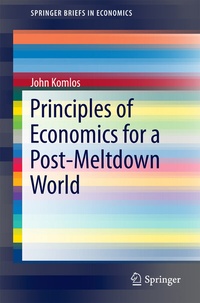
Principles of Economics for a Post-Meltdown World
Description

This brief emphasizes the ways in which introductory economics textbooks incorrectly rely on assumptions about the free market, the rational agent model, market fundamentalism, and standard long-standing assumptions in economics, and in doing so disregard the effects of incomplete and asymmetric information on choice and on allocation, and maintain a general but flawed belief that competitive markets can always provide efficient solutions automatically. In other words, the standard economics principles textbook is anachronistic, they assume that tastes are exogenous, they overlook interdependencies and externalities not only in production but in consumption of goods, and they overlook the fact that path-dependence is a major hindrance to optimization. Mainstream principles of economics textbooks distort our worldview with immense political and cultural consequences. Students of these principles deserve a more complete perspective, and this brief critiques that conventional worldviewand provides an alternative perspective, with an emphasis on free-market economics wherein the human element should be paramount and moral judgments should override market outcomes. In other words, what is important is not GNP as much as the quality of life, not institutions but how people live and fare in them. This brief argues that economics cannot be a science; it has too many ideological aspects, and in many ways conventional textbooks are not providing a true-to-life depiction of the economy. This Brief will be a reference or supplemental text for college and university students enrolled in such applied undergraduate and graduate courses and seminars in economics and economic theory.
More details
Other editions
Additional editions
Person
Komlos received a PhD in history (1978) and a second PhD in economics (1990) from the University of Chicago, where he was influenced by the Nobel Prize winning economic historian Robert Fogel to research the economic history of human physical stature. Komlos named this new discipline "anthropometric history" in 1989. He was a fellow at the Carolina Population Center of the University of North Carolina at Chapel Hill from 1984 to 1986. Komlos also taught at such institutions as Harvard University, Duke University, University of North Caroline at Chapel Hill, University of Vienna, and the Vienna University of Economics. He was professor of economics and of economic history at the University of Munich for eighteen years before his retirement. He is also the founding editor of Economics and Human Biology in 2003. Elected fellow of the Cliometric Society in 2013.
Content
Introduction.- Basic Concepts.- Micro: Supply and Demand in the Product Markets.- Micro: Supply and Demand in the Factor Markets.- Applications of Economic Principles.- Macroeconomics Economic Growth and Business Cycles.- Growth, Development and the Global Economy.- Unemployment, Inflation, and Economic Policy.- Conclusion.- Endnotes.
