

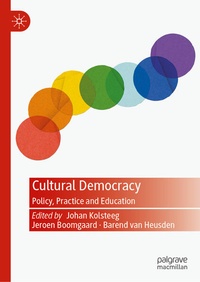
Cultural Democracy
Description

This book considers the ramifications of the term 'cultural democracy' from a variety of perspectives. In recent years, the concept of cultural democracy has gained traction in cultural policy and academic discourse, while manifesting itself on a practical level in cultural practice, but has not been uniformly defined. This book proposes that it is a system of production, participation, support and policy of the arts acknowledging the right for all citizens to produce, access, and experience culture.
The book goes on to elaborate on how the fields of cultural policy and cultural production could be aware of and relate to the cultural life-world of people. This is in opposition to the traditional top-down approach of cultural policy, distribution and cultural education systems, which depart from the canonical value of artworks and the institutional power of producers and venues.
Cultural Democracy advocates a fundamentally bottom-up approach towards organising, supporting and educating arts and culture. It elaborates on perspectives that theoretically enrich the concept, while at the same time presenting artistic practices that are, while often not labelled as such, culturally democratic.
More details
Other editions
Additional editions
Persons
Johan Kolsteeg is Assistant Professor in the Department of Arts, Culture, and Media Studies, University of Groningen (the Netherlands). His teaching concerns organisation and communication theory in the arts, his research concerns the theory and practice of cultural democracy.
Barend van Heusden is Emeritus Professor since 2024, in Culture and Cognition, with special reference to the Arts, in the Department of Arts, Culture, and Media Studies, University of Groningen (the Netherlands). He publishes in the fields of literary and culture theory, semiotics and cognition, arts and culture education.
Jeroen Boomgaard studied Art History at the University of Amsterdam. From 2003 to 2022 he was Professor of Art and Public Space at the Gerrit Rietveld Academie in Amsterdam. Until 2019 Boomgaard held a position as assistant professor at the University of Amsterdam, functioning as coordinator of the Research Master track Artistic Research since 2007.
Content
Chapter 1 Introduction.- Chapter 2 - Cultural Democracy is hacking the system.- Chapter 3: Cultural participation, culture and democracy.- Chapter 4 - Speaking twice: Cultural democracy and art in the public domain.- Chapter 5 - Cultural democracy in education.- Chapter 6 - Everyone Can Make. Creative Democracy and the Ideals and Realities of Making Education.- Chapter 7 - Culture, contingency and democracy, an invitation to cultural encounter.- Chapter 8 - Creators of Cultural Democracy: A perspective of a young generation.- Chapter 9 - Democratising cultural policy through participatory governance.- Chapter 10 - Cultural Democracy and Participatory Art: Artistic Co-Creation as Democratic Deliberation.- Chapter 11 - Cultural democracy in performative theatrical practices: a dialogue.
