

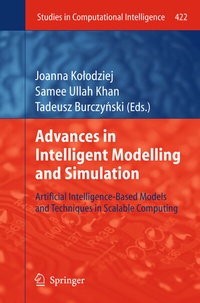
Advances in Intelligent Modelling and Simulation
Artificial Intelligence-Based Models and Techniques in Scalable Computing
Published on 11. July 2012
XXIV, 384 pages
978-3-642-30154-4 (ISBN)
Description

One of the most challenging issues in today's large-scale computational modeling and design is to effectively manage the complex distributed environments, such as computational clouds, grids, ad hoc, and P2P networks operating under various types of users with evolving relationships fraught with uncertainties. In this context, the IT resources and services usually belong to different owners (institutions, enterprises, or individuals) and are managed by different administrators. Moreover, uncertainties are presented to the system at hand in various forms of information that are incomplete, imprecise, fragmentary, or overloading, which hinders in the full and precise resolve of the evaluation criteria, subsequencing and selection, and the assignment scores. Intelligent scalable systems enable the flexible routing and charging, advanced user interactions and the aggregation and sharing of geographically-distributed resources in modern large-scale systems. This book presents new ideas, theories, models, technologies, system architectures and implementation of applications in intelligent scalable computing systems. In 15 chapters, several important Artificial Intelligence-based techniques, such as fuzzy logic, neural networks, evolutionary, and memetic algorithms are studied and implemented. All of those technologies have formed the foundation for the intelligent scalable computing that we know of today. We believe that this book will serve as a reference for students, researchers, and industry practitioners working or interested in joining interdisciplinary research in the areas of intelligent decision systems using emergentdistributed computing paradigms. It will also allow newcomers (students and researchers alike) to grasp key issues and potential solutions on the selected topics. This book presents new ideas, theories, models, technologies, system architectures and implementation of applications in intelligent scalable computing systems. In 15 chapters, several important Artificial Intelligence-based techniques, such as fuzzy logic, neural networks, evolutionary, and memetic algorithms are studied and implemented. All of those technologies have formed the foundation for the intelligent scalable computing that we know of today. We believe that this book will serve as a reference for students, researchers, and industry practitioners working or interested in joining interdisciplinary research in the areas of intelligent decision systems using emergent distributed computing paradigms. It will also allow newcomers (students and researchers alike) to grasp key issues and potential solutions on the selected topics.
More details
Other editions
Additional editions
Joanna Kolodziej | Samee Ullah Khan | Tadeusz Burczy´nski
Advances in Intelligent Modelling and Simulation
Artificial Intelligence-Based Models and Techniques in Scalable Computing
Book
07/2012
Springer
€106.99
Shipment within 7-9 days
Content
- Title Page
- Preface
- Contents
- List of Contributo
- Part I: Future Generation Fuzzy Systems
- Towards Designing Human Centric Systems: A New View at Fuzzy Modeling with Granular Membership Functions
- Introductory Notes
- Granular Representation of Membership Functions- A Design of Output Interfaces
- The Design of Input Interface-Construction of Logic-Consistent Granular Representations of Fuzzy Sets
- The Components of the Optimization Problem
- Decision-Making with a Granular Representation of Fuzzy Sets: AHP Modeling Revisited
- The AHP Method-A Brief Review
- A Quantification (Granulation) of Linguistic Terms as Their Operational Re
- The Optimization of the Granulation Problem
- Conclusions
- References
- Step Fuzzy Numbers and Neural Networks in Defuzzification Functional Approximation
- Introduction
- Ordered Fuzzy Numbers
- Defuzzification Functionals
- Step Numbers
- Approximation of Defuzzification Functionals
- Neural Network Simulations
- Nonlinear Defuzzification Functional
- Activation Functions
- Conclusion
- References
- Part II: Parallel and Multiobjective Evo-Based Techniques and Architectures in Large-Scale Global Optimization
- Parallel Approaches in MOACOs for Solving the Bi-criteria TSP: A Preliminary Study
- Introduction
- Preliminary Concepts
- Ant Colony Optimization
- Multi-Objective Optimization
- Parallel Approaches
- MOACOs to Study
- BIANT
- MOACS
- CHAC
- Experiments and Results
- Conclusions and Future Work
- References
- Island Injection Genetic Algorithm with Relaxed Coordination for the Multiple Sequence Alignment Problem
- Introduction
- Serial and Parallel Genetic Algorithms
- Parallel Genetic Algorithms
- Multiple Sequence Alignment
- Parallel Genetic Algorithms for MSA
- MSA Island Injection Algorithm with Relaxed Coordination
- General Overview
- High Resolution Archipelago
- Low Resolution Archipelago
- Basic Genetic Algorithm
- Experimental Results
- Results for 1ac5
- Results for ttkrsyedq
- Results for virul fac
- Overall Evaluation
- Comparison with the Strong Coordination Strategy
- Conclusion
- References
- Distributed Evolutionary Computation Using SOAP and REST Web Services
- Introduction
- SOAP: Simple Object Access Protocol
- REST: Representational State Transfer
- Parallel and Distributed EA Using Web Services
- Comparing SOAP and REST Programming Models
- Experimental Setup and Results
- Proof of Concept: Client-Server Efficienczy Comparison
- Master-Slave Based GA Implementation
- Master-Slave Based EA Implementation Using Web-Services
- Conclusions
- References
- GPU Parallel Computation in Bioinspired Algorithms: A Review
- Introduction
- Throughput, Parallelism and GPUs
- GPUs Programming
- Programming Model
- Execution Model
- Memory Model
- Bioinpired Methods on GPUs
- Master-Slave Approaches
- Fine-Grained Approaches
- Coarse-Grained Approaches (Island Model)
- Hybrid Approaches
- Artificial Neural Networks Implementations on GPUs
- Conclusions
- References
- Part III: Nature-Inspired Solutions for Intelligent Networking
- Scalability Analysis: Reconfiguration of Overlay Networks Using Nature-Inspired Algorithms
- Introduction
- Related Work
- Approaches
- Genetic Algorithm Implementation
- Artificial Immune System Implementation
- Particle Swarm Optimization Implementation
- Experiments and Resu
- Overall Comparison of Approaches
- Investigation of Network and Link Failures
- Scalability Analysis
- Conclusion
- References
- Analysis of Emergent Behavior for GA-based Topology Control Mechanism for Self-Spreading Nodes in MANETs
- Introduction
- Related Work
- Force-based Genetic Algorithm (FGA)
- Chromosomes in FGA
- Fitness Function for FGA
- Dynamical System Model of FGA
- Population Representation
- Heuristic Functions
- Selection
- Crossover
- Mutation
- Estimating FGA Behavior
- Markov Chain Model for FGA
- Homogeneous Finite Markov Chains
- Convergent Nature of Ergodic Homogeneous Finite Markov Chains
- Convergence of FGA Analytical Model
- Fitness Analysis for Stationary Distribution
- Conclusions and Future Work
- References
- Evolutionary P2P Networking for Realizing Adaptive Networks
- Introduction
- Evolutionary P2P Networking
- Network Composition
- Joining and Leaving Nodes
- Fitnesses Assigned by Nodes
- Representations of Network Topologies
- Evolutionary Operators
- Timing for Topology Generation
- Procedure and Parameters
- Simulations of EP2P
- Dynamic P2P Environmental Model
- Evaluation Scenarios
- Observations
- Results
- Using a Different Type of Network Topology
- Parallel Evolutionary P2P Networking
- Gathering Fitnesses by Super Nodes
- Evolutionary Operators
- Simulations of P-EP2P
- Simulation Model and Configurations
- Simulation Results
- Conclusion
- References
- A Taxonomy of Evolutionary Inspired Solutions for Energy Management in Green Computing: Problems and Resolution Methods
- Introduction
- Taxonomy of Energy Management in Future Generation Distributed Computing Systems
- Static Energy Management: Code Optimizers in Embedded Systems
- Evolutionary Inspired Dynamic Data and Resource Management in Green Computing
- Energy Efficient Data Transmission
- Energy-Aware Data Aggregation in Grids, Clouds and Wireless Sensor Networks
- Dynamic Voltage and Frequency Scaling in Energy-Aware Scheduling and Resource Allocation Problems
- Conclusions
- References
- A Simulation Model for Mechanisms, Heuristics and Rules for P2P Systems
- Introduction
- P2P Issues and Their Influence on the Simulation Model
- Performance Optimization in Large Scale P2P Systems
- Simulation Models and Tools for LSDS
- MONARC Simulation Engine
- MONARC Extensions with an Overlay for P2P Systems
- Simulation Experiments
- Conclusions
- References
- Part IV: Economic and Biological Approaches
- An Economics-Inspired Noise Model in Spatial Games with Reputation
- Introduction
- Complex Interactions
- Noisy Behavior
- Spatiality
- Indirect Reciprocity
- The Donation Game
- Implementation
- Psychic Noise: A Novel Approach
- Psychic Distance
- Definition of Psychic Noise
- Modelling Psychic
- Case Studies
- Noise-Free Spatial Interactions
- Noisy Spatial Interactions
- Conclusion
- References
- Intelligent Modeling and Control for Autonomous Logistics
- Introduction
- Multi-agent Control of Logistic Processes
- Knowledge Management in Autonomous Logistics
- Machine Learning in Autonomous Logistics
- Autonomous Control in Pickup and Delivery Operations
- Learning Predictive Models for Decision Support
- Optimization of Transport Schedules
- Future Challenges and Research Directions
- Integration of Multiple Knowledge Sources
- Knowledge Transfer in Heterogeneous MAS
- Conclusion
- References
- LINDSAY Virtual Human: Multi-scale, Agent-based, and Interactive
- Motivation
- Starting with Virtual Anatomy
- Bringing Virtual Physiology to Life
- Related Work
- Replicating Human Anatomy and Physiology
- Virtual Human Anatomy and Physiology
- Components as Dynamic Building Blocks
- The LINDSAY Virtual Human
- LINDSAY Presenter
- Anatomy Atlas
- Interactivity
- Creating 3D Slides
- Volumetric Data Integration
- LINDSAY Composer
- The Computational Framework
- Agent-based Modelling
- Component Architecture
- Graphical Programming Interface
- The Educational Perspective
- Current and Future Work
- Conclusions
- References
- Comparison of Enterprise Integration Modelling Concepts Based on Intelligent Multi-Agent System
- Introduction
- Cimosa and VLProGraph Architectures
- Cimosa
- Multi-agent Approaches to Production Planning and Scheduling
- Movable Resources
- Implementation
- Numerical Experiment
- GRAI METHODOLOGY and GRAIMOD
- GRAI Methodology
- GRAIMOD
- Combining CBR and Multi-Agents Systems for Developing GRAIMOD
- Comparing VLProGraph for CIMOSA and GRAIMOD for GRAI
- Perspectives - Conclusion
- References
- Author Index
