

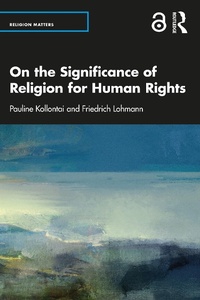
On the Significance of Religion for Human Rights
Published on 14. March 2023
126 pages
978-1-000-88595-8 (ISBN)
Description

This progressive volume furthers the inter-religious, international, and interdisciplinary understanding of the role of religion in the area of human rights.
Building bridges between the often-separated spheres of academics, policymakers, and practitioners, it draws on the expertise of its authors alongside historical and contemporary examples of how religion's role in human rights manifests. At the core of the book are four case studies, dealing with Hinduism, Judaism, Christianity, and Islam. Authors from each religion show the positive potential that their faith and its respective traditions has for the promotion of human rights, while also addressing why and how it stands in the way of fulfilling this potential.
Addressed to policymakers, academics, and practitioners worldwide, this engaging and accessible volume provides pragmatic studies on how religious and secular actors can cooperate and contribute to policies that improve global human rights.
Building bridges between the often-separated spheres of academics, policymakers, and practitioners, it draws on the expertise of its authors alongside historical and contemporary examples of how religion's role in human rights manifests. At the core of the book are four case studies, dealing with Hinduism, Judaism, Christianity, and Islam. Authors from each religion show the positive potential that their faith and its respective traditions has for the promotion of human rights, while also addressing why and how it stands in the way of fulfilling this potential.
Addressed to policymakers, academics, and practitioners worldwide, this engaging and accessible volume provides pragmatic studies on how religious and secular actors can cooperate and contribute to policies that improve global human rights.
More details
Series
Language
English
Place of publication
London
United Kingdom
Publishing group
Taylor & Francis Ltd
Target group
College/higher education
Product notice
Reflowable
File size
0,56 MB
ISBN-13
978-1-000-88595-8 (9781000885958)
Copyright in bibliographic data and cover images is held by Nielsen Book Services Limited or by the publishers or by their respective licensors: all rights reserved.
Schweitzer Classification
Other editions
Additional editions
Pauline Kollontai | Friedrich Lohmann
On the Significance of Religion for Human Rights
Book
03/2023
1st Edition
Routledge
€125.10
Shipment within 10-20 days
Pauline Kollontai | Friedrich Lohmann
On the Significance of Religion for Human Rights
Book
03/2023
1st Edition
Routledge
€30.10
Shipment within 10-20 days
Persons
Pauline Kollontai is Professor Emerita in the Department of Religion, Politics and International Relations at York St John University, UK.
Friedrich Lohmann is Professor of Protestant Theology and Applied Ethics at the Bundeswehr University Munich, Germany.
Friedrich Lohmann is Professor of Protestant Theology and Applied Ethics at the Bundeswehr University Munich, Germany.
Content
Part I: Summary 1. Summary of Recommendations for Secular and Religious Actors Pauline Kollontai and Friedrich Lohmann Part II: Why Religion Matters 2. Introduction Friedrich Lohmann and Pauline Kollontai Part III: Religion and Human Rights: Problems 3.1 Orientation: How and Why Religion Resists the Idea of Human Rights Friedrich Lohmann and Pauline Kollontai 3.2 Hindu Perspective: Human Rights of Women and the Notion of 'Pollution' in Hinduism Hari Priya Pathak 3.3 Jewish Perspective: Jewish Exclusionist Theology in Israel Pauline Kollontai 3.4 Christian Perspective: The Appeal to Traditional Values as an Argument Against Human Rights Friedrich Lohmann 3.5 Islamic and Iranian Perspectives on Human Rights: Problems Katajun Amirpur and Ingrid Overbeck Part IV: Religion and Human Rights: Potentials 4.1 Orientation: How Religion Can Contribute to Human Rights Pauline Kollontai and Friedrich Lohmann 4.2 Hindu Perspective: Women and Democratic Ideals in Hinduism: A Case Study of Women's Entrance to Sabarimala Temple Hari Priya Pathak 4.3 Jewish Perspective: Challenging Jewish Religious Exclusionist Praxis Pauline Kollontai 4.4 Christian Perspective: Jesus Christ the Liberator Friedrich Lohmann 4.5 Islamic and Iranian Perspectives on Human Rights: Potentials Katajun Amirpur and Ingrid Overbeck Part V: Now What? Implications and Recommendations 5. Now What? Recommendations for Building Cooperation Between Secular and Religious Actors Pauline Kollontai and Friedrich Lohmann. Index
