

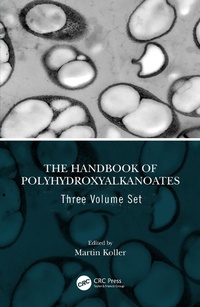
The Handbook of Polyhydroxyalkanoates, Three Volume Set
1st Edition
Published on 5. November 2020
1416 pages
978-1-000-17359-8 (ISBN)
Description

The Handbook of Polyhydroxyalkanoates (PHA) focusses on and addresses varying facets of PHA biosynthesis and processing, spread across three volumes. The first volume discusses feedstock aspects, enzymology, metabolism and genetic engineering of PHA biosynthesis. It addresses better understanding the mechanisms of PHA biosynthesis in scientific terms and profiting from this understanding in order to enhance PHA biosynthesis in bio-technological terms and in terms of PHA microstructure. It further discusses making PHA competitive for outperforming established petrol-based plastics on industrial scale and obstacles for market penetration of PHA.
This second volume focusses on thermodynamic and mathematical considerations of PHA biosynthesis, bioengineering aspects regarding bioreactor design and downstream processing for PHA recovery from microbial biomass. It covers microbial mixed culture processes and includes a strong industry-focused section with chapters on the economics of PHA production, industrial-scale PHA production from sucrose, next generation industrial biotechnology approaches for PHA production based on novel robust production strains, and holistic techno-economic and sustainability considerations on PHA manufacturing.
Third volume is on the production of functionalized PHA bio-polyesters, the post-synthetic modification of PHA, processing and additive manufacturing of PHA, development and properties of PHA-based (bio)composites and blends, the market potential of PHA and follow-up materials, different bulk- and niche applications of PHA, and the fate and use of spent PHA items. Divided into fourteen chapters, it describes functionalized PHA and PHA modification, processing and their application including degradation of spent PHA-based products and fate of these bio-polyesters during compositing and other disposal strategies.
Aimed at professionals and graduate students in Polymer (plastic) industry, wastewater treatment plants, food industry, biodiesel industry, this set:
Presents comprehensive and holistic consideration of these microbial bioplastics in the volumes.
Enables reader to learn about microbiological, enzymatic, genetic, synthetic biology, and metabolic aspects of PHA biosynthesis based on the latest scientific discoveries.
Discusses design and operate a PHA production plant.
Strong focus on post-synthetic modification, preparation of functional PHA and follow-up products, and PHA processing.
Covers all related engineering considerations
This second volume focusses on thermodynamic and mathematical considerations of PHA biosynthesis, bioengineering aspects regarding bioreactor design and downstream processing for PHA recovery from microbial biomass. It covers microbial mixed culture processes and includes a strong industry-focused section with chapters on the economics of PHA production, industrial-scale PHA production from sucrose, next generation industrial biotechnology approaches for PHA production based on novel robust production strains, and holistic techno-economic and sustainability considerations on PHA manufacturing.
Third volume is on the production of functionalized PHA bio-polyesters, the post-synthetic modification of PHA, processing and additive manufacturing of PHA, development and properties of PHA-based (bio)composites and blends, the market potential of PHA and follow-up materials, different bulk- and niche applications of PHA, and the fate and use of spent PHA items. Divided into fourteen chapters, it describes functionalized PHA and PHA modification, processing and their application including degradation of spent PHA-based products and fate of these bio-polyesters during compositing and other disposal strategies.
Aimed at professionals and graduate students in Polymer (plastic) industry, wastewater treatment plants, food industry, biodiesel industry, this set:
Presents comprehensive and holistic consideration of these microbial bioplastics in the volumes.
Enables reader to learn about microbiological, enzymatic, genetic, synthetic biology, and metabolic aspects of PHA biosynthesis based on the latest scientific discoveries.
Discusses design and operate a PHA production plant.
Strong focus on post-synthetic modification, preparation of functional PHA and follow-up products, and PHA processing.
Covers all related engineering considerations
More details
Edition
1. Auflage
Language
English
Place of publication
London
United Kingdom
Publishing group
Taylor & Francis Ltd
Illustrations
108 Tables, black and white; 231 Illustrations, black and white
ISBN-13
978-1-000-17359-8 (9781000173598)
Copyright in bibliographic data and cover images is held by Nielsen Book Services Limited or by the publishers or by their respective licensors: all rights reserved.
Schweitzer Classification
Other editions
Additional editions
Martin Koller
The Handbook of Polyhydroxyalkanoates, Three Volume Set
Book
04/2025
1st Edition
CRC Press
€216.65
Shipment within 15-20 days
Martin Koller
The Handbook of Polyhydroxyalkanoates, Three Volume Set
Book
11/2020
1st Edition
CRC Press
€618.99
Shipment within 15-20 days
Person
Martin Koller was awarded his PhD degree by Graz University of Technology, Austria, for his thesis on polyhydroxyalkanoate (PHA) production from dairy surplus streams which was enabled by the EU-project WHEYPOL ("Dairy industry waste as source for sustainable polymeric material production"), supervised by Gerhart Braunegg, one of the most eminent PHA pioneers. As senior researcher, he worked on bio-mediated PHA production, encompassing development of continuous and discontinuous fermentation processes, and novel downstream processing techniques for sustainable PHA recovery. His research focused on cost-efficient PHA production from surplus materials by bacteria and haloarchaea and, to a minor extent, to the development for PHA for biomedical use.
He currently holds more than 70 Web-of-science listed articles in high ranked scientific journals (h-index 23), authored twelve chapters in scientific books, edited three scientific books and four journal special issues on PHA, gave plenty of invited and plenary lectures at scientific conferences, and supports the editorial teams of several distinguished journals.
Moreover, Martin Koller coordinated the EU-FP7 project ANIMPOL ("Biotechnological conversion of carbon containing wastes for eco-efficient production of high added value products"), which, in close cooperation between academia and industry, investigated the conversion of animal processing industry?s waste streams towards structurally diversified PHA and follow-up products. In addition to PHA exploration, he was also active in microalgal research and in biotechnological production of various marketable compounds from renewables by yeasts, chlorophyte, bacteria, archaea, fungi or lactobacilli.
At the moment, Martin Koller is active as research manager and external supervisor for PHA-related projects.
He currently holds more than 70 Web-of-science listed articles in high ranked scientific journals (h-index 23), authored twelve chapters in scientific books, edited three scientific books and four journal special issues on PHA, gave plenty of invited and plenary lectures at scientific conferences, and supports the editorial teams of several distinguished journals.
Moreover, Martin Koller coordinated the EU-FP7 project ANIMPOL ("Biotechnological conversion of carbon containing wastes for eco-efficient production of high added value products"), which, in close cooperation between academia and industry, investigated the conversion of animal processing industry?s waste streams towards structurally diversified PHA and follow-up products. In addition to PHA exploration, he was also active in microalgal research and in biotechnological production of various marketable compounds from renewables by yeasts, chlorophyte, bacteria, archaea, fungi or lactobacilli.
At the moment, Martin Koller is active as research manager and external supervisor for PHA-related projects.
Content
1. Monomer-Supplying Enzymes for Polyhydroxyalkanoate Biosynthesis. 2. PHA Granule-Associated Proteins and their Diverse Functions. 3. Genomics of PHA Synthesizing Bacteria. 4. Molecular Basis of Medium-Chain Length-PHA Metabolism of Pseudomonas putida. 5. Production of Polyhydroxyalkanoates by Paraburkholderia and Burkholderia species: A Journey from the Genes through Metabolic Routes to their Biotechnological Applications. 6. Genetic Engineering as a Tool for Enhanced PHA Biosynthesis from Inexpensive Substrates. 7. Biosynthesis and Sequence Control of scl-PHA and mcl-PHA. 8. Inexpensive and Waste Raw Materials for PHA Production. 9. Sustainable Production of Polyhydroxyalkanoates from Crude Glycerol. 10. Biosynthesis of Polyhydroxyalkanoates (PHA) from Vegetable Oils and its By-products by Wild-Type and Recombinant Microbes. 11. Production and Modification of PHA Polymers Produced from Long-Chain Fatty Acid. 12. Converting Petrochemical Plastic to Biodegradable Plastic. 13. Comparing Heterotrophic with Phototrophic PHA Production - Concurring or Complementing Strategies?. 14. Coupling Biogas (CH4) with PHA Biosynthesis. 15. Syngas as a Sustainable Carbon Source for PHA Production. 1. An Introduction to the Thermodynamics Calculation of PHA Production in Microbes 2. Mathematical Modelling for Advanced PHA Biosynthesis. 3. Interconnection between PHA and Stress Robustness of Bacteria. 4. Linking Salinity to Microbial Biopolyesters Biosynthesis: Polyhydroxyalkanoate Production by Haloarchaea and Halophilic Eubacteria. 5. Role of Different Bioreactor Types and Feeding Regimes in Polyhydroxyalkanoates Production. 6. Recovery of Polyhydroxyalkanoates from Microbial Biomass. 7. Polyhydroxyalkanoates by Mixed Microbial Cultures: The Journey so Far and Challenges Ahead. 8. PHA Production by Microbial Mixed Cultures and Organic Waste of Urban Origin: Pilot Scale Evidences. 9. Production Quality Control of Mixed Culture Poly(3-Hydroxbutyrate-co-3-Hydroxyvalerate) Blends Using Full-Scale Municipal Activated Sludge and Non-Chlorinated Solvent Extraction. 10. Economics and Industrial Aspects of PHA Production. 11. Next Generation Industrial Biotechnology (NGIB) for PHA Production. 12. PHA Biosynthesis Starting from Sucrose and Materials from Sugar Industry. 13. LCA, Sustainability and Techno-economic Studies for PHA Production. 1. Recent Advances in Chemically Modifiable Polyhydroxyalkanoates. 2. The Design of Functionalized PHA-Based Polymeric Materials by Chemical Modifications. 3. Amphiphiles from Poly(3-hydroxyalkanoates). 4. Bioactive and Functional Oligomers derived from Natural PHA and their Synthetic Analogues. 5. Processing and Thermomechanical Properties of PHA. 6. Additive Manufacturing of PHA. 7. Mechanical and Permeation Properties of PHA-Based Blends and Composites. 8. Competitive Advantage and Market Introduction of PHA Polymers and Potential Use of PHA Monomers. 9. Linking the Properties of Polyhydroxyalkanoates (PHA) to Current and Prospective Applications. 10. Hydrogen-Oxydizing Producers of Polyhydroxyalkanoates: Synthesis, Properties, and Applications. 11. Polyhydroxyalkanoates, their Processing and Biomedical Applications. 12. Polyhydroxyalkanoates (PHA) Based Materials in Food Packaging Applications. State of the Art and Future Perspectives. 13. Aerobic and Anaerobic Degradation Pathways of PHA. 14. Factors Controlling Lifetimes of Polyhydroxyalkanoates and their Composites in the Natural Environment.
