

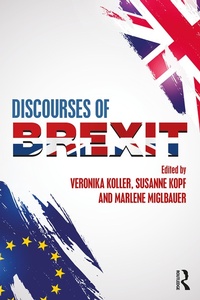
Discourses of Brexit
1st Edition
Published on 12. February 2019
268 pages
978-1-351-04185-0 (ISBN)
Description

Discourses of Brexit provides a kaleidoscope of insights into how discourse influenced the outcome of the EU referendum and what discourses have sprung up as a result of it. Working with a wide variety of data, from political speeches to Twitter, and a wide range of methods, Discourses of Brexit presents the most thorough examination of the discourses around the British EU referendum and related events. It provides a comprehensive understanding of the discursive treatment of Brexit, while also providing detailed investigations of how Brexit has been negotiated in different contexts. Discourses of Brexit is key reading for all students and researchers in language and politics, discourse analysis and related areas, as well as anyone interested in developing their understanding of the referendum.
Reviews / Votes
"This publication makes a timely contribution to the fields of both social sciences and, in particular, to discourse analysis ... It will, in fact, appeal to researchers, students and a broader audience that is interested in populism or Brexit but also discourse and the way it shapes identity and opinion. It is well written with clearly presented thought-provoking research that is a credit to its contributors and editors alike."Sharon Hartle, Iperstoria, Issue 15 - Spring/Summer 2020
"Addressing a wide range of data and methods, Discourses of Brexit decodes the political, social and discursive strategies that shaped the 'No' vote on the British EU referendum ... a valuable contribution to both political science and discourse studies."
Salomi Boukala, Panteion University of Social and Political Sciences, Greece
"We have been told that 'Brexit means Brexit'. This book finds that it means rather more than that. Contributors explore the many things Brexit has been made to mean across genres and media. [...] It will be of interest and use to political scientists, media scholars and many others concerned with the future of political debate in Britain."
Alan Finlayson, University of East Anglia, UK
"Do we really need to talk about how we talk about Brexit? We do, and the present volume shows why. It is tightly organized, chapters meticulously cross-referenced, and, for an edited volume, remarkably coherent in style. In these qualities it even surpasses Steve Buckledee's monograph, The Language of Brexit, the research area's trailblazer."
Christophe Fricker, SAGE Journal of European Studies 49(3-4) 1-24
More details
Edition
1. Auflage
Language
English
Place of publication
London
United Kingdom
Publishing group
Taylor & Francis Ltd
Target group
College/higher education
Illustrations
10 Line drawings, black and white; 5 Halftones, black and white; 15 Illustrations, black and white
File size
3,92 MB
ISBN-13
978-1-351-04185-0 (9781351041850)
Copyright in bibliographic data and cover images is held by Nielsen Book Services Limited or by the publishers or by their respective licensors: all rights reserved.
Schweitzer Classification
Other editions
Additional editions

Veronika Koller | Susanne Kopf | Marlene Miglbauer
Discourses of Brexit
Book
03/2019
1st Edition
Routledge
€63.50
Shipment within 10-20 days

Veronika Koller | Susanne Kopf | Marlene Miglbauer
Discourses of Brexit
Book
03/2019
1st Edition
Routledge
€212.60
Shipment within 10-20 days
Persons
Veronika Koller is Reader in Discourse Studies at Lancaster University, UK.
Susanne Kopf is a Research and Teaching Assistant at WU Vienna University of Economics and Business, Austria.
Marlene Miglbauer is Senior Lecturer in English Language, Linguistics and E-Learning at the University of Teacher Education Burgenland, Austria.
Susanne Kopf is a Research and Teaching Assistant at WU Vienna University of Economics and Business, Austria.
Marlene Miglbauer is Senior Lecturer in English Language, Linguistics and E-Learning at the University of Teacher Education Burgenland, Austria.
Content
1. Introduction: context, history and previous research
Veronika Koller, Susanne Kopf, Marlene Miglbauer
Part I: Discursive drivers of the Brexit vote
2. Values as tools of legitimation in EU and UK Brexit discourses
Samuel Bennett
3. 'This is about the kind of Britain we are': national identities as constructed in parliamentary debates about EU membership
Nora Wenzl
4. Ambient affiliation and #Brexit: negotiating values about experts through censure and ridicule
Michele Zappavigna
5. 'Britain is full to bursting point!': immigration themes in the Brexit discourse of the UK Independence Party
Piotr Cap
6. 'The British people have spoken': voter motivations and identities in vox pops on the British EU referendum
Marlene Miglbauer and Veronika Koller
7. 'Friends don't let friends go Brexiting without a mandate': changing discourses of Brexit in The Guardian
Ursula Lutzky and Andrew Kehoe
Part II: Discursive consequences of the Brexit vote
8. 'The referendum result delivered a clear message': Jeremy Corbyn's populist discourse
Massimiliano Demata
9. The official vision for 'global Britain': Brexit as rupture and continuity between free trade, liberal internationalism and 'values'
Franco Zappettini
10 'Get your shyte together Britain': Wikipedians' treatment of Brexit
Susanne Kopf
11. Citizens' reactions to Brexit on Twitter: a content and discourse analysis
Catherine Bouko and David Garcia
12. Brexit and blame avoidance: officeholders' discursive strategies of self-preservation
Sten Hansson
13. Brexit as 'having your cake and eating it': the discourse career of a proverb
Andreas Musolff
14. 'Don't go brexin' my heart': the ludic aspects of Brexit-induced neologisms
Gordana Lalic-Krstin and Nadezda Silaski
15. Brexit and discourse studies: reflections and outlook
Gerlinde Mautner
Veronika Koller, Susanne Kopf, Marlene Miglbauer
Part I: Discursive drivers of the Brexit vote
2. Values as tools of legitimation in EU and UK Brexit discourses
Samuel Bennett
3. 'This is about the kind of Britain we are': national identities as constructed in parliamentary debates about EU membership
Nora Wenzl
4. Ambient affiliation and #Brexit: negotiating values about experts through censure and ridicule
Michele Zappavigna
5. 'Britain is full to bursting point!': immigration themes in the Brexit discourse of the UK Independence Party
Piotr Cap
6. 'The British people have spoken': voter motivations and identities in vox pops on the British EU referendum
Marlene Miglbauer and Veronika Koller
7. 'Friends don't let friends go Brexiting without a mandate': changing discourses of Brexit in The Guardian
Ursula Lutzky and Andrew Kehoe
Part II: Discursive consequences of the Brexit vote
8. 'The referendum result delivered a clear message': Jeremy Corbyn's populist discourse
Massimiliano Demata
9. The official vision for 'global Britain': Brexit as rupture and continuity between free trade, liberal internationalism and 'values'
Franco Zappettini
10 'Get your shyte together Britain': Wikipedians' treatment of Brexit
Susanne Kopf
11. Citizens' reactions to Brexit on Twitter: a content and discourse analysis
Catherine Bouko and David Garcia
12. Brexit and blame avoidance: officeholders' discursive strategies of self-preservation
Sten Hansson
13. Brexit as 'having your cake and eating it': the discourse career of a proverb
Andreas Musolff
14. 'Don't go brexin' my heart': the ludic aspects of Brexit-induced neologisms
Gordana Lalic-Krstin and Nadezda Silaski
15. Brexit and discourse studies: reflections and outlook
Gerlinde Mautner
