

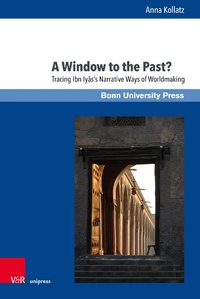
A Window to the Past?
Tracing Ibn Iyas's Narrative Ways of Worldmaking
1st Edition
Published on 11. July 2022
314 pages
978-3-8470-1448-5 (ISBN)
Description

The only Arabic voice to have witnessed the Ottoman conquest of Cairo, Ibn Iy?s, is an eminent historical source for the late Mamluk period. This book is the first to take stock of the author's complete works, approaching him through an examination of his narrative voice and writing strategies. Tracing Ibn Iy?s's working process by compilation analysis, it shows how the author adapted his representations of Egyptian history to his writing projects and audience. Ibn Iy?s's ways of worldmaking are shaped deeply by beliefs, biases and intellectual trends as well as the impact of the social and historical context the author wrote in. Knowing these conditioning factors allows to understand his presentation of history as an individual voice of his time.
Dr Anna Kollatz is a Research Associate and Lecturer at the Department for Middle Eastern History and Islamic Studies, University of Bonn, who focuses on Islam in the Mediterranean and in South Asia.
Dr Anna Kollatz is a Research Associate and Lecturer at the Department for Middle Eastern History and Islamic Studies, University of Bonn, who focuses on Islam in the Mediterranean and in South Asia.
More details
Other editions
Additional editions
Book
07/2022
1st Edition
Brill Deutschland
€59.00
Shipment within 7-9 days
Person
Dr Anna Kollatz is professor for Islamic Studies (Arabic), University of Heidelberg, who focuses on Islam in the Mediterranean and in South Asia.
Content
- Intro
- Title Page
- Copyright
- Table of Contents
- Body
- Acknowledgments
- Notes on Transliteration and Dates
- I Introduction
- II Stricken with Decline?
- Economy, Environment and Rule
- Changes in the Social Architecture of the Society: Mamluk Descendants (awlad al-nas)
- III Ibn Iyas Through His Own Lenses
- Is There a Self-Representative Approach in Ibn Iyas's Writings? Approaching Bada?i? al-zuhur and ?Uqud al-juman
- Ibn Iyas on his Family
- Ibn Iyas on Ibn Iyas
- Ibn Iyas on his Teachers and Friends
- Ibn Iyas's Intellectual Background: His Archive Reconstructed through Citations
- Intellectual Changes-New Recipients?
- IV Why and to Whom Does Ibn Iyas Write? Comparing Prefaces
- Analysis in Chronological Order
- Nuzhat al-umam
- Bada?i? ba?d al-khalq
- Marj al-zuhur
- Nashq al-a?har
- Bada?i? al-zuhur
- Poems as Frames
- Conclusion to Chapter IV
- V Beyond Bada?i? al-zuhur
- Structuring Ibn Iyas's Oeuvre
- Tentative Chronology
- Questioning Genre
- Inventory of Texts and Manuscripts
- Main Source Base of the Study
- Further Texts and Manuscripts
- VI A Litterateur at Work: First Contacts between Egypt and Muslim Domination
- The Choice of Sample
- The 'Treasure Anecdote'
- Macro-Structure: The Outer Structure of the Texts
- The First Hypotext: Ibn ?Abd al-?akam, Futu? Mi?r wa akhbariha
- A Second Hypotext: Al-Maqrizi's (766-845/1364-1442) Khi?a?
- The Hypertexts
- Meso-Structure: Building a Narrative
- Micro-Structure: Figurating Meaning
- Constructing Figures: Muslims and Copts
- Nuzhat al-umam
- Jawahir al-suluk
- Bada?i? al-zuhur
- Conclusion to Chapter VI
- Appendix to Chapter VI: The Anecdote on Maria the Copt as narrated in Nuzhat al-umam
- VII Narrating Mamluk Transitions of Rule
- The Narrative and the Narrated Put in Order: Sequentiality in the First Sample
- The Major Step to Bada?i? al-zuhur
- Travelling Plots, Changing Characteristics and the Magic of Addition
- Ceremonialized Narration as a Way of Representing Order (Even out of Chaos)
- Transition Narratives: The First Four Mamluk Sultans
- Transition Narratives: Al-Na?ir Mu?ammad's Three Reigns
- Conclusion to Chapter VII: Ibn Iyas's 'Imaginary Norm' of Stable Rule Narrated
- VIII The Ottoman Conquest Narrated
- The Discourse: Temporal and Spatial Organization of the Narrative
- Temporal Dimensions and Frequency
- Spatial Dimensions
- Acting Figures and Groups: Mamluks vs. Ottomans
- The Moment of Transition Narrated
- Ottoman Characterization
- Conclusion to Chapter VIII
- IX Concluding Remarks and Research Prospects
- Bibliography
- Index of Names
- Index of Subjects
