

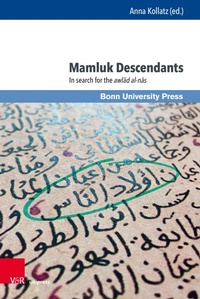
Mamluk Descendants
In search for the awlad al-nas
1st Edition
Published on 8. August 2022
612 pages
978-3-8470-1458-4 (ISBN)
Description

Research on the Mamluk period has so far remained relatively silent about the Mamluk descendants, who are often referred to by the Arabic term awl?d al-n?s (roughly: children of the elite). After Ulrich Haarmann's fundamental theses, research on this group seems to have paused, in comparison to the study dedicated to other social groups of Mamluk society. This volume brings together the results of an international conference and presents the state of the art in approaching the Mamluk descendants, whose emic perception as a group and social roles were far more differentiated and variable than previously assumed. The contributions shed light on the status of the Mamluk descendants from a variety of viewpoints, including historiographies, archival material, and artifacts produced by Mamluk descendants.
Dr Anna Kollatz is a Research Associate and Lecturer at the Department for Middle Eastern History and Islamic Studies, University of Bonn, who focuses on Islam in the Mediterranean and in South Asia.
Dr Anna Kollatz is a Research Associate and Lecturer at the Department for Middle Eastern History and Islamic Studies, University of Bonn, who focuses on Islam in the Mediterranean and in South Asia.
More details
Other editions
Additional editions
Book
08/2022
1st Edition
Brill Deutschland
€79.00
Shipment within 7-9 days
Person
Dr Anna Kollatz is a Research Associate and Lecturer at the Department for Middle Eastern History and Islamic Studies, University of Bonn, who focuses on Islam in the Mediterranean and in South Asia.
Content
- Intro
- Title Page
- Copyright
- Table of Contents
- Body
- Anna Kollatz: Introduction: On to New Horizons-Tackling the Mamluks' Descendants
- Bibliography
- Studies
- Part I
- Jo Van Steenbergen: Where are the Awla¯d al-Na¯s? Arabic Historiography, Mamlukization, and the Semantics and Discursive Politics of a Polysemous Concept
- 1 Introduction
- 2 The semantics of a polysemous concept: between mamluk and non-mamluk meanings
- 3 The history of a polysemous concept: from non-mamluk to mamlukizing frequencies of awlad al-nas occurrences
- 3.1 7th-9th/13th-15th century awlad al-nas occurrences: silence, ambiguity and mamlukization
- 3.2 Awlad al-nas mamlukization in the chronicles of Ibn Taghribirdi and al-Jawhari
- 3.3 10th/16th century occurrences: the awlad al-nas specialty of Ibn Iyas' Bada?i?
- 4 The politics of a polysemous concept: discursive strategies and awlad al-nas occurrences
- 4.1 An 8th/14th century Syrian discourse of (im)?morality
- 4.2 A 9th/15th century Egyptian discourse of good rulership
- 4.3 A 10th/16th century Egyptian discourse of (in)?justice
- 5 Concluding observations: fluidity, transformations, and mamlukization in past and present
- Bibliography
- Sources
- Studies
- Stephan Conermann: Mamluk Descendants in Military Service: The ?alqa
- 1 Military Service
- 1.1 Emergence
- 1.2 From the Ayyubid to the Mamluk period
- 1.3 A case study: ?Abdallah b. Aybak al-Dawadari
- 1.4 The land reforms under ?usam al-Din al-Man?ur Lajin (al-rawk al-?usami) and al-Malik al-Na?ir Mu?ammad (al-rawk al-Na?iri)
- 1.5 The ?alqa from the death of al-Malik al-Na?ir Mu?ammad 1341 to the second half of the 15th century
- 1.6 The end of the army unit
- 2 Conclusion: The (male) descendants of the Mamluks as a group
- Bibliography
- Sources
- Studies
- Mustafa Banister: "Sul?an Awlad al-Nas" or "Amir ibn Mamluk"? Re-framing Khalil ibn Shahin's Zubdat Kashf al-Mamalik wa-Bayan al-?uruq wa-l-Masalik
- 1 The author and his context
- 2 Text: Zubdat Kashf
- 3 Exploring truth claims in the Zubdat kashf
- 3.1 Claiming authority through geography
- 3.2 Time: Al-Ashraf Barsbay's reign as a 'golden age'
- 3.3 Changing numbers: personnel and revenues
- 3.4 Self-representation: descent from the elites
- 4 Conclusion
- Bibliography
- Sources
- Studies
- Noha Abou-Khatwa: The Mu?sini Brothers: A Case Study in the Contribution of Mamluks' Descendants to Cairo's Material Culture in the Fourteenth Century
- 1 Na?ir al-Din Mu?ammad ibn Badr al-Din Baylik al-Mu?sini
- 2 Mu?ammad's association with Sultan ?asan
- 3 Shihab al-Din A?mad ibn Badr al-Din Baylik al-Mu?sini
- 4 Conclusion
- Bibliography
- Sources
- Studies
- Daisuke Igarashi: 'Who should benefit from my Waqf?' Mamluks' Views on Progeny, Lineage, and Family based on their Waqf Stipulations
- 1 Introduction: Waqf as a tool for wealth transmission
- 2 Beneficiary stipulations for Mamluk descendants
- 3 Role of sex and lineage
- 4 Mamluk descendants outside the founders' lineage
- 5 Conclusion
- Appendix: The Kha??bak Family
- Acknowledgements
- Bibliography
- Sources
- Studies
- Takao Ito: Awlad al-Nas during and after the Reign of al-Na?ir ?asan
- 1 Introduction
- 2 The rule of al-Na?ir ?asan
- 3 Amirs of one hundred and Syrian governors
- 4 Descendants of al-Na?ir ?asan
- 4.1. Al-Na?ir ?asan's children
- 4.2. Properties of al-Na?ir ?asan's descendants
- 4.3. After their expulsion from the citadel
- 5 Conclusion
- Bibliography
- Sources
- Studies
- Yehoshua Frenkel: Awlad al-Nas in Mamluk Jerusalem: An Inquiry into several ?aram documents
- 1 Introduction
- 2 The state of the art
- 3 Ajnad al-?alqa
- 4 Awlad al-nas
- 5 Conclusion
- Bibliography
- Sources
- Studies
- Part II
- Koby Yosef: The Rise of Mamluks' Descendants in the Turkish Period (648-?784/?1250-?1382): The Status and Identity of Mamluks' Descendants who were Amirs in Cairo according to the Jarida Iq?a?iyya of the Year 778/1377
- 1 Introduction
- 2 Estimation of the share of mamluks' descendants who were iq?a? holders in Egypt's total tax yield in 778/1377 and the relevant categories of land holders in the jarida iq?a?iyya
- 2.1 The general category of "muq?a?un" in the Tu?fa
- 2.2 The categories of "muq?a?un" and "amirs"
- 2.3 The categories of "muq?a?un" and "?urban"
- 2.4 The categories of "muq?a?un", "al-?alqa", "al-mamalik al-sul?aniyya", and "al-diwan al-sul?ani"
- 2.5 Royal mamluks and their remuneration (iq?a?s, salaries, and rations): "al-mamalik al-sul?aniyya" and "al-diwan al-sul?ani"
- 2.5.1 The category of "al-mamalik al-sul?aniyya": Kha??akiyya receiving iq?a?s
- 2.5.2 The category of "al-diwan al-sul?ani": Simple mamluks receiving salaries and rations
- 2.6 The category of "muq?a?un": Members of the ?alqa
- 3 Mamluks' descendants as amirs
- 4 The reigns of al-?ahir Baybars and al-Man?ur Qalawun (658-689/1260-1290)
- 5 The "Man?uriyya period": Between the death of al-Man?ur Qalawun and al-Na?ir Mu?ammad's third reign (689-709/1290-1310)
- 6 Al-Na?ir Mu?ammad's third reign (709-741/1310-1341)
- 7 741-784/1341-1382: Mamluks' descendants who were amirs in the jarida iq?a?iyya of 778/1377
- 7.1 The Date of the jarida iq?a?iyya
- 7.2 Iq?a? holders mentioned by name in the Tu?fa and the amirs of Cairo in 778/1377
- 7.3 A decline in the number of amirs in Cairo
- 7.4 Reconstructing a list of amirs in Cairo in 778/1377 from the Tu?fa (MS. Hunt 2)
- 7.5 Muqaddam alfs in Cairo in 778/1377
- 7.6 Amirs of ?ablkhana in Cairo in 778/1377
- 7.7 Amirs of ten in Cairo in 778/1377
- 7.8 The amirs of Cairo in 778/1377-Groups and shares
- 7.9 The identity of the mamluks' descendants who were amirs in Cairo in 778/1377
- 8 Conclusion
- Appendix I: The amirs of Cairo in 778/1377-iq?a? holders mentioned by name in the jarida iq?a?iyya of 778/1377 (not including asyad) and their tax yield
- 1 Muqaddam alfs
- 1.1 Mamluks
- 1.2 Free persons (who are not mamluks' descendants)
- 2 Amirs of ?ablkhana
- 2.1 Mamluks
- 2.2 Eunuchs
- 2.3 Mamluks' descendants
- 2.4 Free persons (who are not mamluks' descendants)
- 2.5 Free persons-Provinces of Egypt (obviously, not counted in calculations of ?ibras of amirs in Cairo):
- 3 Amirs of ten
- 3.1 Mamluks
- 3.2 Mamluks' descendants
- 3.3 Free persons (who are apparently not mamluks' descendants)
- 4 Additional iq?a?s (not counted in calculations of ?ibras of amirs in Cairo)
- Appendix II: Categories of land and beneficiaries-The Tax yield of Egypt's land in 778/1377
- A. Date and beneficiary (or category of land) mentioned-Total: 9,503,014 DJ + 20,300 feddans X 2.64 DJ 9,556,606 DJ~
- B. Beneficiary not mentioned (at all, or in 778/1377)-Total: 213,060 DJ + 1,617 feddans X 2.64 DJ 217,329 DJ~
- C. Beneficiary (or category of land) mentioned, but the relevant date is not mentioned-Total: 334,314 DJ + 60,567 feddans X 2.64 DJ 494,211 DJ~
- Bibliography
- Unpublished Sources
- Published Sources
- Studies
- Koby Yosef: The Term Awlad al-Nas and "the Rise of a New Class"
- Introduction
- 1. The term awlad al-nas in the Turkish period (648-784/1250-1382)
- 2. The term awlad al-nas in the Circassian period (784-923/1382-1517)
- 2.1 The term awlad al-nas until the reign of al-?ahir Jaqmaq
- 2.2 The term awlad al-nas starting from the reign of al-?ahir Jaqmaq
- 3. The decline in the military-political status of the mamluks' descendants during the Circassian period
- 3.1 Mamluks' descendants during the days of Barquq (782-801/1380-1399): transformation and gradual decline
- 3.2 Mamluks' descendants after the days of Barquq: total decline
- 3.3 The age of mamluks when promoted to amirates and the age structure of mamluks' families during the Circassian period
- 3.4 The decline in the military-political status of mamluks' descendants and "the rise of a new class" of awlad al-nas
- 3.5 Mamluks' descendants who became amirs during the ninth/fifteenth century
- 4. Who are the awlad al-nas?
- 4.1 Awlad al-nas were mamluks' descendants
- 4.2 Awlad al-nas were not amirs
- 4.3 Awlad al-nas were soldiers
- 4.4 Awlad al-nas were Cairene
- 4.5 Awlad al-nas: wealth and sources of livelihood
- 5 Conclusion
- Appendix A: Mamluks' descendants who became amirs (for the first time) after 802/1399 in Ibn Taghribirdi's Manhal, al-Sakhawi's ?aw?, and al-Mala?i's Nayl, Raw?, and Majma? (excluding sons of sultans)
- Syria
- Cairo
- Appendix B: Awlad al-nas in al-Mala?i's al-Majma? al-Mufannan
- Appendix B2: Mamluks' descendants in Cairo who were not amirs but are also not labeled as "one of the awlad al-nas" in al-Mala?i's Majma?, Raw?, and Nayl
- Appendix C: Age of mamluks at amirate in Cairo from the beginning of the reign of al-?ahir Barquq until the end of al-Mu?ayyad Shaykh's reign (784-824/1382-1421)
- Bibliography
- Unpublished Sources
- Published Sources
- Studies
- Biographies
