

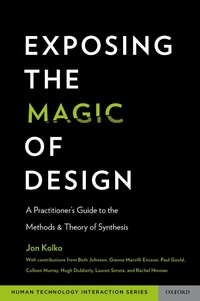
Exposing the Magic of Design
A Practitioner's Guide to the Methods and Theory of Synthesis
1st Edition
Published on 7. March 2011
206 pages
978-0-19-978095-2 (ISBN)
Description

Design synthesis is a way of thinking about complicated, multifaceted problems of a large scale with a repeatable degree of success. Design synthesis methods can be applied in business, with the goal of producing new and compelling products and services, and they can be applied in government, with the goal of changing culture and bettering society. In both contexts, however, there is a need for speed and for aggressive action. This text is immediately relevant, and is more relevant than ever, as we acknowledge and continually reference a feeling of an impending and massive change. Simply, this text is intended to act as a practitioner's guide to exposing the magic of design.
More details
Other editions
Additional editions
Book
05/2011
Oxford University Press Inc
€109.20
Available immediately
Content
- Intro
- Contents
- Introduction
- A Lack of Method in Practice Leads to Problems
- The Goals of This Text
- The Immediacy of This Text
- Section One: What Is Synthesis?
- Chapter 1 A Theory of Synthesis
- Understanding How People Solve Problems
- Chapter 2 Sensemaking, Frames, Models, and Patterns
- The Role of Perspective in Framing Situations
- The Importance of Models in Sensemaking
- Mental Models as a Specific Type of Cognitive Representation
- The Nature of Patterns on Our Experiences
- Chapter 3 Abductive Reasoning
- Section Two: Design Synthesis in a Business Context
- Chapter 4 The Value of Synthesis in Driving Innovation
- What Is Innovation?
- Design Synthesis Links Innovation Research and Design
- Chapter 5 The Culture of Synthesis
- Challenging Constraints and Questioning Purpose
- Being Playful
- Experiencing Flow
- Using Visualization as a Primary Mechanism of Thought
- Changing a Prohibitive Culture
- Section Three: Methods and Applicability
- Chapter 6 Methods for Making Meaning out of Data
- Externalizing the Process (Get out of Your Laptop!)
- Using Visual Design to Clean up the Mess
- Organizing to Produce Semantic Relationships
- Prioritizing the Data to Emphasize What Is Important
- Judging the Data to Reduce the Quantity
- Enhancing the Data through "Best Guess" Intuitive Leaps
- Method: Affinity Diagramming
- Method: Flow Diagramming
- Chapter 7 Methods for Building an Experience Framework
- Telling a Story
- Changing the Scale
- Shifting the Placements
- Method: Concept Mapping
- Method: Forced Semantic Zoom ("Ecosystem Mapping")
- Method: Forced Temporal Zoom ("Customer Journey Mapping")
- Chapter 8 Methods for Creating Empathy and Insight
- Understanding Chasm 3: Empathy and Insight
- Method: Reframing
- Method: Insight Combination
- Conclusion
- Glossary
- A
- C
- D
- E
- F
- I
- M
- P
- R
- S
- V
- Works Cited
- Index
- A
- B
- C
- D
- E
- F
- G
- H
- I
- J
- K
- L
- M
- N
- O
- P
- Q
- R
- S
- T
- U
- V
- W
- Z
