

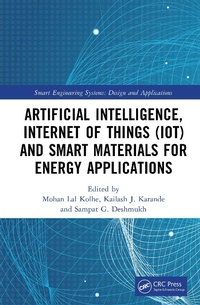
Artificial Intelligence, Internet of Things (IoT) and Smart Materials for Energy Applications
1st Edition
Published on 12. October 2022
316 pages
978-1-000-65362-5 (ISBN)
Description

This reference text offers the reader a comprehensive insight into recent research breakthroughs in blockchain, the Internet of Things (IoT), artificial intelligence and material structure and hybrid technologies in their integrated platform, while also emphasizing their sustainability aspects.
The text begins by discussing recent advances in energy materials and energy conversion materials using machine learning, as well as recent advances in optoelectronic materials for solar energy applications. It covers important topics including advancements in electrolyte materials for solid oxide fuel cells, advancements in composite materials for Li-ion batteries, progression of materials for supercapacitor applications, and materials progression for thermochemical storage of low-temperature solar thermal energy systems.
This book:
Discusses advances in blockchain, the Internet of Things, artificial intelligence, material structure and hybrid technologies
Covers intelligent techniques in materials progression for sensor development and energy material characterization using signal processing
Examines the integration of phase change materials in construction for thermal energy regulation in new buildings
Explores the current happenings in technology in conjunction with basic laws and mathematical models
Connecting advances in engineering materials with the use of smart techniques including artificial intelligence, machine learning and Internet of Things (IoT) in a single volume, this text will be especially useful for graduate students, academic researchers and professionals in the fields of electrical engineering, electronics engineering, materials science, mechanical engineering and computer science.
The text begins by discussing recent advances in energy materials and energy conversion materials using machine learning, as well as recent advances in optoelectronic materials for solar energy applications. It covers important topics including advancements in electrolyte materials for solid oxide fuel cells, advancements in composite materials for Li-ion batteries, progression of materials for supercapacitor applications, and materials progression for thermochemical storage of low-temperature solar thermal energy systems.
This book:
Discusses advances in blockchain, the Internet of Things, artificial intelligence, material structure and hybrid technologies
Covers intelligent techniques in materials progression for sensor development and energy material characterization using signal processing
Examines the integration of phase change materials in construction for thermal energy regulation in new buildings
Explores the current happenings in technology in conjunction with basic laws and mathematical models
Connecting advances in engineering materials with the use of smart techniques including artificial intelligence, machine learning and Internet of Things (IoT) in a single volume, this text will be especially useful for graduate students, academic researchers and professionals in the fields of electrical engineering, electronics engineering, materials science, mechanical engineering and computer science.
More details
Series
Edition
1. Auflage
Language
English
Place of publication
London
United Kingdom
Publishing group
Taylor & Francis Ltd
Target group
College/higher education
Professional and scholarly
Product notice
Reflowable
Illustrations
29 Tables, black and white; 77 Line drawings, black and white; 55 Halftones, black and white; 5 Illustrations, color; 127 Illustrations, black and white
ISBN-13
978-1-000-65362-5 (9781000653625)
Copyright in bibliographic data and cover images is held by Nielsen Book Services Limited or by the publishers or by their respective licensors: all rights reserved.
Schweitzer Classification
Other editions
Additional editions
Mohan Lal Kolhe | Kailash J. Karande | Sampat G. Deshmukh
Artificial Intelligence, Internet of Things (IoT) and Smart Materials for Energy Applications
Book
10/2024
1st Edition
CRC Press
€71.90
Shipment within 10-20 days
Mohan Lal Kolhe | Kailash J. Karande | Sampat G. Deshmukh
Artificial Intelligence, Internet of Things (IoT) and Smart Materials for Energy Applications
Book
10/2022
1st Edition
CRC Press
€175.90
Shipment within 10-20 days
Persons
Prof. (Dr.) Mohan Lal Kolhe (ORCID 0000-0001-7547-9413) is a full time professor at University of Agder, Norway. He is a leading renewable energy technologist with three decades of academic experience at the international level and previously held academic positions at the world's prestigious universities, e.g., University College London (UK/Australia), University of Dundee (UK); University of Jyvaskyla (Finland); Hydrogen Research Institute, QC (Canada); etc. In addition, he was a member of the Government of South Australia's first Renewable Energy Board (2009-2011) and worked on developing renewable energy policies. He received the offer of full professorship in smart grid from the Norwegian University of Science and Technology (NTNU). He won competitive research funding from the prestigious research councils (e.g. Norwegian Research Council, EU, EPSRC, BBSRC, NRP) for his work on sustainable energy systems. He has published extensively in the Energy Systems Engineering. He has been invited by many International organizations for delivering expert lectures/keynote addresses. His research works in Energy Systems have been recognized within the top 2% of scientists globally by Stanford University's 2020 and 2021 matrices. He is working as Editor for various journals of Springer, Elsevier, AIP Publishing, and MDPI. He is an internationally recognized pioneer in his field, whose top 10 published works have an average of over 175 citations each.
Prof. (Dr.) Kailash J. Karande (ORCID 0000-0002-3089-8937) is the Director and Principal of SKN Sinhgad College of Engineering, Pandharpur, India. His research interest encompasses a wide range of activities with a focus in face recognitions and developed a comparative approach in ICA analysis. A strong Electronics background combined with FRT has enabled him and his team to produce PCA-ICA modules for specific applications. He has published 10 books and 80+ research papers (h-index 10, i-10 index 10) in various National and International journals. He is working as PI on research project funded by Punyashlok Ahilyadevi Holkar Solapur University, Solapur, India. He received European fellowship of Erasmus Mundus Program at Aalborg University, Denmark. He was honoured by Albert Nelson Lifetime Achievement Award. Also he was awarded as Best Principal from Punyashlok Ahilyadevi Holkar Solapur University, Solapur and many more for contribution in the field of Education. He is acting as Editor for various journals/Books of Lambert Publications, Springer, CRC Press TandF Group, IOP Publishing, AIP Publishing.
Dr. Sampat G. Deshmukh (ORCID 0000-0002-1880-4272) is working as Dean at SKN Sinhgad College of Engineering, Pandharpur. He has completed his Ph. D. from Sardar Vallabhbhai National Institute of Technology, an Institute of National Importance, Surat, India, giving his societal contribution in the field of Nanoscience and Nanotechnology. He has 24 years' experience of Research, Teaching and Industrial. Dr. Sampat and his team have continuously working for their contribution in the field of Material Science. He has published 15 research articles in journals, 15 papers in various National and International conferences and 02 Book Chapters (h-index 7, i-10 index 7). He is Editor Board Member of Electronics Science Technology and Application (ESTA) and Journals of Frontiers of Mechatronical Engineering. He received Best Paper award in ICEM-2014 at Chennai, and consolation award in ICC-2015 at Bikaner, India. He is working as PI on research project funded by Punyashlok Ahilyadevi Holkar Solapur University, Solapur. He is acting as Editor for proceedings/Books of IOP Publishing, AIP Publishing,
CRC Press TandF Group, etc.
Prof. (Dr.) Kailash J. Karande (ORCID 0000-0002-3089-8937) is the Director and Principal of SKN Sinhgad College of Engineering, Pandharpur, India. His research interest encompasses a wide range of activities with a focus in face recognitions and developed a comparative approach in ICA analysis. A strong Electronics background combined with FRT has enabled him and his team to produce PCA-ICA modules for specific applications. He has published 10 books and 80+ research papers (h-index 10, i-10 index 10) in various National and International journals. He is working as PI on research project funded by Punyashlok Ahilyadevi Holkar Solapur University, Solapur, India. He received European fellowship of Erasmus Mundus Program at Aalborg University, Denmark. He was honoured by Albert Nelson Lifetime Achievement Award. Also he was awarded as Best Principal from Punyashlok Ahilyadevi Holkar Solapur University, Solapur and many more for contribution in the field of Education. He is acting as Editor for various journals/Books of Lambert Publications, Springer, CRC Press TandF Group, IOP Publishing, AIP Publishing.
Dr. Sampat G. Deshmukh (ORCID 0000-0002-1880-4272) is working as Dean at SKN Sinhgad College of Engineering, Pandharpur. He has completed his Ph. D. from Sardar Vallabhbhai National Institute of Technology, an Institute of National Importance, Surat, India, giving his societal contribution in the field of Nanoscience and Nanotechnology. He has 24 years' experience of Research, Teaching and Industrial. Dr. Sampat and his team have continuously working for their contribution in the field of Material Science. He has published 15 research articles in journals, 15 papers in various National and International conferences and 02 Book Chapters (h-index 7, i-10 index 7). He is Editor Board Member of Electronics Science Technology and Application (ESTA) and Journals of Frontiers of Mechatronical Engineering. He received Best Paper award in ICEM-2014 at Chennai, and consolation award in ICC-2015 at Bikaner, India. He is working as PI on research project funded by Punyashlok Ahilyadevi Holkar Solapur University, Solapur. He is acting as Editor for proceedings/Books of IOP Publishing, AIP Publishing,
CRC Press TandF Group, etc.
Content
Chapter 01 - A Review of Automated Sleep Apnea Detection Using Deep Neural Network
Praveen Kumar Tyagi, Dheeraj Agarwal and Pushyamitra Mishra
Chapter 02 - Optimization of Tool Wear Rate using Artificial Intelligence-Based TLBO and Cuckoo Search Approach
Vishal Parashar, Shubham Jain and P.M. Mishra
Chapter 03 - Lung Tumor Segmentation Using a 3D Densely Connected Convolutional Neural Network
Shweta Tyagi and Sanjay N. Talbar
Chapter 04 - Day-Ahead Solar Power Forecasting Using Artificial Neural Network with Outlier Detection
D. Janith Kavindu Dassanayake, M.H.M.R.S. Dilhani, Konara Mudiyanselage Sandun Y. Konara and Mohan Lal Kolhe
Chapter 05 - Fuzzy-Inspired Three-Dimensional DWT and GLCM Framework for Pixel Characterisation of Hyperspectral Images
K. Kavitha and D. Sharmila Banu
Chapter 06 - Painless Machine Learning Approach to Estimate Blood Glucose Level with Non-Invasive Devices
Altaf O. Mulani, Makarand M. Jadhav and Mahesh Seth
Chapter 07 - Artificial Intelligence and Machine Learning in Biomedical Applications
Vaibhav.V. Dixit and Mayuresh B. Gulame
Chapter 08 - The Use of Artificial Intelligence-Based Models for Biomedical Application
Sharad Mulik, Nilesh Dhobale, Kanchan Pujari and Kailash Karande
Chapter 09 - Role of Artificial Intelligence in Transforming Agriculture
K. Kanagaraj and K. Nalini
Chapter 10 - Internet of Things (IoT) and Artificial Intelligence for Smart Communications
Dnyaneshwar S. Mantri, Pranav M. Pawar, Nandkumar Kulkarni and Ramjee Prasad
Chapter 11 - Cyber-Security in the Internet of Things
Snehal A. Bhosale and S.S. Sonavane
Chapter 12 - Smart Materials for Electrochemical Water Oxidation
Shital B. Kale, Dhanaji B. Malavekar and Chandrakant D. Lokhande
Chapter 13 - Innovative Approach for Real-Time P-V Curve Identification: Design-to-Application
Mahmadasraf A. Mulla and Ashish K. Panchal
Chapter 14 - Superhydrophobic Coatings of Silica NPs on Cover Glass of Solar Cells for Self-Cleaning Applications
Rajaram S. Sutar, Sampat G. Deshmukh, A.M. More, A.K. Bhosale and Sanjay S. Latthe
Chapter 15 - Carbonaceous Composites of Rare Earth Metal Chalcogenides: Synthesis, Properties and Supercapacitive Applications
Dhanaji B. Malavekar, Shital B. Kale and Chandrakant D. Lokhande
Chapter 16 - Low-Stress Abrasion Response of Heat-Treated LM25-SiCp Composite
Raj Kumar Singh, Sanjay Soni and Pushyamitra Mishra
Chapter 17 - Post-Annealing Influence on Structural, Surface and Optical Properties of Cu3BiS3 Thin Films for Photovoltaic Solar Cells
Sampat G. Deshmukh, Kailash J. Karande , Koki Ogura, Vipul Kheraj and Rohan S. Deshmukh
Chapter 18 - Self-Cleaning Antireflection Coatings on Glass for Solar Energy Applications
J. Shanthi, R. Swathi and O. Seifunnisha
Praveen Kumar Tyagi, Dheeraj Agarwal and Pushyamitra Mishra
Chapter 02 - Optimization of Tool Wear Rate using Artificial Intelligence-Based TLBO and Cuckoo Search Approach
Vishal Parashar, Shubham Jain and P.M. Mishra
Chapter 03 - Lung Tumor Segmentation Using a 3D Densely Connected Convolutional Neural Network
Shweta Tyagi and Sanjay N. Talbar
Chapter 04 - Day-Ahead Solar Power Forecasting Using Artificial Neural Network with Outlier Detection
D. Janith Kavindu Dassanayake, M.H.M.R.S. Dilhani, Konara Mudiyanselage Sandun Y. Konara and Mohan Lal Kolhe
Chapter 05 - Fuzzy-Inspired Three-Dimensional DWT and GLCM Framework for Pixel Characterisation of Hyperspectral Images
K. Kavitha and D. Sharmila Banu
Chapter 06 - Painless Machine Learning Approach to Estimate Blood Glucose Level with Non-Invasive Devices
Altaf O. Mulani, Makarand M. Jadhav and Mahesh Seth
Chapter 07 - Artificial Intelligence and Machine Learning in Biomedical Applications
Vaibhav.V. Dixit and Mayuresh B. Gulame
Chapter 08 - The Use of Artificial Intelligence-Based Models for Biomedical Application
Sharad Mulik, Nilesh Dhobale, Kanchan Pujari and Kailash Karande
Chapter 09 - Role of Artificial Intelligence in Transforming Agriculture
K. Kanagaraj and K. Nalini
Chapter 10 - Internet of Things (IoT) and Artificial Intelligence for Smart Communications
Dnyaneshwar S. Mantri, Pranav M. Pawar, Nandkumar Kulkarni and Ramjee Prasad
Chapter 11 - Cyber-Security in the Internet of Things
Snehal A. Bhosale and S.S. Sonavane
Chapter 12 - Smart Materials for Electrochemical Water Oxidation
Shital B. Kale, Dhanaji B. Malavekar and Chandrakant D. Lokhande
Chapter 13 - Innovative Approach for Real-Time P-V Curve Identification: Design-to-Application
Mahmadasraf A. Mulla and Ashish K. Panchal
Chapter 14 - Superhydrophobic Coatings of Silica NPs on Cover Glass of Solar Cells for Self-Cleaning Applications
Rajaram S. Sutar, Sampat G. Deshmukh, A.M. More, A.K. Bhosale and Sanjay S. Latthe
Chapter 15 - Carbonaceous Composites of Rare Earth Metal Chalcogenides: Synthesis, Properties and Supercapacitive Applications
Dhanaji B. Malavekar, Shital B. Kale and Chandrakant D. Lokhande
Chapter 16 - Low-Stress Abrasion Response of Heat-Treated LM25-SiCp Composite
Raj Kumar Singh, Sanjay Soni and Pushyamitra Mishra
Chapter 17 - Post-Annealing Influence on Structural, Surface and Optical Properties of Cu3BiS3 Thin Films for Photovoltaic Solar Cells
Sampat G. Deshmukh, Kailash J. Karande , Koki Ogura, Vipul Kheraj and Rohan S. Deshmukh
Chapter 18 - Self-Cleaning Antireflection Coatings on Glass for Solar Energy Applications
J. Shanthi, R. Swathi and O. Seifunnisha
