

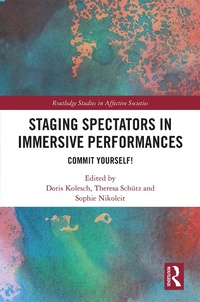
Staging Spectators in Immersive Performances
Commit Yourself!
1st Edition
Published on 3. May 2019
222 pages
978-0-429-58421-3 (ISBN)
Description

At present, we are witnessing a significant transformation of established forms of spectatorship in theatre, performance art and beyond. In particular, immersive and participatory forms of theatre allow audiences and performers to interact in a shared performance space.
Staging Spectators in Immersive Performances discusses forms and concepts of contemporary spectatorship and explores various modes of audience participation in theory as well as in practice. The volume also reflects on what new terms and methods must be developed in order to address the theoretical challenges of contemporary immersive performances.
Split into three parts, Staging Spectators in Immersive Performances, respectively, focuses on various strategies for mobilising the audience, methodological questions for research on being a spectator in immersive and participatory forms of theatre, and thematising new modes of partaking and ways of spectating in contemporary art.
Poignantly capturing experiences that can be viewed as manifestations of affective relationality in the strongest possible sense, this volume will appeal to students and researchers interested in fields such as Theatre and Performance Studies, Media Studies and Philosophy.
Staging Spectators in Immersive Performances discusses forms and concepts of contemporary spectatorship and explores various modes of audience participation in theory as well as in practice. The volume also reflects on what new terms and methods must be developed in order to address the theoretical challenges of contemporary immersive performances.
Split into three parts, Staging Spectators in Immersive Performances, respectively, focuses on various strategies for mobilising the audience, methodological questions for research on being a spectator in immersive and participatory forms of theatre, and thematising new modes of partaking and ways of spectating in contemporary art.
Poignantly capturing experiences that can be viewed as manifestations of affective relationality in the strongest possible sense, this volume will appeal to students and researchers interested in fields such as Theatre and Performance Studies, Media Studies and Philosophy.
More details
Series
Edition
1. Auflage
Language
English
Place of publication
London
United Kingdom
Publishing group
Taylor & Francis Ltd
Target group
College/higher education
Illustrations
3 Tables, black and white; 42 Halftones, black and white
ISBN-13
978-0-429-58421-3 (9780429584213)
Copyright in bibliographic data and cover images is held by Nielsen Book Services Limited or by the publishers or by their respective licensors: all rights reserved.
Schweitzer Classification
Other editions
Additional editions
Doris Kolesch | Theresa Schuetz | Sophie Nikoleit
Staging Spectators in Immersive Performances
Commit Yourself!
Book
12/2020
1st Edition
Routledge
€54.46
Shipment within 15-20 days
Doris Kolesch | Theresa Schuetz | Sophie Nikoleit
Staging Spectators in Immersive Performances
Commit Yourself!
Book
05/2019
1st Edition
Routledge
€179.50
Shipment within 15-20 days
Persons
Doris Kolesch is Professor of Theatre and Performance Studies and a co-director of the Deutsche Forschungsgemeinschaft (DFG)-funded Collaborative Research Center (CRC) "Affective Societies" at Freie Universitaet Berlin, Germany.
Theresa Schuetz is a theatre scholar and research assistant working in the CRC "Affective Societies" at Freie Universitaet Berlin, Germany.
Sophie Nikoleit is a theatre scholar and research assistant working in the CRC "Affective Societies" at Freie Universitaet Berlin, Germany.
Theresa Schuetz is a theatre scholar and research assistant working in the CRC "Affective Societies" at Freie Universitaet Berlin, Germany.
Sophie Nikoleit is a theatre scholar and research assistant working in the CRC "Affective Societies" at Freie Universitaet Berlin, Germany.
Content
List of figures
List of tables
List of contributors
Acknowledgements
Funding note
Immersion and Spectatorship at the Interface of Theatre, Media Tech and Daily Life: An Introduction
Doris Kolesch
Part I: Mobile Audiences
Unexpected Encounter. On Installation Art as Immersive Space
Barbara Gronau
Doggies, Masters and the End of the European Union. On Immersive Theatre Installations by SIGNA and Thomas Bellinck
Benjamin Wihstutz
On the Impossibility of Being Together
A conversation between performance artist Signa Koestler and Theresa Schuetz
Bordering and Shattering the Stage: Mobile Audiences as Compositional Forces
Liesbeth Groot Nibbelink
Structures of Spectatorship
Kerstin Schankweiler
Part II: Researching Spectatorship
Keep it real
A conversation between performance artist Julian Hetzel and Theresa Schuetz
Participatory Audiencing and the Committed Return
Matthew Reason
Immersive Art - Immersive Research?
Stefanie Husel
Parsing 'Commitment': The Multiple Valences of Spectatorship
Janelle Reinelt
The Case for Empirical Audience Research
Antje Kahl
Part III: Questions of Power - Politics of Affect in Immersive Performances
Feminism, Audience Interaction, and Performer Authority
Jen Harvie
The Promise of Participation Revisited: Affective Strategies of Participation
Gareth White
Capturing complexity while being pressed for time
A conversation between scenographer Mona el Gammal and Theresa Schuetz
Immersive Guilt Factories
Theresa Schuetz
Dark Immersion. Some thoughts on SIGNA's Wir Hunde/Us Dogs
Rainer Muehlhoff
List of tables
List of contributors
Acknowledgements
Funding note
Immersion and Spectatorship at the Interface of Theatre, Media Tech and Daily Life: An Introduction
Doris Kolesch
Part I: Mobile Audiences
Unexpected Encounter. On Installation Art as Immersive Space
Barbara Gronau
Doggies, Masters and the End of the European Union. On Immersive Theatre Installations by SIGNA and Thomas Bellinck
Benjamin Wihstutz
On the Impossibility of Being Together
A conversation between performance artist Signa Koestler and Theresa Schuetz
Bordering and Shattering the Stage: Mobile Audiences as Compositional Forces
Liesbeth Groot Nibbelink
Structures of Spectatorship
Kerstin Schankweiler
Part II: Researching Spectatorship
Keep it real
A conversation between performance artist Julian Hetzel and Theresa Schuetz
Participatory Audiencing and the Committed Return
Matthew Reason
Immersive Art - Immersive Research?
Stefanie Husel
Parsing 'Commitment': The Multiple Valences of Spectatorship
Janelle Reinelt
The Case for Empirical Audience Research
Antje Kahl
Part III: Questions of Power - Politics of Affect in Immersive Performances
Feminism, Audience Interaction, and Performer Authority
Jen Harvie
The Promise of Participation Revisited: Affective Strategies of Participation
Gareth White
Capturing complexity while being pressed for time
A conversation between scenographer Mona el Gammal and Theresa Schuetz
Immersive Guilt Factories
Theresa Schuetz
Dark Immersion. Some thoughts on SIGNA's Wir Hunde/Us Dogs
Rainer Muehlhoff
