

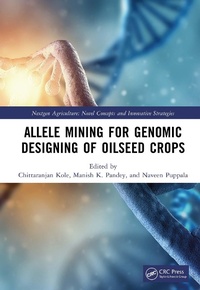
Allele Mining for Genomic Designing of Oilseed Crops
1st Edition
Published on 18. September 2024
314 pages
978-1-040-10336-4 (ISBN)
Description

This book deliberates on the concept, strategies, tools, and techniques of allele mining in oilseed crops and its application potential in genome elucidation and improvement, including studying allele evolution, discovery of superior alleles, discerning new haplotypes, assessment of intra- and interspecific similarity, and studies of gene expression and gene prediction. Available gene pools in global germplasm collections, specifically consisting of wild allied species and local landraces for almost all major crops, have facilitated allele mining. The development of advanced genomic techniques, including PCR-based allele priming and Eco-TILLING-based allele mining, is now widely used for mining superior alleles. Allele's discovery has become more relevant now for employing molecular breeding to develop designed crop varieties matching consumer needs and with genome plasticity to adapt to climate change scenarios. All these concepts and strategies, along with precise success stories, are presented in the chapters dedicated to the major oilseed crops.
1. This is the first book on the novel strategy of allele mining in oilseed crops for precise breeding.
2. This book presents genomic strategies for mining superior alleles underlying agronomic traits from genomic resources.
3. This book depicts case studies of PCR-based allele priming and Eco-TILLING based allele mining.
4. This book elaborates on gene discovery and gene prediction in major oilseed crops.
This book will be useful to students and faculties in various plant science disciplines, including genetics, genomics, molecular breeding, agronomy, and bioinformatics; scientists in seed industries; and policymakers and funding agencies interested in crop improvement.
1. This is the first book on the novel strategy of allele mining in oilseed crops for precise breeding.
2. This book presents genomic strategies for mining superior alleles underlying agronomic traits from genomic resources.
3. This book depicts case studies of PCR-based allele priming and Eco-TILLING based allele mining.
4. This book elaborates on gene discovery and gene prediction in major oilseed crops.
This book will be useful to students and faculties in various plant science disciplines, including genetics, genomics, molecular breeding, agronomy, and bioinformatics; scientists in seed industries; and policymakers and funding agencies interested in crop improvement.
More details
Series
Edition
1. Auflage
Language
English
Place of publication
London
United Kingdom
Publishing group
Taylor & Francis Ltd
Target group
College/higher education
Professional and scholarly
Illustrations
31 Tables, black and white; 3 Line drawings, color; 22 Line drawings, black and white; 1 Halftones, color; 3 Halftones, black and white; 4 Illustrations, color; 25 Illustrations, black and white
ISBN-13
978-1-040-10336-4 (9781040103364)
Copyright in bibliographic data and cover images is held by Nielsen Book Services Limited or by the publishers or by their respective licensors: all rights reserved.
Schweitzer Classification
Other editions
Additional editions
Chittaranjan Kole | Manish Kumar Pandey | Naveen Puppala
Allele Mining for Genomic Designing of Oilseed Crops
Book
09/2024
1st Edition
CRC Press
€228.50
Shipment within 10-20 days

Book
09/2024
CRC Press
Unfortunately, price unknown
Available (delivery time upon request)
Persons
Prof. Chittaranjan Kole is an internationally reputed scientist with an illustrious professional career spanning over forty years and globally recognized for his original contributions in the fields of plant genomics, biotechnology and molecular breeding leading to the publication of more than 150 quality research articles. He has edited over 170 books for the leading publishers of the world including Springer, Wiley-Blackwell and Taylor and Francis Group. His scientific contributions and editing acumen have been appreciated by seven Nobel Laureates including Profs. Norman Borlaug, Arthur Kornberg, Werner Arber, Phillip Sharp, Guenter Blobel, Lee Hartwell and Roger Kornberg. He has been honored with a number of fellowships, honorary fellowships, and national and international awards including the 'Outstanding Crop Scientist Award' conferred by the International Crop Science Society. Prof. Kole has served in all prestigious positions in academia including as Vice-Chancellor of the BC Agricultural university and Project Coordinator of Indo-Russian Center of Biotechnology in India, and Director of Research of the Institute of Nutraceutical Research of Clemson University, in USA. He worked also in the Pennsylvania State University and Clemson University as Visiting Professor in USA. He was awarded with the Raja Ramanna Fellow by the Department of Energy, Government of India. He is also heading the International Climate-Resilient Crop Genomics Consortium, International Phytomedomics and Nutriomics Consortium and Genome India International as their Founding President. Prof. Kole has recently established the Prof. Chittaranjan Kole Foundation for Science and Society and working for his Founding Chairman.
Dr. Manish K Pandey is currently leading the Groundnut and Pigeonpea Genomics, Prebreeding & Bioinformatics group at International Crops Research Institute for the Semi-Arid Tropics (ICRISAT), Hyderabad, India. His key contributions include reference genome sequence for diploid progenitor and both the subspecies of cultivated tetraploid groundnut, gene expression atlas, low to high density SNP genotyping assays, diagnostic markers for key traits, quality control panel, marker-assisted pyramiding and genomic selection in groundnut. Through genomics-based breeding, his team developed three high oleic groundnut varieties which are released for cultivation in six states of India. He has published more than 170 scientific articles (>8000 citations) in various international journals including Nature Genetics, PNAS-USA and Molecular Plant. His efforts have been recognized at international level as he has been invited to deliver presentations in several international conferences, review the proposals for international funding agencies and he is collaborating with a large number of scientists at international level. He is also Adjunct Associate Professor in University of Southern Queensland (USQ), Australia & Distinguished Professor, in Institute of Crop Genetic Resources of Shandong Academy of Agricultural Sciences (SAAS), China. He is now been inducted in many scientific academies of India namely as Fellow in National Academy of Agricultural Sciences (NAAS)-New Delhi, and Telangana Academy of Agricultural Sciences (TAAS)-Telangana, while Associate Fellow/Member in Andhra Pradesh Academy of Agricultural Sciences (APAS)-Andhra Pradesh, and Member of The National Academy of Sciences-India (NASI). He was also among the top 2% highly cited researcher in 2019-2021 compiled by Stanford University, USA.
Naveen Puppala is a Professor at New Mexico State University, USA. His research focuses on genetic characterization and improvement of Valencia peanuts through molecular techniques & conventional breeding approaches. His Valencia breeding emphasizes variety development for high yield; high oleic; four seeds per pod; good taste, and disease resistance. He has published 86 peer-reviewed journal articles, six book chapters, and 170 meeting abstracts as author or co-author. He has given numerous invited presentations at national and international conferences. Seventeen graduate students have been supported with grants secured from USAID funds, USDA-NIFA, New Mexico Peanut Research Board, and National Peanut Research, where he was the Principal Investigator or co-PI of the project. He has served as an advisor, co-advisor, and on a graduate student committee. He has mentored National peanut breeders from ten different countries to develop high-yielding, disease-resistant Valencia peanuts to increase the livelihood of economically poor farmers. He served as a President-Elect for American Peanut Research and Education Society from 2014 to 2015. He has released 14 peanut cultivars. He served as a peanut crop germplasm committee chair from 2009 to 2011. He served on grant review panels for USDA-NIFA. He was an associate editor for BMC Plant Biology, Journal of Plant Registration, and Peanut Science.
Dr. Manish K Pandey is currently leading the Groundnut and Pigeonpea Genomics, Prebreeding & Bioinformatics group at International Crops Research Institute for the Semi-Arid Tropics (ICRISAT), Hyderabad, India. His key contributions include reference genome sequence for diploid progenitor and both the subspecies of cultivated tetraploid groundnut, gene expression atlas, low to high density SNP genotyping assays, diagnostic markers for key traits, quality control panel, marker-assisted pyramiding and genomic selection in groundnut. Through genomics-based breeding, his team developed three high oleic groundnut varieties which are released for cultivation in six states of India. He has published more than 170 scientific articles (>8000 citations) in various international journals including Nature Genetics, PNAS-USA and Molecular Plant. His efforts have been recognized at international level as he has been invited to deliver presentations in several international conferences, review the proposals for international funding agencies and he is collaborating with a large number of scientists at international level. He is also Adjunct Associate Professor in University of Southern Queensland (USQ), Australia & Distinguished Professor, in Institute of Crop Genetic Resources of Shandong Academy of Agricultural Sciences (SAAS), China. He is now been inducted in many scientific academies of India namely as Fellow in National Academy of Agricultural Sciences (NAAS)-New Delhi, and Telangana Academy of Agricultural Sciences (TAAS)-Telangana, while Associate Fellow/Member in Andhra Pradesh Academy of Agricultural Sciences (APAS)-Andhra Pradesh, and Member of The National Academy of Sciences-India (NASI). He was also among the top 2% highly cited researcher in 2019-2021 compiled by Stanford University, USA.
Naveen Puppala is a Professor at New Mexico State University, USA. His research focuses on genetic characterization and improvement of Valencia peanuts through molecular techniques & conventional breeding approaches. His Valencia breeding emphasizes variety development for high yield; high oleic; four seeds per pod; good taste, and disease resistance. He has published 86 peer-reviewed journal articles, six book chapters, and 170 meeting abstracts as author or co-author. He has given numerous invited presentations at national and international conferences. Seventeen graduate students have been supported with grants secured from USAID funds, USDA-NIFA, New Mexico Peanut Research Board, and National Peanut Research, where he was the Principal Investigator or co-PI of the project. He has served as an advisor, co-advisor, and on a graduate student committee. He has mentored National peanut breeders from ten different countries to develop high-yielding, disease-resistant Valencia peanuts to increase the livelihood of economically poor farmers. He served as a President-Elect for American Peanut Research and Education Society from 2014 to 2015. He has released 14 peanut cultivars. He served as a peanut crop germplasm committee chair from 2009 to 2011. He served on grant review panels for USDA-NIFA. He was an associate editor for BMC Plant Biology, Journal of Plant Registration, and Peanut Science.
Content
1 Soybean Allele Mining for Molecular Breeding: A Review
2 Allele mining in Soybean
3 Allele Mining and Its Importance in Rapeseed
4 The QTL Identification and Allele Mining for Molecular Design Breeding of Rapeseed
5 Mining Alleles for Creating Environment-Resilient Sunflower
6 Allele Mining for Crop Genomic Designing in Peanut
7 Allelic variation and its functional characterization in peanut
8 Integration of genomics assisted allele mining approaches for improvement of flax: Current advancements and future perspective
9 Molecular Breeding to Design Ideal Sesame Crop
10 Genetic Diversity, Gene Discovery and Allele Mining in Mustard (Brassica juncea L. Czern.)
11 Prospects of Allele Mining for Improvement of Qualitative and Quantitative Traits in Safflower (Carthamus tinctorius L.)
2 Allele mining in Soybean
3 Allele Mining and Its Importance in Rapeseed
4 The QTL Identification and Allele Mining for Molecular Design Breeding of Rapeseed
5 Mining Alleles for Creating Environment-Resilient Sunflower
6 Allele Mining for Crop Genomic Designing in Peanut
7 Allelic variation and its functional characterization in peanut
8 Integration of genomics assisted allele mining approaches for improvement of flax: Current advancements and future perspective
9 Molecular Breeding to Design Ideal Sesame Crop
10 Genetic Diversity, Gene Discovery and Allele Mining in Mustard (Brassica juncea L. Czern.)
11 Prospects of Allele Mining for Improvement of Qualitative and Quantitative Traits in Safflower (Carthamus tinctorius L.)
