

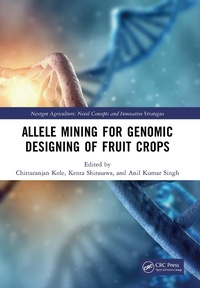
Allele Mining for Genomic Designing of Fruit Crops
1st Edition
Published on 29. March 2024
350 pages
978-1-003-84654-3 (ISBN)
Description

This book deliberates on the concept, strategies, tools, and techniques of allele mining in fruit crops and its application potential in genome elucidation and improvement including studying allele evolution, discovery of superior alleles, discerning new haplotypes, assessment of intra- and interspecific similarity, and also studies of gene expression and gene prediction. Available gene pools in global germplasm collections specifically consisting of wild allied species and local landraces for almost all major crops have facilitated allele mining. Advanced genomic techniques have been developed including PCR-based allele priming and Eco-TILLING-based allele mining that are being widely used now for mining superior alleles. Allele discovery has become more relevant now for employing molecular breeding to develop designed crop varieties matching with consumer needs and also with genome plasticity to adapt the climate change scenarios. All these concepts and strategies along with precise success stories are presented over the chapters dedicated to the major fruit crops.
The features of this book are as follows:
The first book on the novel strategy of allele mining in fruit crops for precise breeding
Presents genomic strategies of mining superior alleles underlying agronomic traits from genomic resources
Depicts case studies of PCR-based allele priming and Eco-TILLING-based allele mining
Elaborates on gene discovery and gene prediction in major fruit crops
This book will be useful to students and faculties in various plant science disciplines including genetics, genomics, molecular breeding, agronomy, and bioinformatics; scientists in seed industries; and also policy makers and funding agencies interested in crop improvement.
The features of this book are as follows:
The first book on the novel strategy of allele mining in fruit crops for precise breeding
Presents genomic strategies of mining superior alleles underlying agronomic traits from genomic resources
Depicts case studies of PCR-based allele priming and Eco-TILLING-based allele mining
Elaborates on gene discovery and gene prediction in major fruit crops
This book will be useful to students and faculties in various plant science disciplines including genetics, genomics, molecular breeding, agronomy, and bioinformatics; scientists in seed industries; and also policy makers and funding agencies interested in crop improvement.
More details
Series
Edition
1. Auflage
Language
English
Place of publication
London
United Kingdom
Publishing group
Taylor & Francis Ebooks
Target group
College/higher education
Professional and scholarly
Illustrations
34 Tables, black and white; 11 Line drawings, color; 21 Line drawings, black and white; 6 Halftones, color; 1 Halftones, black and white; 17 Illustrations, color; 22 Illustrations, black and white
ISBN-13
978-1-003-84654-3 (9781003846543)
Copyright in bibliographic data and cover images is held by Nielsen Book Services Limited or by the publishers or by their respective licensors: all rights reserved.
Schweitzer Classification
Other editions
Additional editions
Chittaranjan Kole | Kenta Shirasawa | Anil Kumar Singh
Allele Mining for Genomic Designing of Fruit Crops
Book
03/2024
1st Edition
CRC Press
€266.60
Shipment within 10-20 days
Persons
Prof. Chittaranjan Kole is an internationally reputed scientist with an illustrious professional career spanning over thirty-seven years and original contributions in the fields of plant genomics, biotechnology and molecular breeding leading to the publication of more than 160 quality research articles and reviews. He has edited over 150 books for the leading publishers of the world including Springer, Wiley-Blackwell and Taylor and Francis Group. His scientific contributions and editing acumen have been appreciated by seven Nobel Laureates including Profs. Norman Borlaug, Arthur Kornberg, Werner Arber, Phillip Sharp, Guenter Blobel, Lee Hartwell and Roger Kornberg. He has been honored with a number of Fellowships, Honorary Fellowships, and national and international awards including the Outstanding Crop Scientist award conferred by the International Crop Science Society. He has served at all prestigious positions in academia including as Vice-Chancellor of BC Agricultural university, Project Coordinator of Indo-Russian Center of Biotechnology in India, and Director of Research of Institute of Nutraceutical Research of Clemson University, in USA. He worked also in the Pennsylvania State University and Clemson University as Visiting Professor in USA. Recently, he has been awarded with the Raja Ramanna Fellow by the Department of Energy, Government of India. He is also heading the International Climate-Resilient Crop Genomics Consortium, International Phytomedomics and Nutriomics Consortium and Genome India International as their founding President.
Dr. Kenta Shirasawa is the head of the Laboratory of Plant Genetics and Genomics at the Kazusa DNA Research Institute in Japan. He holds a Ph.D. in Agricultural Science from Tohoku University, where his doctoral research focused on unraveling the genetic mechanisms underlying important traits in rice, specifically stress tolerance. Dr. Shirasawa specializes in utilizing advanced genomic technologies and bioinformatics tools to analyze and understand the complex genetic composition of more than 50 plant species such as vegetables, fruits, and ornamentals including tomato, pepper, peanut, pear, rhododendron, cherry, etc. His research is centered around revealing the molecular mechanisms behind plant traits such as disease resistance, stress tolerance, and yield potential. Through the study of diverse plant species' genomes, he aims to identify key genes and genetic variations responsible for these traits, with the ultimate aim of enhancing crop productivity and sustainability. Dr. Shirasawa's work has been extensively published in scientific journals, Nature, Nature Genetics, Nature Plants, DNA Research and so on, and he actively collaborates with fellow scientists and research institutions to advance the field of plant genomics. His contributions to the comprehension of plant genomes and their implications for agriculture hold immense potential for significant advancements in crop improvement and the global pursuit of food security. In addition, Dr. Shirasawa has organized citizen science projects aimed at developing a DNA testing kit for cherry blossom forecasting and uncovering the molecular mechanisms behind leaf color evolution in oxalis during urbanization.
Dr. Anil Kumar Singh is currently Principal Scientist at ICAR-National Institute for Plant Biotechnology, New Delhi, India. He has been working in the field of plant molecular biology and biotechnology for more than two decades. His group has characterized genomes and transcriptomes of several crop plants and commercially important microbes, and developed gene resource for crop improvement. Many of these genes have been validated in model plants as well as economically important crops like potato and rice using gene pyramiding approach. He has also done pioneering work to understand the molecular regulatory mechanism of decline in yield and quality of apple fruit due to climate change. For the first time, his group showed a significant association between chilling and DNA methylation, and suggested that chilling acquisition during dormancy affects the epigenetic regulation through DNA methylation. Dr. Singh has published more than 85 articles in peer-reviewed international journals with cumulative Impact Factor >280, >3,000 citations, and h-index 32. He has also edited one book, authored 15 book chapters, and delivered invited/keynote talks in >35 national and international conferences in India and abroad. He is serving as editor of various reputed journals such as Frontiers in Plant Science, PLoS ONE, BMC Research Notes, and Phyton-International Journal of Experimental Botany and a guest edited special issues in Antioxidants, Genes, Tree Physiology, and Physiologia Plantarum. For his excellent publication record and contribution to plant molecular biology research, he has been conferred membership of the National Academy of Sciences, India (NASI) and Plant Tissue Culture Association-India.
Dr. Kenta Shirasawa is the head of the Laboratory of Plant Genetics and Genomics at the Kazusa DNA Research Institute in Japan. He holds a Ph.D. in Agricultural Science from Tohoku University, where his doctoral research focused on unraveling the genetic mechanisms underlying important traits in rice, specifically stress tolerance. Dr. Shirasawa specializes in utilizing advanced genomic technologies and bioinformatics tools to analyze and understand the complex genetic composition of more than 50 plant species such as vegetables, fruits, and ornamentals including tomato, pepper, peanut, pear, rhododendron, cherry, etc. His research is centered around revealing the molecular mechanisms behind plant traits such as disease resistance, stress tolerance, and yield potential. Through the study of diverse plant species' genomes, he aims to identify key genes and genetic variations responsible for these traits, with the ultimate aim of enhancing crop productivity and sustainability. Dr. Shirasawa's work has been extensively published in scientific journals, Nature, Nature Genetics, Nature Plants, DNA Research and so on, and he actively collaborates with fellow scientists and research institutions to advance the field of plant genomics. His contributions to the comprehension of plant genomes and their implications for agriculture hold immense potential for significant advancements in crop improvement and the global pursuit of food security. In addition, Dr. Shirasawa has organized citizen science projects aimed at developing a DNA testing kit for cherry blossom forecasting and uncovering the molecular mechanisms behind leaf color evolution in oxalis during urbanization.
Dr. Anil Kumar Singh is currently Principal Scientist at ICAR-National Institute for Plant Biotechnology, New Delhi, India. He has been working in the field of plant molecular biology and biotechnology for more than two decades. His group has characterized genomes and transcriptomes of several crop plants and commercially important microbes, and developed gene resource for crop improvement. Many of these genes have been validated in model plants as well as economically important crops like potato and rice using gene pyramiding approach. He has also done pioneering work to understand the molecular regulatory mechanism of decline in yield and quality of apple fruit due to climate change. For the first time, his group showed a significant association between chilling and DNA methylation, and suggested that chilling acquisition during dormancy affects the epigenetic regulation through DNA methylation. Dr. Singh has published more than 85 articles in peer-reviewed international journals with cumulative Impact Factor >280, >3,000 citations, and h-index 32. He has also edited one book, authored 15 book chapters, and delivered invited/keynote talks in >35 national and international conferences in India and abroad. He is serving as editor of various reputed journals such as Frontiers in Plant Science, PLoS ONE, BMC Research Notes, and Phyton-International Journal of Experimental Botany and a guest edited special issues in Antioxidants, Genes, Tree Physiology, and Physiologia Plantarum. For his excellent publication record and contribution to plant molecular biology research, he has been conferred membership of the National Academy of Sciences, India (NASI) and Plant Tissue Culture Association-India.
Content
1. 1. Allele Mining in Banana C. Anuradha, S. Backiyarani and A. Chandrasekar. 2. Practices of Allele Mining in Apple Shigeki Moriya and S. Moriya. 3.Tools and Techniques for Allele Mining in Apple Cheol Choi 4. Allele mining in Citrus: prospects and potentials for functional genomics, evolutional studies, and genomics-assisted breeding Tokurou Shimizu and Hiroyoshi Iwata. 5. Allele Mining for Complex Traits in Grapevine Anuradha Upadhyay, Roshni R. Samarth, Nandini Goyal and Kashmir Singh. 6. Allele mining and marker identification for germplasm characterization and breeding in berries. 7. Allele mining and candidate gene identification in cherries - basis for crop improvement, Birute Frercks, Raminta Antanyniene, Edvinas Misiukevicius, Jurgita Vinskiene, Augustina Kolytaite and Gunars Lacis 8. Allele Mining In Tropical Fruit Crop Carica papaya L; Current Scenario And Future Perspective Fawad Ali and Rebecca Ford. 9. Allele Mining for Genome Designing of Pear Gilad Gabay 10. Molecular Markers and Allele mining in kiwifruit breeding De Mori G, De Rosa V, Cipriani G. 11. Allele Mining in Apricot (Prunus armeniaca L.) Breeding: Current State and Future Prospect Filippo Geuna, Juan Alfonso Salazar, Pedro Martinez-Gomez. 12. Allele Mining in Melon Crop Improvement Rakesh Kumar
8.
5.
3. .
4.
6.
9.
10.
8.
5.
3. .
4.
6.
9.
10.
