

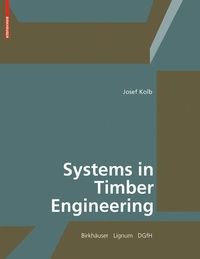
Systems in Timber Engineering
Loadbearing Structures and Component Layers
1st Edition
Published on 23. April 2008
320 pages
978-3-7643-8690-0 (ISBN)
Description

Timber construction has become completely modernized. It has gained considerably in market share with respect to competing building materials and is dominated by systems such as frame and solid timber construction. Every timber construction is determined by its structure. Hence it is essential to know the connections and relationships from the design stage right through to the construction phase. Systems in Timber Engineering takes a whole new approach to this subject. It is a comprehensive, analytical, and visually organized treatment, from the simple single-family house to the large-scale multistore structure. It includes the building envelope, which is so important for saving energy, and systems for ceilings and interior dividing walls, which are so essential from the vantage point of construction. This work uses plans, schematic drawings, and pictures to show the current and forward-looking state of the technology as applied in Switzerland, a leading country in the field of timber construction.
More details
Language
English
Place of publication
Basel/Berlin/Boston
Switzerland
Target group
Professional and scholarly
US School Grade: College Graduate Student
Illustrations
310 s/w Abbildungen, 55 farbige Abbildungen
310 b/w and 55 col. ill.
File size
165,02 MB
ISBN-13
978-3-7643-8690-0 (9783764386900)
Schweitzer Classification
Other editions
Additional editions
Josef Kolb | Lignum - Holzwirtschaft Schweiz | DGfH - German Society of Wood Research
Systems in Timber Engineering
Loadbearing Structures and Component Layers
Book
04/2008
1st Edition
Birkhäuser Verlag GmbH
€54.95
Shipment within 7-9 days
Persons
Josef Kolb war Leiter Technik bei der "Lignum" in Zürich und betätigt sich seit mehreren Jahren vielseitig als exzellenter Fachmann mit eigenem Ingenieurbüro im Bereich Holzbau.
Content
Principles. Material-related.- Timber construction systems. Loadbearing structure, building structure, design.- Building envelope, walls, suspended floors. Functions, layers, construction.- Basic parameters. Timber preservation, fire prevention.
a3 Conception and design (p. 23-24)
Detailed design
Detailed design means turning the conceptual ideas, the draft design, into clearly defined sizes, dimensions, layers and their arrangement, at the same time specifying junctions and details. In doing so, the interactive process between conception and design must always be taken into account, as mentioned above. The ideas often emerge out of the draft design, but the feasibility becomes apparent during the detailed design. During detailed design, the building work is given a clear configuration. Concerning the loadbearing structure the aim is to satisfy the requirements in terms of load-carrying capacity and serviceability. In the case of the walls, roofs and suspended floors, besides the structural engineering requirements, it is the building`s physics and energyrelated requirements that have to be coordinated with and optimised for the intended use.
Important conditions for simple interfaces between conception and design are a draft design coordinated with the timber building on plan (grid dimensions) and in section (storey heights) and from that the maintenance of system heights and component dimensions. Larger structural depths for suspended floors result in, for example, simpler and more economic constructions and at the same time offer space for services. Section b10 "Suspended floor structures" specifies typical system depths for the loads of residential and office buildings plus places of assembly. The grid dimension likewise influences the loadbearing system of a large timber building with respect to component dimensions and the number of joints.
Another conception and design rule is that component and functional layers should continue uninterrupted through the wallground floor and foundation, wall-wall, wall-suspended floor and wall-roof junctions. Contemporary conception and design therefore calls for coordinated concepts or systems for thermal performance, fire protection, sound insulation, moisture control, airtightness, etc. at the draft and detailed design stages.
In addition, through the skilful conception of plan and section it is possible to meet ideal sound insulation and fire protection requirements right from the draft design stage. The detailed design phase allows the architectural, technical, economic, and ecological conditions to be refined and optimised. Also important are the criteria of durability and maintenance. Good solutions can be achieved by choosing a suitable building form, well-thought-out designs and intelligent details. Added to this is the choice of species of wood and the surface finishes, possibly also precautions for chemical wood preservatives.
a3 20 Planning
Owing to the increasing industrial fabrication of timber structures, there has been a shift in the chronological order of the critical decision- making process of architects, engineers, specialists, and contractors. Things that in the past were first discussed on the building site, must now be specified well in advance of fabricating the walls, suspended floors, and roofs. Fig. a37 shows the planning, production and erection sequence (in weeks) for a medium- sized timber building in comparison with the conventional approach, which is frequently still the situation with masonry or concrete buildings.
Detailed design
Detailed design means turning the conceptual ideas, the draft design, into clearly defined sizes, dimensions, layers and their arrangement, at the same time specifying junctions and details. In doing so, the interactive process between conception and design must always be taken into account, as mentioned above. The ideas often emerge out of the draft design, but the feasibility becomes apparent during the detailed design. During detailed design, the building work is given a clear configuration. Concerning the loadbearing structure the aim is to satisfy the requirements in terms of load-carrying capacity and serviceability. In the case of the walls, roofs and suspended floors, besides the structural engineering requirements, it is the building`s physics and energyrelated requirements that have to be coordinated with and optimised for the intended use.
Important conditions for simple interfaces between conception and design are a draft design coordinated with the timber building on plan (grid dimensions) and in section (storey heights) and from that the maintenance of system heights and component dimensions. Larger structural depths for suspended floors result in, for example, simpler and more economic constructions and at the same time offer space for services. Section b10 "Suspended floor structures" specifies typical system depths for the loads of residential and office buildings plus places of assembly. The grid dimension likewise influences the loadbearing system of a large timber building with respect to component dimensions and the number of joints.
Another conception and design rule is that component and functional layers should continue uninterrupted through the wallground floor and foundation, wall-wall, wall-suspended floor and wall-roof junctions. Contemporary conception and design therefore calls for coordinated concepts or systems for thermal performance, fire protection, sound insulation, moisture control, airtightness, etc. at the draft and detailed design stages.
In addition, through the skilful conception of plan and section it is possible to meet ideal sound insulation and fire protection requirements right from the draft design stage. The detailed design phase allows the architectural, technical, economic, and ecological conditions to be refined and optimised. Also important are the criteria of durability and maintenance. Good solutions can be achieved by choosing a suitable building form, well-thought-out designs and intelligent details. Added to this is the choice of species of wood and the surface finishes, possibly also precautions for chemical wood preservatives.
a3 20 Planning
Owing to the increasing industrial fabrication of timber structures, there has been a shift in the chronological order of the critical decision- making process of architects, engineers, specialists, and contractors. Things that in the past were first discussed on the building site, must now be specified well in advance of fabricating the walls, suspended floors, and roofs. Fig. a37 shows the planning, production and erection sequence (in weeks) for a medium- sized timber building in comparison with the conventional approach, which is frequently still the situation with masonry or concrete buildings.
