

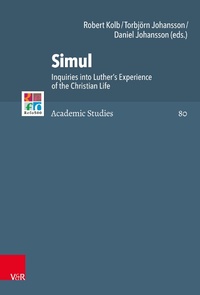
Simul
Inquiries into Luther's Experience of the Christian Life
1st Edition
Published on 7. June 2021
270 pages
978-3-647-56552-1 (ISBN)
Description

This volume introduces an important concept which hitherto has not gotten the recognition it deserves. The concept simul, the idea of a both-and in theology, is primarily associated with the Lutheran understanding of justification. The formula simul iustus et peccator is a shorthand for the nucleus and heart of the Reformation. But the concept, which implies a tension or even a paradox, appears to play a significant role in other areas of theological reflection. This volume highlights a number of areas in which this idea historically has played an important role, as well as its potential in the contemporary conversation. The aim of the work is to provide an informed and readable introduction to the simul concept in various areas of systematical theology and Biblical exegesis.
Dr. Robert Kolb ist Professor em. für Systematische Theologie am Concordia Seminary in Saint Louis, USA.
Dr. Robert Kolb ist Professor em. für Systematische Theologie am Concordia Seminary in Saint Louis, USA.
More details
Other editions
Additional editions
Robert A. Kolb | Torbjörn Johansson | Daniel Johansson
Simul
Inquiries into Luther's Experience of the Christian Life
Book
06/2021
1st Edition
Vandenhoeck & Ruprecht
€85.00
Shipment within 5-7 days
Persons
Dr. Robert Kolb ist Professor em. für Systematische Theologie am Concordia Seminary in Saint Louis, USA.
Content
- Cover
- Title page
- Copyright
- Table of contents
- Body
- Abbreviations
- Robert Kolb, Torbjörn Johansson, Daniel Johansson: Preface
- Introduction
- Torbjörn Johansson: The Simul Dimension of Lutheran Theology
- 1. Law and Gospel
- 2. Justification
- 3. Simul iustus et peccator, the Certitude of Salvation and Experience
- 4. Holy Scripture as Norm
- 5. Holy Scripture as Means of Grace
- 6. Baptism
- 7. The Lord's Supper
- 8. Predestination
- 9. Heavenly and Earthly Citizenship
- 10. Simul and Sola
- 11. Concluding Reflections
- Luther
- Oswald Bayer: Luther's "Simul Iustus et Peccator"
- 1. Preliminary Remarks
- 2. A Statement of the Problem
- 3. The Philosophy of Science Perspective
- 4. Being and Becoming - The Two Dimensions of Baptism
- 5. The Primacy of the Identifying "as" not the Teleological "to"
- 6. God's Eternal Present
- 7. A Dual Perspective: The Category of Relatio
- Erik H. Herrmann: Luther and the Importance of the Hebrew Heritage for His World of Thought
- 1. Luther and the Old Testament
- 2. The Hebrew Homo Peccator
- 3. The Hebrew Homo Religiosus
- Robert Kolb: Old Adam, New Martin
- 1. The Mystery of Sin and Evil
- 2. The Believer's Contrary Self-Perceptions
- 3. Simul iustus et peccator as Gospel and as Law
- 4. Simul iustus et peccator in Colossians
- 5. Baptismal Dying and Rising in John 19
- 6. Conclusion
- Roland Ziegler: Simul and the Lord's Supper
- 1. Introduction
- 2. Simul of the Body and Blood / Bread and Wine
- 2.1 God Gives Himself in External Things - the Structural Similarity between the Means of Grace
- 2.2 The Proper of the Lord's Supper: Simul of Body and Blood and Bread and Wine
- 2.3 Praedicatio identica / Synecdoche
- 2.4 Christological Parallelism
- 3. The Simul of Human and Divine Action
- 3.1 Human and Divine Action in the Church
- 3.2 The Word Constitutes the Sacrament
- 3.3 The Institution as Basis for Human Action
- 3.4 Human and Divine Speaking
- 3.5 Human Action as Condition of Possibility of Divine Action (katabatic and anabatic)?
- 4. Simul of Times
- 5. The Simul of Christ and Faith / The Simul of Spiritual and Oral Eating
- 6. Conclusion
- Mark Mattes: Martin Luther on simul pulcher et turpis
- 1. Luther and Lutherans on Beauty
- 2. Medieval Perspectives on Beauty
- 3. Beauty as a Transcendental
- 4. Later Psalm Commentaries: Psalm 8 and Psalm 45
- 5. Lectures on Genesis: Creation Beauty and Gospel Beauty
- 6. Conclusion
- The Lutheran Tradition
- Timothy J. Wengert: Philip Melanchthon and the "Simul Iustus et Peccator"
- 1. Melanchthon's Early Publications
- 1.1. The Loci communes seu Hypotyposes theologicae of 1521
- 1.2. The Annotationes in Epistolam ad Romanos of 1522
- 2. Melanchthon in Mid-Career
- 2.1. The Dispositio orationis in Epistolam ad Romanos (1529/30)
- 2.2. The Apology of the Augsburg Confession (1531)
- 2.3. The Commentarii in Epistolam Pauli ad Romanos (1532)
- 2.4. The Second Edition of the Loci communes (1535)
- 2.5. The Commentarii in Epistolam Pauli ad Romanos of 1540 and the Loci communes of 1543
- 3. A Final Clarification: The Response to Andreas Osiander in the 1550s
- 4. Conclusion
- Jakob Valdemar Olsen: Kierkegaard, the Paradox, and the Lutheran Heritage
- 1. The Paradox in Luther and Kierkegaard
- 2. Kierkegaard as a Lutheran
- 3. Kierkegaard's Concept of Hereditary Sin
- 4. Logic and Contradictions
- 5. A Relational Anthropology
- 6. Sin as the Distinguishing Mark of Christianity
- 7. Sin and Grace
- Harald Jung: The "Simul-Dimension" and its Possible Contribution toward a View of Social Theory
- 1. A Secret Mission and a "Comissioned Work" in Social Theory
- 2. The Dilemma of Two Alternative Perspectives
- 3. A "Missing Dimension" and a Proposal for a Theoretical Framework of Five Ideal Type Models
- 4. Three More Types: "Paradigmatic Discipleship" (B), "Dualistic-Realistic Moderation," (D) and "Two Godly Realms (Regimenten) in Eschatological Expectation" (C)
- 5. The "simul iustus et peccator-Dimension" and the Program of Economic Order in the "Freiburg Memorandum" 1942/43
- Bernd Wannenwetsch: The Simultaneity of Two Citizenships
- 1. Simul iustus et peccator: "both and"
- 2. A Simultaneity of Two Regiments
- 3. Fellow Citizens of the Saints: Ecclesiastical Rule
- 4. From Spatial to Temporal: Luther's Modification of the Augustinian Framework
- 5. Chalcedonian Logic: Versus the Devil's Cookbook
- 6. Church as Bearer of the Tension between the Two Regiments
- 7. Civic Responsibility in the Earthly Regiment
- 8. The Luther Myth: How the Teacher of Two Regiments and Political Resistance Became "Hitler's Ally"
- 9. Clichés: the "Prince-Bishops" of Modernity
- Exegetical perspectives
- Tim Saleska: The Clarity of Paradox
- 1. Introduction
- 2. What Does God Show Moses?
- 3. What Do Modern Readers Do?
- 4. What Does Moses Do?
- 5. The Place of Exodus 34:6-7 in Israel's On-Going Life with Yhwh
- 6. The Hard Truth of Numbers 14
- 7. Pastoral Care in the Midst of Such Contradiction
- 8. Conclusion
- Daniel Johansson: The Shema, Kyrios, Theos, and Simul
- 1. Introduction
- 2. The Shema in the New Testament
- 3. Old Testament YHWH Texts in Paul
- 4. The Lord in the Gospel of Mark
- 5. Jesus as "God" in the Book of Revelation
- 6. Conclusion
- Timo Laato: Justification in the Sermon on the Mount
- 1. Introduction
- 2. The Beatitudes - in General
- 3. The Structure of the Beatitudes
- 4. The Beatitudes in Light of Isaiah 61
- 5. The Righteousness Acquired by Christ (the Messiah)
- 6. The Righteousness Practiced by Christians
- 7. The Concept of "Righteousness": The Relationship between the First Four and the Last Four Beatitudes
- 8. Persecution for the Sake of Jesus
- 9. The Greater Righteousness (5:20)
- 10. Different Nuances in the Concept of "Righteousness"
- 11. To Practice Your Righteousness (6:1)
- 12. To Seek God's Kingdom and His Righteousness (6:33)
- 13. The Righteous in 25:31-46
- 14. Summary and Conclusion
- Person Index
- Index of Scripture Passages
- Notes on Contributors
