

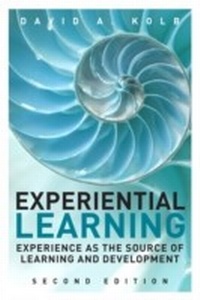
Experiential Learning
Experience as the Source of Learning and Development
2nd Edition
Published on 17. December 2014
416 pages
978-0-13-389250-5 (ISBN)
Description

Experiential learning is a powerful and proven approach to teaching and learning that is based on one incontrovertible reality: people learn best through experience. Now, in this extensively updated book, David A. Kolb offers a systematic and up-to-date statement of the theory of experiential learning and its modern applications to education, work, and adult development.
Experiential Learning, Second Edition builds on the intellectual origins of experiential learning as defined by figures such as John Dewey, Kurt Lewin, Jean Piaget, and L.S. Vygotsky, while also reflecting three full decades of research and practice since the classic first edition.
Kolb models the underlying structures of the learning process based on the latest insights in psychology, philosophy, and physiology. Building on his comprehensive structural model, he offers an exceptionally useful typology of individual learning styles and corresponding structures of knowledge in different academic disciplines and careers. Kolb also applies experiential learning to higher education and lifelong learning, especially with regard to adult education.
This edition reviews recent applications and uses of experiential learning, updates Kolb's framework to address the current organizational and educational landscape, and features current examples of experiential learning both in the field and in the classroom. It will be an indispensable resource for everyone who wants to promote more effective learning: in higher education, training, organizational development, lifelong learning environments, and online.
Experiential Learning, Second Edition builds on the intellectual origins of experiential learning as defined by figures such as John Dewey, Kurt Lewin, Jean Piaget, and L.S. Vygotsky, while also reflecting three full decades of research and practice since the classic first edition.
Kolb models the underlying structures of the learning process based on the latest insights in psychology, philosophy, and physiology. Building on his comprehensive structural model, he offers an exceptionally useful typology of individual learning styles and corresponding structures of knowledge in different academic disciplines and careers. Kolb also applies experiential learning to higher education and lifelong learning, especially with regard to adult education.
This edition reviews recent applications and uses of experiential learning, updates Kolb's framework to address the current organizational and educational landscape, and features current examples of experiential learning both in the field and in the classroom. It will be an indispensable resource for everyone who wants to promote more effective learning: in higher education, training, organizational development, lifelong learning environments, and online.
All prices
More details
Edition
2nd edition
Language
English
Place of publication
NJ
United States
Publishing group
Pearson Education (US)
Target group
College/higher education
File size
7,75 MB
ISBN-13
978-0-13-389250-5 (9780133892505)
Copyright in bibliographic data and cover images is held by Nielsen Book Services Limited or by the publishers or by their respective licensors: all rights reserved.
Schweitzer Classification
Other editions
Additional editions
Book
04/2015
2nd Edition
Pearson FT Press
€129.50
Shipment within 15-20 days
Person
Craig Stanford is a professor of anthropology and biological sciences at the University of Southern California, where he also co-directs the Jane Goodall Research Center. He has conducted field research on primate behavior in south Asia, Latin America, and East Africa. He is well known for his long-term studies of meat-eating among wild chimpanzees in Gombe, Tanzania, and of the relationship between mountain gorillas and chimpanzees in the Impenetrable Forest of Uganda. He has authored or coauthored more than 130 scientific publications. Craig has received USC's highest teaching awards for his introductory biological anthropology course.
John Allen is a research scientist in the Dornsife Cognitive Neuroscience Imaging Center and the Brain and Creativity Institute at the University of Southern California. He is also Research Associate in the Department of Anthropology, Indiana University. Previously, he was a neuroscience researcher at the University of Iowa College of Medicine and a faculty member in the Department of Anthropology at the University of Auckland, New Zealand, for several years. His primary research interests are the evolution of the human brain and behaviour, and behavioral disease. He also has research experience in molecular genetics, nutritional anthropology, and the history of anthropology. He has conducted fieldwork in Japan, New Zealand, Papua New Guinea, and Palau. He has received university awards for teaching introductory courses in biological anthropology both as a graduate student instructor at the University of California and as a faculty member at the University of Auckland.
Susan Anton is a professor in the Center for the Study of Human Origins, Department of Anthropology at New York University, where she also directs the M.A. program in Human Skeletal Biology. Her field research concerns the evolution of genus Homo in Indonesia and human impact on island ecosystems in the South Pacific. She is best known for her research on H. erectus in Kenya and Indonesia, for which she was elected as a fellow of the American Association for the Advancement of Science (AAAS). She is the President of the American Association of Physical Anthropologists and past editor of the Journal of Human Evolution. She received awards for teaching as a graduate student instructor of introductory physical anthropology and anatomy at the University of California, was Teacher of the Year while at the University of Florida, and received a Golden Dozen teaching award and the Distinguished Teaching Medal from NYU.
John Allen is a research scientist in the Dornsife Cognitive Neuroscience Imaging Center and the Brain and Creativity Institute at the University of Southern California. He is also Research Associate in the Department of Anthropology, Indiana University. Previously, he was a neuroscience researcher at the University of Iowa College of Medicine and a faculty member in the Department of Anthropology at the University of Auckland, New Zealand, for several years. His primary research interests are the evolution of the human brain and behaviour, and behavioral disease. He also has research experience in molecular genetics, nutritional anthropology, and the history of anthropology. He has conducted fieldwork in Japan, New Zealand, Papua New Guinea, and Palau. He has received university awards for teaching introductory courses in biological anthropology both as a graduate student instructor at the University of California and as a faculty member at the University of Auckland.
Susan Anton is a professor in the Center for the Study of Human Origins, Department of Anthropology at New York University, where she also directs the M.A. program in Human Skeletal Biology. Her field research concerns the evolution of genus Homo in Indonesia and human impact on island ecosystems in the South Pacific. She is best known for her research on H. erectus in Kenya and Indonesia, for which she was elected as a fellow of the American Association for the Advancement of Science (AAAS). She is the President of the American Association of Physical Anthropologists and past editor of the Journal of Human Evolution. She received awards for teaching as a graduate student instructor of introductory physical anthropology and anatomy at the University of California, was Teacher of the Year while at the University of Florida, and received a Golden Dozen teaching award and the Distinguished Teaching Medal from NYU.
Content
Foreword x
About the Author xii
Preface xiii
Introduction xvi
Part I Experience and Learning
Chapter 1 The Foundations of Contemporary Approaches to Experiential Learning 1
Experiential Learning in Higher Education: The Legacy of John Dewey 4
Experiential Learning in Training and Organization Development: The Contributions of Kurt Lewin 8
Jean Piaget and the Cognitive-Development Tradition of Experiential Learning 12
Other Contributions to Experiential Learning Theory 15
Update and Reflections 19
Foundational Scholars of Experiential Learning Theory 19
Liminal Scholars 20
Contributions to Experiential Learning 23
Chapter 2 The Process of Experiential Learning 31
Three Models of the Experiential Learning Process 32
Characteristics of Experiential Learning 37
Summary: A Definition of Learning 49
Update and Reflections 50
The Learning Cycle and the Learning Spiral 50
Understanding the Learning Cycle 50
The Learning Spiral 61
Part II The Structure of Learning and Knowledge
Chapter 3 Structural Foundations of the Learning Process 65
Process and Structure in Experiential Learning 66
The Prehension Dimension-Apprehension Versus Comprehension 69
The Transformation Dimension-Intention and Extension 77
Summary 85
Update and Reflections 87
Experiential Learning and the Brain 87
James Zull and the Link between the Learning Cycle and Brain Functioning 88
My Brain Made Me Do It? 94
Chapter 4 Individuality in Learning and the Concept of Learning Styles 97
The Scientific Study of Individuality 98
Learning Styles as Possibility-Processing Structures 100
Assessing Individual Learning Styles: The Learning Style Inventory 104
Evidence for the Structure of Learning 111
Characteristics of the Basic Learning Styles 114
Summary and Conclusion 135
Update and Reflections 137
Individuality, the Self, and Learning Style 137
Western and Eastern Views of the Self 138
Experiential Learning and the Self 139
Learning Style 141
Chapter 5 The Structure of Knowledge 153
Apprehension vs Comprehension-A Dual-Knowledge Theory 154
The Dialectics of Apprehension and Comprehension 159
The Structure of Social Knowledge: World Hypotheses 164
Summary 173
Social Knowledge as Living Systems of Inquiry-The Relation between the Structure of Knowledge and Fields of Inquiry and Endeavor 175
Update and Reflections 186
The Spiral of Knowledge Creation 186
Personal Characteristics and Ways of Knowing 188
Knowledge Structures and Disciplinary Learning Spaces 190
The knowledge Structures of Experiential Learning 192
Part III Learning and Development
Chapter 6 The Experiential Learning Theory of Development 197
Learning and Development as Transactions between Person and Environment 198
Differentiation and Integration in Development 199
Unilinear vs Multilinear Development 201
The Experiential Learning Theory of Development 205
Consciousness, Learning, and Development 210
Adaptation, Consciousness, and Development 216
Update and Reflections 225
Culture and Context 226
Individual Differences and Multilinear Development 227
Integration and Advanced Stages of Adult Development 228
Implications for Experiential Learning Theory Development Theory 234
Chapter 7 Learning and Development in Higher Education 239
Specialized Development and the Process of Accentuation 242
Undergraduate Student Development in a Technological University 244
Professional Education and Career Adaptation 261
A Comparative Study of Professional Education in Social Work and Engineering 263
Managing the Learning Process 276
Implications for Higher Education 283
Update and Reflections 287
Becoming an Experiential Educator 287
Chapter 8 Lifelong Learning and Integrative Development 311
Adaptive Flexibility and Integrative Development 315
On Integrity and Integrative Knowledge 327
Update and Reflections 333
Lifelong Learning and the Learning Way 333
Bibliography 355
Index 377
About the Author xii
Preface xiii
Introduction xvi
Part I Experience and Learning
Chapter 1 The Foundations of Contemporary Approaches to Experiential Learning 1
Experiential Learning in Higher Education: The Legacy of John Dewey 4
Experiential Learning in Training and Organization Development: The Contributions of Kurt Lewin 8
Jean Piaget and the Cognitive-Development Tradition of Experiential Learning 12
Other Contributions to Experiential Learning Theory 15
Update and Reflections 19
Foundational Scholars of Experiential Learning Theory 19
Liminal Scholars 20
Contributions to Experiential Learning 23
Chapter 2 The Process of Experiential Learning 31
Three Models of the Experiential Learning Process 32
Characteristics of Experiential Learning 37
Summary: A Definition of Learning 49
Update and Reflections 50
The Learning Cycle and the Learning Spiral 50
Understanding the Learning Cycle 50
The Learning Spiral 61
Part II The Structure of Learning and Knowledge
Chapter 3 Structural Foundations of the Learning Process 65
Process and Structure in Experiential Learning 66
The Prehension Dimension-Apprehension Versus Comprehension 69
The Transformation Dimension-Intention and Extension 77
Summary 85
Update and Reflections 87
Experiential Learning and the Brain 87
James Zull and the Link between the Learning Cycle and Brain Functioning 88
My Brain Made Me Do It? 94
Chapter 4 Individuality in Learning and the Concept of Learning Styles 97
The Scientific Study of Individuality 98
Learning Styles as Possibility-Processing Structures 100
Assessing Individual Learning Styles: The Learning Style Inventory 104
Evidence for the Structure of Learning 111
Characteristics of the Basic Learning Styles 114
Summary and Conclusion 135
Update and Reflections 137
Individuality, the Self, and Learning Style 137
Western and Eastern Views of the Self 138
Experiential Learning and the Self 139
Learning Style 141
Chapter 5 The Structure of Knowledge 153
Apprehension vs Comprehension-A Dual-Knowledge Theory 154
The Dialectics of Apprehension and Comprehension 159
The Structure of Social Knowledge: World Hypotheses 164
Summary 173
Social Knowledge as Living Systems of Inquiry-The Relation between the Structure of Knowledge and Fields of Inquiry and Endeavor 175
Update and Reflections 186
The Spiral of Knowledge Creation 186
Personal Characteristics and Ways of Knowing 188
Knowledge Structures and Disciplinary Learning Spaces 190
The knowledge Structures of Experiential Learning 192
Part III Learning and Development
Chapter 6 The Experiential Learning Theory of Development 197
Learning and Development as Transactions between Person and Environment 198
Differentiation and Integration in Development 199
Unilinear vs Multilinear Development 201
The Experiential Learning Theory of Development 205
Consciousness, Learning, and Development 210
Adaptation, Consciousness, and Development 216
Update and Reflections 225
Culture and Context 226
Individual Differences and Multilinear Development 227
Integration and Advanced Stages of Adult Development 228
Implications for Experiential Learning Theory Development Theory 234
Chapter 7 Learning and Development in Higher Education 239
Specialized Development and the Process of Accentuation 242
Undergraduate Student Development in a Technological University 244
Professional Education and Career Adaptation 261
A Comparative Study of Professional Education in Social Work and Engineering 263
Managing the Learning Process 276
Implications for Higher Education 283
Update and Reflections 287
Becoming an Experiential Educator 287
Chapter 8 Lifelong Learning and Integrative Development 311
Adaptive Flexibility and Integrative Development 315
On Integrity and Integrative Knowledge 327
Update and Reflections 333
Lifelong Learning and the Learning Way 333
Bibliography 355
Index 377
