

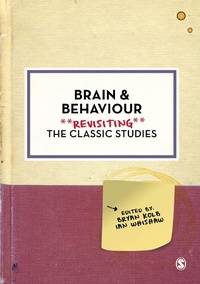
Brain and Behaviour
Revisiting the Classic Studies
1st Edition
Published on 18. October 2016
296 pages
978-1-4739-5292-8 (ISBN)
Description

Revisiting the Classic Studies is a series of texts that introduces readers to the studies in psychology that changed the way we think about core topics in the discipline today. It provokes students to ask more interesting and challenging questions about the field by encouraging a deeper level of engagement both with the details of the studies themselves and with the nature of their contribution. Edited by leading scholars in their field and written by researchers at the cutting edge of these developments, the chapters in each text provide details of the original works and their theoretical and empirical impact, and then discuss the ways in which thinking and research has advanced in the years since the studies were conducted.
Brain and Behaviour: Revisiting the Classic Studies traces 17 ground-breaking studies by researchers such as Gage, Luria, Sperry, and Tulving to re-examine and reflect on their findings and engage in a lively discussion of the subsequent work that they have inspired.
Suitable for students on neuropsychology courses at all levels, as well as anyone with an enquiring mind.
Brain and Behaviour: Revisiting the Classic Studies traces 17 ground-breaking studies by researchers such as Gage, Luria, Sperry, and Tulving to re-examine and reflect on their findings and engage in a lively discussion of the subsequent work that they have inspired.
Suitable for students on neuropsychology courses at all levels, as well as anyone with an enquiring mind.
More details
Series
Edition
First Edition
Language
English
Place of publication
London
United Kingdom
Target group
College/higher education
Product notice
Reflowable
ISBN-13
978-1-4739-5292-8 (9781473952928)
Copyright in bibliographic data and cover images is held by Nielsen Book Services Limited or by the publishers or by their respective licensors: all rights reserved.
Schweitzer Classification
Other editions
Additional editions
Book
11/2016
1st Edition
SAGE Publications Ltd
€148.56
Shipment within 15-20 days
Persons
Bryan Kolb is a native of Calgary, Canada and is currently a Professor in the Department Neuroscience at the University of Lethbridge, Canada, where he has been since 1976. He received his PhD from Pennsylvania State University in 1973 and did postdoctoral work at the U of Western Ontario and the Montreal Neurological Institute. His recent work has focused on the development of the prefrontal cortex and how neurons of the cerebral cortex change in response to various developmental factors including hormones, experience, stress, drugs, neurotrophins, and injury, and how these changes are related to behaviour. Bryan Kolb has published 5 books, including two textbooks with Ian Whishaw (Fundamentals of Human Neuropsychology, 7th Edition; Introduction to Brain and Behavior, 5th Edition), and over 375 articles and chapters. Kolb is a Fellow of the Royal Society of Canada. He is currently a member of the Canadian Institute for Advanced Research program in Child Brain Development. He and his wife train and show horses in Western riding performance events.
Ian Whishaw received his PhD from Western University and is a Professor of Neuroscience at the University of Lethbridge. He has had visiting appointments at the University of Texas, University of Michigan, Cambridge University, and the University of Strasbourg. He is a fellow of Clare Hall Cambridge, The Canadian Psychological Association, The American Psychological Association, and the Royal Society of Canada. He is a recipient of the Canadian Humane Society Medal for bravery, the Speaker Medal for Research, The Alberta Science and Technology Leadership Award, the Donald O Hebb Prize from the Canadian Society for Brain Behavior and Cognitive Science, and the distinguished teaching medal from the University of Lethbridge. He has received the keys to the City of Lethbridge and honorary degrees from Thompson Rivers University and the University of Lethbridge. His research addresses the neural basis of skilled movement and the neural basis of brain disease. The Institute of Scientific Information includes him in its list of most cited neuroscientists and the most highly cited neuroscientist in Canada.
Ian Whishaw received his PhD from Western University and is a Professor of Neuroscience at the University of Lethbridge. He has had visiting appointments at the University of Texas, University of Michigan, Cambridge University, and the University of Strasbourg. He is a fellow of Clare Hall Cambridge, The Canadian Psychological Association, The American Psychological Association, and the Royal Society of Canada. He is a recipient of the Canadian Humane Society Medal for bravery, the Speaker Medal for Research, The Alberta Science and Technology Leadership Award, the Donald O Hebb Prize from the Canadian Society for Brain Behavior and Cognitive Science, and the distinguished teaching medal from the University of Lethbridge. He has received the keys to the City of Lethbridge and honorary degrees from Thompson Rivers University and the University of Lethbridge. His research addresses the neural basis of skilled movement and the neural basis of brain disease. The Institute of Scientific Information includes him in its list of most cited neuroscientists and the most highly cited neuroscientist in Canada.
Content
Chapter 1: An introduction to classic studies in behavioural neuroscience - Bryan Kolb and Ian Q. Wishaw
Part 1: CEREBRAL ORGANIZATION
Chapter 2: Revisiting Luria The Organization of Higher Cortical Functions - Bryan Kolb
Chapter 3: Revisiting Penfield and Boldrey - Somatic motor and sensory representation in the cerebral cortex of man as studied by electrical stimulation - Ian Q. Whishaw
Chapter 4: Revisiting Kaas and Colleagues - The homunculus: The discovery of multiple representations within the "primary" somatosensory cortex - Leah Krubitzer and Mary Baldwin
Chapter 5: Revisiting Ungerleider and Mishkin - Two cortical visual systems - Jason W. Flindall and Claudia L. R. Gonzalez
Chapter 6: Revisiting Sperry: What the split brain tells us - Michael C. Corballis
PART 2: CORTICAL FUNCTIONS
Chapter 7: Revisiting Hebb - The Organization of Behavior - Richard E. Brown
Chapter 8: Revisiting Scoville and Milner - Loss of recent memory after bilateral hippocampal lesions - Robert J. Sutherland
Chapter 9: Revisiting MacLean - The limbic system and emotional behavior - Marie-H. Monfils
Chapter 10: Revisiting Phineas Gage - Lessons we learned from damaged brains - Antoine Bechara
Chapter 11: Revisiting Tulving et al., - Priming of semantic autobiographical knowledge: A case study of retrograde amnesia - Melanie J. Sekeres, Gordon Winocur and Morris Moscovitch
Chapter 12: Revisiting O'Keefe - Place units in the hippocampus of the freely moving rat - Matthew Shapiro
PART 3: CHEMICALS AND BEHAVIOUR
Chapter 13: Revisiting Phoenix, Goy, Gerall and Young: The Organizational/Activational Theory of Steroid-Mediated Sexual Differentiation of Brain and Behavior - Sarah Raza and Robbin Gibb
Chapter 14: Beyond Wise et al - Neuroleptic-induced "anhedonia" in rats: pimozide blocks reward quality of food. - Terry E. Robinson and Kent C. Berridge
PART 4: BRAIN PLASTICITY
Chapter 15: Revisiting Krech, Rosenzweig, & Bennett Effects of environmental complexity and training on brain chemistry - Bryan Kolb
Chapter 16: Revisiting Harry Harlow - Love in infant monkeys - Bryan Kolb and Stephen J. Suomi
Chapter 17: Bevisiting Bliss and L?mo - Long-term Potentiation and the Synaptic Basis of Learning and Memory - G. Campbell Teskey
Chapter 18: Beyond Pons et al - Massive cortical reorganization after sensory deafferentation in adult macaques, Science, 1991 - Theresa A. Jones
Chapter 19: Revisiting Roland - How Does the Human Brain Produce Complex Motor Behaviours? Insights from Functional Neuroimaging - Jenni M. Karl and Jody C. Culham
Part 1: CEREBRAL ORGANIZATION
Chapter 2: Revisiting Luria The Organization of Higher Cortical Functions - Bryan Kolb
Chapter 3: Revisiting Penfield and Boldrey - Somatic motor and sensory representation in the cerebral cortex of man as studied by electrical stimulation - Ian Q. Whishaw
Chapter 4: Revisiting Kaas and Colleagues - The homunculus: The discovery of multiple representations within the "primary" somatosensory cortex - Leah Krubitzer and Mary Baldwin
Chapter 5: Revisiting Ungerleider and Mishkin - Two cortical visual systems - Jason W. Flindall and Claudia L. R. Gonzalez
Chapter 6: Revisiting Sperry: What the split brain tells us - Michael C. Corballis
PART 2: CORTICAL FUNCTIONS
Chapter 7: Revisiting Hebb - The Organization of Behavior - Richard E. Brown
Chapter 8: Revisiting Scoville and Milner - Loss of recent memory after bilateral hippocampal lesions - Robert J. Sutherland
Chapter 9: Revisiting MacLean - The limbic system and emotional behavior - Marie-H. Monfils
Chapter 10: Revisiting Phineas Gage - Lessons we learned from damaged brains - Antoine Bechara
Chapter 11: Revisiting Tulving et al., - Priming of semantic autobiographical knowledge: A case study of retrograde amnesia - Melanie J. Sekeres, Gordon Winocur and Morris Moscovitch
Chapter 12: Revisiting O'Keefe - Place units in the hippocampus of the freely moving rat - Matthew Shapiro
PART 3: CHEMICALS AND BEHAVIOUR
Chapter 13: Revisiting Phoenix, Goy, Gerall and Young: The Organizational/Activational Theory of Steroid-Mediated Sexual Differentiation of Brain and Behavior - Sarah Raza and Robbin Gibb
Chapter 14: Beyond Wise et al - Neuroleptic-induced "anhedonia" in rats: pimozide blocks reward quality of food. - Terry E. Robinson and Kent C. Berridge
PART 4: BRAIN PLASTICITY
Chapter 15: Revisiting Krech, Rosenzweig, & Bennett Effects of environmental complexity and training on brain chemistry - Bryan Kolb
Chapter 16: Revisiting Harry Harlow - Love in infant monkeys - Bryan Kolb and Stephen J. Suomi
Chapter 17: Bevisiting Bliss and L?mo - Long-term Potentiation and the Synaptic Basis of Learning and Memory - G. Campbell Teskey
Chapter 18: Beyond Pons et al - Massive cortical reorganization after sensory deafferentation in adult macaques, Science, 1991 - Theresa A. Jones
Chapter 19: Revisiting Roland - How Does the Human Brain Produce Complex Motor Behaviours? Insights from Functional Neuroimaging - Jenni M. Karl and Jody C. Culham
