

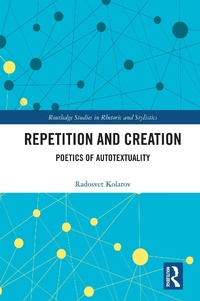
Repetition and Creation
Poetics of Autotextuality
1st Edition
Published on 29. December 2020
276 pages
978-1-000-33060-1 (ISBN)
Description

This book advances the notion of autotextuality, the dialogue between works in an author's oeuvre, and the ways in which new texts are created in self-repetition through the tracing and revisiting of past texts and the subsequent uncovering of undisclosed meanings, unexhausted constructive principles, and alternative versions.
Kolarov draws on cognitive models, such as dual coding theory and conceptual blending, to substantiate a theory of autotextuality and build on previous work on self-repetition and difference to highlight the notion of "discursive desire," in which new meanings are generated through repetition, and its distinct relationship to creativity. Drawing on analyses of well-established works in Bulgarian as well as the established oeuvres of such authors as Gogol, Dostoevsky, Kafka, and Baudelaire, the volume explores key themes in autotextuality such as the functions of creative memory, the connections between word and image, and the hermeneutic relationships and steps of transformation between texts.
This innovative work addresses topical questions of importance in literary theory today and will be of interest to students and scholars in literary studies and related areas of study within such fields as cognitive science, quantum mechanics, and psychology.
Kolarov draws on cognitive models, such as dual coding theory and conceptual blending, to substantiate a theory of autotextuality and build on previous work on self-repetition and difference to highlight the notion of "discursive desire," in which new meanings are generated through repetition, and its distinct relationship to creativity. Drawing on analyses of well-established works in Bulgarian as well as the established oeuvres of such authors as Gogol, Dostoevsky, Kafka, and Baudelaire, the volume explores key themes in autotextuality such as the functions of creative memory, the connections between word and image, and the hermeneutic relationships and steps of transformation between texts.
This innovative work addresses topical questions of importance in literary theory today and will be of interest to students and scholars in literary studies and related areas of study within such fields as cognitive science, quantum mechanics, and psychology.
More details
Series
Edition
1. Auflage
Language
English
Place of publication
London
United Kingdom
Publishing group
Taylor & Francis Ltd
Target group
College/higher education
Product notice
Reflowable
ISBN-13
978-1-000-33060-1 (9781000330601)
Copyright in bibliographic data and cover images is held by Nielsen Book Services Limited or by the publishers or by their respective licensors: all rights reserved.
Schweitzer Classification
Other editions
Additional editions
Book
08/2022
1st Edition
Routledge
€67.60
Shipment within 15-20 days
Book
12/2020
1st Edition
Routledge
€206.60
Shipment within 15-20 days
Person
Radosvet Kolarov is Associate Professor at the Institute for Literature at the Bulgarian Academy of Sciences, Bulgaria.
Content
CONTENTS
Introduction
Part I
Main Concepts
1. A Work and OEuvre: Intra/Intertextuality
2. Discursive Desire: Poetics of Repetitiveness
3. Hesitation: A Theoretical Digression
Part II
Generative Models
4. The Work of the Matrix
5. Frames, Scenarios, Networks
6. The Initiation Work
7. Self-polemic
8. Self-parody
Part III
Creative Memory
9. Memory Versus Machine
10. The Virtual Figure
11. Word or Image: The Forms of Memory
Part IV
Hermeneutic Autotextuality
12. The Amplifier Work
13. The Explicator Work
14. The Transmodal Idea
Afterword
Index
Afterword
Introduction
Part I
Main Concepts
1. A Work and OEuvre: Intra/Intertextuality
2. Discursive Desire: Poetics of Repetitiveness
3. Hesitation: A Theoretical Digression
Part II
Generative Models
4. The Work of the Matrix
5. Frames, Scenarios, Networks
6. The Initiation Work
7. Self-polemic
8. Self-parody
Part III
Creative Memory
9. Memory Versus Machine
10. The Virtual Figure
11. Word or Image: The Forms of Memory
Part IV
Hermeneutic Autotextuality
12. The Amplifier Work
13. The Explicator Work
14. The Transmodal Idea
Afterword
Index
Afterword
