

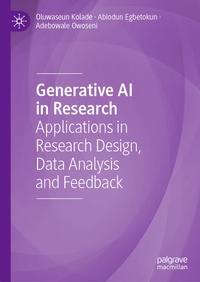
Generative AI in Research
Description

The growing popularity of Generative AI has stirred new debates about the future of knowledge production. With a prompt and a click, regular users can now generate contents on just about any topic of interest, drawing from hundreds of billions of parameters with which the latest versions of Gen AI models are trained. As Generative AI rapidly evolves with more advanced features and capabilities, stakeholders have expressed worries that AI models will displace humans as central agents in the research process. This book examines the case for and against applications of Gen AI in research, highlighting the prospects and pitfalls. Using exemplar prompts and custom GPTs created by the authors, it explores prospective use cases for automated data processing, complex modelling and simulations; applications in experimental designs; and review of draft manuscripts. The book also engages with key issues around algorithmic bias, inaccuracies, fake information, epistemic injustice, and the ethics of AI applications in research.
In some ways a companion piece to the authors' previous title, 'Generative AI in Higher Education: Innovation Strategies for Teaching and Learning', this book has a particularly practical appeal for researchers, as well as university officials and policymakers getting to grips with the explosion of AI-assisted research. It will also be of value to scholars of AI and innovation strategy in higher education.
Reviews / Votes
"Kolade, Owoseni, and Egbetokun's AI in Research is a timely and thought provoking exploration of how generative AI is transforming the research enterprise. The book strikes a careful balance between optimism and caution, showing both the unprecedented opportunities AI offers for designing projects, generating data, and engaging the public, as well as the serious ethical, methodological, and epistemic challenges it raises. With rich case studies and practical tools, including custom GPT applications, the authors move beyond surface level commentary to provide a rigorous, accessible, and nuanced roadmap for integrating AI responsibly into research. Their engagement with topics such as epistemic injustice, bias in training data, and the risks of "AI hallucinations" makes this book stand out as not just a technical guide but a critical reflection on the future of knowledge production." (Professor Felix Arndt, Eyton Director, Conrad School of Entrepreneurship and Business at the University of Waterloo, Canada)
"Clearly, AI has come to stay whether we like it or not. I liken the scepticism surrounding AI to the same way some were unsure of what the internet could do when it exploded. Engaging it better, more profitably, and ethically ought to be our major concerns. As one who has worked closely with academics for over five years now in my role as an editor with a general news website, I find the book
Generative AI in Research: Applications in Research Design, Data Analysis and Feedback
timely. Research is crucial to our existence as humans, and whichever tool could make research easier should be embraced. No meaningful practical intervention is possible without deep theorising. Two of the authors have written for The Conversation Africa and I attest to their cutting-edge research in their respective fields. This book is therefore not surprising considering their past output. I heartily recommend it." (Wale Fatade, Commissioning Editor, The Conversation Africa)
"This book is timely and practical. It covers an increasingly debatable topic in academic research and in society in general. Each proposed chapter addresses an important aspect in the research process." (Huiping Xian, Associate Professor in HRM, University of Leicester, United Kingdom)
More details
Other editions
Additional editions
Persons
Oluwaseun Kolade is a Full Professor of Entrepreneurship and Digital Transformation at Sheffield Business School, Sheffield Hallam University, UK. He has authored more than 100 academic outputs spanning digital transformation, AI, circular economy and SMEs strategies.
Abiodun Egbetokun is Senior Lecturer in Business Management at De Montfort University, Leicester, UK, and a Senior Fellow of the Higher Education Academy (SFHEA). His current research examines the implications of LLMs in research, industry and higher education.
Adebowale Owoseni is a Senior Lecturer in Information Systems at De Montfort University, Leicester, UK, and a Senior Fellow of the Higher Education Academy (SFHEA). He transitioned to academia in 2019 after a 13-year career in fintech.
Content
Chapter 1: Gen AI for Research revolution or risk.- Chapter 2: Generative AI Applications in Research Design.- Chapter 3: Gen AI enabled data generation and simulation in Social Sciences.- Chapter 4: Generative AI Use Cases for Data Processing and Analysis.- Chapter 5: Towards Methodological Innovation CoCreating Research Design with Generative AI.- Chapter 6: Reviewing manuscripts for originality significance and rigour.- Chapter 7: Gen AI for public engagement and knowledge exchange.- Chapter 8: The future of AI for knowledge production.
