

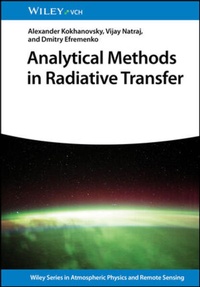
Analytical Methods in Radiative Transfer
1st Edition
Published on 4. September 2025
192 pages
978-3-527-69897-4 (ISBN)
Description

Provides in-depth knowledge of the physics of radiative transfer
In Analytical Methods in Radiative Transfer, a team of distinguished researchers delivers a comprehensive exploration of solutions to practical problems of modern atmospheric optics related to solar light interaction with the terrestrial atmosphere and the remote sensing of clouds, aerosols, and gases. The authors describe analytic methods in radiative transfer that help explain atmospheric phenomena.
The book includes discussions on the interaction of solar light with the atmosphere. Readers will also benefit from thorough reviews of various analytical radiative transfer techniques, for various turbid media, including media with phase functions extended in the forward direction, and also semi-infinite, non-absorbing, weakly absorbing, and strongly absorbing light scattering media.
Analytical Methods in Radiative Transfer also includes:
* A thorough introduction to exact solutions of the radiative transfer equation, including situations of single scattering, as well as isotropic and Rayleigh scattering
* A comprehensive exploration of approximate solutions for scalar radiative transfer, including single and multiple light scattering separation and the case of semi-infinite media such as snow
* In-depth examinations of the applications of analytical methods in atmospheric radiative transfer, including aerosol remote sensing, cloud remote sensing, and the remote sensing of trace gases
Perfect for meteorologists, climatologists and graduate students studying physics, Analytical Methods in Radiative Transfer is also an indispensable resource for geophysicists seeking a practical exploration of modern atmospheric optics.
In Analytical Methods in Radiative Transfer, a team of distinguished researchers delivers a comprehensive exploration of solutions to practical problems of modern atmospheric optics related to solar light interaction with the terrestrial atmosphere and the remote sensing of clouds, aerosols, and gases. The authors describe analytic methods in radiative transfer that help explain atmospheric phenomena.
The book includes discussions on the interaction of solar light with the atmosphere. Readers will also benefit from thorough reviews of various analytical radiative transfer techniques, for various turbid media, including media with phase functions extended in the forward direction, and also semi-infinite, non-absorbing, weakly absorbing, and strongly absorbing light scattering media.
Analytical Methods in Radiative Transfer also includes:
* A thorough introduction to exact solutions of the radiative transfer equation, including situations of single scattering, as well as isotropic and Rayleigh scattering
* A comprehensive exploration of approximate solutions for scalar radiative transfer, including single and multiple light scattering separation and the case of semi-infinite media such as snow
* In-depth examinations of the applications of analytical methods in atmospheric radiative transfer, including aerosol remote sensing, cloud remote sensing, and the remote sensing of trace gases
Perfect for meteorologists, climatologists and graduate students studying physics, Analytical Methods in Radiative Transfer is also an indispensable resource for geophysicists seeking a practical exploration of modern atmospheric optics.
More details
Other editions
Additional editions
Alexander Kokhanovsky | Vijay Natraj | Dmitry Efremenko
Analytical Methods in Radiative Transfer
Book
10/2025
1st Edition
Wiley-VCH
€119.00
Shipment within 5-7 days
A. Kokhanovsky
Analytical Methods in Atmospheric Radiative Transfer
Software
04/2024
Wiley-VCH
€165.22
Shipment within 5-7 days
Persons
Alexander Kokhanovsky is the leader of Cloud Remote Sensing Group at Institute of Environmental Physics and Remote Sensing of Univeristy of Bremen. Having obtained his academic degrees from the Belarusian State University and Institute of Physics at National Academy of Sciences of Belarus, he spent most of his career working for Institute of Physics in Minsk before taking up his present appointment at University of Bremen in 2001. He has authored over 150 scientific publications and published 4 books (Lights Scattering Media Optics, Polarization Optics of Random Media, Cloud Optics, Aerosol Optics). He is also a member of the American and European Geophysical Unions and an associate editor of the JQSRT, Atmospheric Measurement Techniques, and Remote Sensing. He is editor of the series in "Light Scattering" and "Wiley Series in Atmospheric Physics and Remote Sensing".
Vijay Natraj is a scientist at the Jet Propulsion Laboratory, California Institute of Technology (JPL). He obtained Bachelor and Master from the National University of Singapore, Singapore in 1998 and 2002, respectively, and a Ph.D. in Chemical Engineering from the California Institute of Technology (Caltech), Pasadena, USA in 2008. His Ph.D. thesis was on radiative transfer modeling for the retrieval of CO2 from space. Before joining JPL, Dr. Natraj worked as a researcher in the Department of Planetary Sciences at Caltech. His research interests are in the areas of polarization, aerosol and cloud modeling, fast radiative transfer computations, and information theoretical analysis.
Vijay Natraj is a scientist at the Jet Propulsion Laboratory, California Institute of Technology (JPL). He obtained Bachelor and Master from the National University of Singapore, Singapore in 1998 and 2002, respectively, and a Ph.D. in Chemical Engineering from the California Institute of Technology (Caltech), Pasadena, USA in 2008. His Ph.D. thesis was on radiative transfer modeling for the retrieval of CO2 from space. Before joining JPL, Dr. Natraj worked as a researcher in the Department of Planetary Sciences at Caltech. His research interests are in the areas of polarization, aerosol and cloud modeling, fast radiative transfer computations, and information theoretical analysis.
Content
Table of contents
1.Introduction
1.1 Main definitions
1.2 Scalar radiative transfer equation
1.3 Vector radiative transfer equation
1.4 Tensor radiative transfer equation
1.5 3-D radiative transfer equation
1.6 Radiative transfer and narrow light beams
1.7 Time-dependent radiative transfer equation
1.8 Heritage and history of earlier work
2. Exact solutions of radiative transfer equation
2.1 No scattering
2.2 Isotropic scattering
2.3 Rayleigh scattering
2.4 Henyey-Greenstein phase function
3. Approximate solutions for scalar radiative transfer
3.1 Single and multiple scattering separation
3.2 Double and higher orders of scattering
3.3 Semi-infinite media
3.4 Asymptotic radiative transfer
3.4.1 Rayleigh scattering
3.4.2 Clouds
3.5 Method of discrete ordinates and low stream interpolation
3.5.1 Two-stream approximation
3.5.2 Four-stream approximation
3.6 Small-angle approximation
3.7 Quasi-single scattering approximation
3.8 Method of spherical harmonics
3.9 Diffusion approximation
3.10 Radiative transfer in gaseous absorption bands
3.10.1 k-distribution and correlated-k methods
3.10.2 ESFT method
3.10.3 Spectral mapping
3.10.4 Optimal spectral sampling
3.10.5 Principal component analysis
3.11 Neural networks
3.12 3-D radiative transfer
3.13 Narrow beams
3.14 Time-dependent problems
3.15 Radiative transfer with account for effects of fluorescence
3.16 Raman scattering and filling in molecular absorption bands
4. Approximate solutions for polarized radiative transfer
4.1 Single and double scattering
4.2 Semi-infinite media
4.3 Optically thick media
4.4 Method of discrete ordinates
4.4.1 Four-stream approximation
4.5 Small-angle approximation
4.6 Tensor radiative transfer
5. Applications
5.1 Aerosol remote sensing
5.2 Cloud remote sensing
5.3 Remote sensing of trace gases
5.4 Surface remote sensing
5.4.1 Ocean
5.4.2 Land
5.5 Lidar remote sensing
1.Introduction
1.1 Main definitions
1.2 Scalar radiative transfer equation
1.3 Vector radiative transfer equation
1.4 Tensor radiative transfer equation
1.5 3-D radiative transfer equation
1.6 Radiative transfer and narrow light beams
1.7 Time-dependent radiative transfer equation
1.8 Heritage and history of earlier work
2. Exact solutions of radiative transfer equation
2.1 No scattering
2.2 Isotropic scattering
2.3 Rayleigh scattering
2.4 Henyey-Greenstein phase function
3. Approximate solutions for scalar radiative transfer
3.1 Single and multiple scattering separation
3.2 Double and higher orders of scattering
3.3 Semi-infinite media
3.4 Asymptotic radiative transfer
3.4.1 Rayleigh scattering
3.4.2 Clouds
3.5 Method of discrete ordinates and low stream interpolation
3.5.1 Two-stream approximation
3.5.2 Four-stream approximation
3.6 Small-angle approximation
3.7 Quasi-single scattering approximation
3.8 Method of spherical harmonics
3.9 Diffusion approximation
3.10 Radiative transfer in gaseous absorption bands
3.10.1 k-distribution and correlated-k methods
3.10.2 ESFT method
3.10.3 Spectral mapping
3.10.4 Optimal spectral sampling
3.10.5 Principal component analysis
3.11 Neural networks
3.12 3-D radiative transfer
3.13 Narrow beams
3.14 Time-dependent problems
3.15 Radiative transfer with account for effects of fluorescence
3.16 Raman scattering and filling in molecular absorption bands
4. Approximate solutions for polarized radiative transfer
4.1 Single and double scattering
4.2 Semi-infinite media
4.3 Optically thick media
4.4 Method of discrete ordinates
4.4.1 Four-stream approximation
4.5 Small-angle approximation
4.6 Tensor radiative transfer
5. Applications
5.1 Aerosol remote sensing
5.2 Cloud remote sensing
5.3 Remote sensing of trace gases
5.4 Surface remote sensing
5.4.1 Ocean
5.4.2 Land
5.5 Lidar remote sensing
