

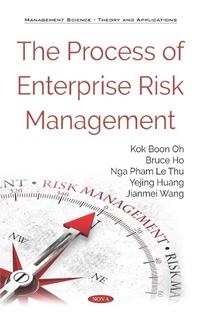
Process of Enterprise Risk Management
Published on 27. November 2018
339 pages
978-1-5361-4428-4 (ISBN)
Description

This book provides an introduction to enterprise risk management. It presents a holistic view of the fundamentals right at the start that will aid the reader in understanding the concepts of risk and why they need to be analyzed to more advanced topics of strategic risk management. The author does this by adopting a widely accepted risk framework that uses financial risk as a common thread weaving through the entire enterprise risk management process to illustrate its workings. Therefore, the aim of this book is three-fold: First, it discusses the concept in a generic analytical framework of managerial decision-making. As the basic principles of risk management have been intermeshed with the generally accepted enterprise risk management framework, this implicitly warrants the discussion of the corporate environments in which risks exist, namely, the operational and financial systems. The second objective is to detail the enterprise risk management process in the context of a firm with a focus on financial risk exposure. Third, the risk management strategies are discussed; their relevance, methods and application are presented. This book also provides a framework for analyzing key financial risks and a guide for implementing risk controls in an enterprise risk management context.
More details
Other editions
Additional editions
Kok-Boon Oh | Bruce Ho | Pham Le Thu Nga
The Process of Enterprise Risk Management
Book
12/2018
Nova Science Publishers Inc
€303.05
Shipment within 15-20 days
Content
- Intro
- Contents
- Preface
- Chapter 1
- Enterprise Risk Management
- 1.1. Introduction
- 1.2. Globalisation and Market Crises
- 1.3. Concept of Risk
- 1.3.1. Dimensions of Risk
- 1.3.2. Risk and Return
- 1.4. Corporate Risk Environment
- 1.5. Enterprise Risk Management and Its Value
- 1.6. Enterprise Risk Management Process
- 1.7. Aim
- Chapter 2
- Enterprise Risk Exposure
- 2.1. Introduction
- 2.2. Firm Value and Risk
- 2.3. Risk-Return Relationship
- 2.4. Business Versus Financial Risk
- 2.4.1. Business Risk
- 2.4.2. Financial Risk
- Liquidity Ratios
- Safety Ratios
- 2.5. Decision-Making and Risks
- 2.6. Risk Decomposition
- 2.7. Financial System and Risk
- 2.8. International Business Risk
- 2.9. Conclusion
- Chapter 3
- Measuring Enterprise Risk
- 3.1. Introduction
- 3.2. Price Behaviour
- 3.3. Risk Measurement
- 3.3.1. Financial Risk Ratios
- Liquidity Ratios
- Leverage Ratios
- 3.3.2. Operational Ratios
- Operating Performance Ratios
- Operating Profitability Ratios
- 3.3.3. Risk-Adjusted Performance Ratios
- Sharp Ratio
- Sortino Ratio
- Information Ratio
- 3.4. Mean-Variance Space (Standard Deviation)
- 3.4.1. Volatility and Expected Returns
- 3.4.1.1. Covariance
- 3.4.1.2. Correlation
- 3.4.2. Coefficient of Variation
- 3.4.3. Market Model and Beta
- 3.4.4. Delta
- 3.4.5. ARCH and GARCH
- 3.4.5.1. ARCH
- 3.4.5.2. GARCH
- I-GARCH
- A-GARCH
- 3.4.5.3. Applications of ARCH
- Applications of ARCH to Stock Return Data
- Application of ARCH to Interest Rate
- Application of ARCH to Foreign Exchange Rate
- 3.5. Measuring Portfolio Risk
- 3.6. Capital Pricing Asset Model
- 3.7. Conclusion
- Chapter 4
- Modelling Enterprise Risk
- 4.1. Introduction
- 4.2. Period versus Continuous Time Analysis
- 4.3. Risk Models
- 4.3.1. Discounted Cash Flow Model
- 4.3.2. Duration Model
- 4.3.3. Duration and Price Volatility
- 4.3.4. Factor Analysis
- 4.3.4.1. Multifactor Model
- 4.3.4.2. Arbitrage Pricing Theory Model
- 4.3.5. Cash Flow-at-Risk Model
- 4.3.6. Extreme Value Theory
- 4.3.7. Value-at-Risk
- 4.3.8. Limitations of VaR
- 4.3.9. Stress Testing
- 4.4. Conclusion
- Chapter 5
- Hedging Techniques and Tools
- 5.1. Introduction
- 5.2. Insurance
- 5.3. Hedging Strategy
- 5.3.1. Macro versus Micro Hedging
- 5.3.2. Internal and External Hedging
- 5.4. Value of Hedging
- 5.5. Derivatives Market
- 5.6. Derivative Pricing
- 5.6.1. Intertemporal Pricing
- 5.6.2. Price Convergence
- 5.6.3. Contango Market
- 5.6.4. Backwardation Market
- 5.7. Forward Contracts
- 5.7.1. Pricing of Forward Contracts
- 5.7.2. Hedging Using Forwards
- 5.7.3. Problems in Forward Markets
- 5.8. Futures Contracts
- 5.8.1. Hedging with Futures
- 5.8.2. Limitations with Futures
- 5.9. Options
- 5.9.1. Call Options
- 5.9.2. Put Options
- 5.9.3. Pricing an Option
- 5.9.3.1. Binomial Pricing Approach
- 5.9.3.2. Black & Scholes Model
- 5.9.3.3. Garman-Kohlhagen Model
- 5.9.4. Exotic Options
- 5.10. Swaps
- 5.11. Cash-Flow Hedging
- 5.12. Derivative Risks
- 5.12.1. Basis Risk
- 5.12.2. Minimum Variance Hedge Ratio
- 5.12.3. Liquidity Risk
- 5.12.4. Delivery Basis Risk
- 5.12.5. Funding Risk
- 5.13. Conclusion
- Chapter 6
- Commodity Price Risk
- 6.1. Introduction
- 6.2. Commodity Price Risk Management
- 6.3. Commodity Prices
- 6.4. Commodity Price Risk
- 6.4.1. Crude Oil
- 6.4.2. Coffee
- 6.4.3. Sugar
- 6.5. Hedging Commodity Price Risk
- 6.5.1. Stabilization Programs
- 6.5.2. Long Term Supply Contracts
- 6.5.3. Forward Contracts
- 6.5.4. Futures
- 6.5.5. Options
- 6.5.6. Swaps
- 6.6. Conclusion
- Chapter 7
- Interest Rate Risk
- 7.1. Introduction
- 7.2. Interest Rates
- 7.2.1. Determinants of Interest Rates
- 7.2.2. Term Structure of Interest Rates
- Yield Curves
- Negative Yield Curves
- 7.2.3. Interest Rates, Risk and Valuation
- 7.3. Impact of Interest Rate Risk on the Firm
- 7.4. Interest Rate Risk Management
- 7.5. Hedging Interest Rate Risk
- 7.5.1. Forward Rate Agreements
- 7.5.2. Futures Contracts
- 7.5.3. Options
- 7.5.3.1. Using Call Options to Hedge Interest Rate Risk
- 7.5.3.2. Using Put Options to Hedge Interest Rate Risk
- 7.5.3.3. Collars
- 7.5.3.4. Using Exotic Options for Hedging Interest Rate Risk
- 7.5.4. Swaps
- 7.6. Conclusion
- Chapter 8
- Foreign Exchange Risk
- 8.1. Introduction
- 8.2. Foreign Exchange Risk Management
- 8.3. Currency Price Determination
- 8.3.1. The Foreign Exchange Rate Market
- 8.3.2. Purchasing Power Parity
- 8.3.3. Interest Rate Parity (IRP)
- 8.3.4. International Fisher Effect (IFE)
- 8.4. Hedging Enterprise Foreign Exchange Risk
- 8.5. Internal Hedging
- 8.5.1. Natural Hedge
- 8.5.2. Invoicing
- 8.5.3. Offsetting and Netting
- 8.5.4. Leading and Lagging
- 8.5.5. Capital Budgeting
- 8.6. External Hedging
- 8.6.1. Forward Contracts
- 8.6.2. Money Market
- 8.6.3. Futures
- 8.6.4. Options
- 8.6.5. Swaps
- 8.7. Forecasting and Modelling Exchange Rate Risk
- 8.8. Conclusion
- Chapter 9
- Strategic Risk Management
- 9.1. Introduction
- 9.2. Risk Governance
- 9.3. Enterprise Risk Management Strategy
- 9.3.1. ERM Structure
- 9.3.2. Enterprise Risk Mapping
- 9.4. Key Elements of the ERM Framework
- 9.4.1. Board of Directors and Senior Management
- 9.5. Conclusion
- Chapter 10
- Emerging Issues and Financial Engineering
- 10.1. Introduction
- 10.2. Standards, Financial Risk Tools and Models
- 10.2.1. Beta Risk (Hedging Equities Using Index Futures)
- 10.2.2. Value at Risk (VaR)
- 10.2.3. VaR and Cash Flow at Risk
- 10.3. Financial Engineering and Model Development
- 10.4. Enterprise Risk Management for Corporate Value Creation
- 10.4.1. Financial Distress
- 10.4.2. Taxes
- 10.4.3. Risk Management and Investment
- 10.5. Strategic Portfolio Risk Management
- 10.6. Capital Asset Pricing Model
- 10.7. Duration Model
- 10.7.1. Duration as a Measure of Price Volatility
- 10.7.2. Duration as a Tool for Hedging or Immunization
- 10.8. Forwards and Futures
- 10.9. Futures and Options
- 10.10. Swaps
- 10.11. Real Options
- 10.11.1. Projects as Call Options
- 10.11.2. Risk and Options to Delay, Expand and Abandon
- 10.12. Conclusion
- References
- About the Authors
- Index
- Blank Page
