

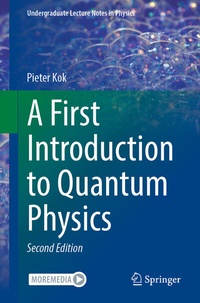
A First Introduction to Quantum Physics
Description

In this undergraduate textbook, now in its 2nd edition, the author develops the quantum theory from first principles based on very simple experiments: a photon traveling through beam splitters to detectors, an electron moving through magnetic fields, and an atom emitting radiation. From the physical description of these experiments follows a natural mathematical description in terms of matrices and complex numbers.
The first part of the book examines how experimental facts force us to let go of some deeply held preconceptions and develops this idea into a description of states, probabilities, observables, and time evolution. The quantum mechanical principles are illustrated using applications such as gravitational wave detection, magnetic resonance imaging, atomic clocks, scanning tunneling microscopy, and many more. The first part concludes with an overview of the complete quantum theory.
The second part of the book covers more advanced topics, including the concept ofentanglement, the process of decoherence or how quantum systems become classical, quantum computing and quantum communication, and quantum particles moving in space. Here, the book makes contact with more traditional approaches to quantum physics. The remaining chapters delve deeply into the idea of uncertainty relations and explore what the quantum theory says about the nature of reality.
The book is an ideal accessible introduction to quantum physics, tested in the classroom, with modern examples and plenty of end-of-chapter exercises.
More details
Other editions
Additional editions
Previous edition
Person
Pieter Kok is Professor of Theoretical Physics at the University of Sheffield, UK. His research interests include quantum information theory and quantum precision measurements. He studied physics at Utrecht University in the Netherlands and received his Ph.D. in quantum teleportation from the University of Wales in 2001. He has contributed to practical architectures for quantum computing and Heisenberg-limited quantum metrology and imaging.
Content
Chapter 1: Three simple experiments.- Chapter 2: Photons and Interference.- Chapter 3: Electrons with Spin.- Chapter 4: Atoms and Energy.- Chapter 5: Operators.- Chapter 6: Entanglement.- Chapter 7: Decoherence.- Chapter 8: The Motion of Particles.- Chapter 9: Uncertainty Relations.- Chapter 10: The Nature of Reality.
