

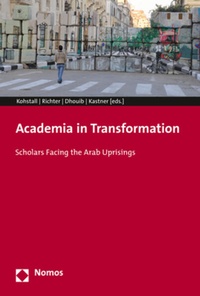
Academia in Transformation
Scholars Facing the Arab Uprisings
1st Edition
Published on 17. May 2018
223 pages
978-3-8452-7434-8 (ISBN)
Description

Popular uprisings in the Middle East and North Africa (MENA) have had a deep impact, not only on the societies and political structures in the respective countries there, but also on different academic disciplines. The events that started in 2010 in Tunisia have altered academic terminology, contributed to a shift in study focus and sometimes challenged dominant theoretical approaches. The book provides an insightful and illuminating view of the transformation of the academic landscape in the aftermath of these uprisings. It analyses how the academic discourse in and on the MENA region has changed and reflects on how the aforementioned transformation processes, which are still ongoing, are shaping lines of inquiry in different disciplines, including political science, Arabic literature and language studies, philosophy, communication studies, sociology, computer studies and archaeology. The book's authors are members of the Arab-German Young Academy of Sciences and Humanities (AGYA).
With contributions by
Ammar Abdulrahman, Tobias Amft, Hanan Badr, Sarhan Dhouib, Kalman Graffi, Amal Grami, Maha Houssami, Christian Junge, Fatima Kastner, Florian Kohstall, Bilal Orfali, Carola Richter, Hans Jörg Sandkühler, Rana Siblini, Jan Claudius Völkel, Barbara Winckler.
More details
Other editions
Additional editions
Florian Kohstall | Carola Richter | Sarhan Dhouib
Academia in Transformation
Scholars Facing the Arab Uprisings
Book
05/2018
1st Edition
Nomos
€54.00
Shipment within 5-7 days
Persons
Content
- Cover
- 1 A Note from the Editors
- 2 Introduction: Academia in Transformation - Testing the Paradigms of New Knowledge
- Overview of articles
- References
- 3 Middle East Studies and Academic Cooperation in the Wake of the Arab Uprisings
- New trends in Middle East studies following the uprisings
- Times of euphoria and self-reflection
- A more diversified but unfinished research agenda
- Local versus foreign scholarship
- Academic knowledge production and activism
- Political uncertainty and restrictions on academic freedom
- Toward a more comparative approach in Middle East studies
- References
- 4 Political Science in Egypt: Talkin' Bout a Revolution
- Political science here and there
- Cairo University in its search for itself
- Euro-Mediterranean studies as a vehicle for discussions about democratization
- Focusing teaching and university activities on student development
- Fear as a factor at Egyptian universities
- Conclusion
- References
- 5 Opening Up the Text: Arabic Literary Studies on the Move
- Research: the "Arab Spring" as a "cultural revolution"
- Documenting post-revolutionary realities: "In 2016"
- Literature and art as cultural practices: "Figures of Thought
- Networks: Towards collaborative research with Arab academia
- Building a transregional network - an interdisciplinary postdoctoral fellowship program
- Towards multiperspectivity and self-reflection - an Arab-German summer school program
- Language: practicing and teaching Arabic as a modern academic language
- Bachelor Plus in Oriental Studies - a one-year study-abroad program for undergraduate students
- German-Algerian joint program for professionalizing the teaching of Arabic as a foreign language
- "Cross-Cultural Exchange via Translation" - tandem workshop for German and Tunisian students
- A professional association promoting the teaching of Arabic as a foreign language
- Societal commitment: outside the ivory tower
- Conclusion
- References
- 6 An Uprising in Teaching Arabic Language
- 9/11 versus the Arab uprisings
- Lebanon and the Arab uprisings
- Remapping the destinations for studying Arabic abroad
- A shift in learners' motives
- Additions to the curriculum
- Increasing interest in colloquial Arabic
- Social and community service
- Daunting challenges and solutions
- Conclusion
- References
- 7 Justice in Transformation: Rethinking Theory and Practice of the Global Transitional Justice Model
- Lex Transitus: On the evolution of the new global legal regime of transitional justice
- Reconfigurations of the present normative concept of transitional justice emerging from the "Arab Spring" experiences
- Conclusion and outlook
- References
- 8 Philosophy in Transition - Philosophy of Transition
- Where there is power, resistance rises - Tunisia before the revolution
- Arriving means going beyond oneself
- "First comes Christmas, then comes New Years, and then the revolution."
- The relevance of a dual critique
- What's the Arabic for "culture of remembrance" (Erinnerungskultur) and "working through the past" (Aufarbeitung)?
- Philosophy and witness
- Do women go to school in your country?
- References
- 9 Communication Studies in Transformation -Self-Reflections on an Evolving Discipline in Times of Change
- The Arab world in focus
- The return of the school of "massive effects"
- Challenging concepts
- Arab inroads?
- Perspectives
- Conclusion
- References
- 10 Webs of Change? The Transformation of Online Social Networks and Communication Infrastructures from a Technological Point of View
- Computer science fields affected by the Arab uprisings
- A brief description of the internet
- Technical possibilities of censoring communication on the internet
- Search engine censorship
- Deep packet inspection
- Disconnection of networks
- Solutions for combatting surveillance and censorship in general
- Encryption
- Proxy routing
- Decentralization of service provisioning
- Darknets: Anonymous communication with the help of peer-to-peer networks
- Influence of the Arab uprisings on the computer science field
- Conclusion
- References
- 11 The Damage Done: The "Arab Spring", Cultural Heritage and Archaeologists at Risk
- Syria - cultural heritage for humankind
- The threat to artifacts
- Impact on the field of archaeology
- The future of Syrian archaeology
- References
- 12 Transformations and Continuities. Some general Reflections
- Societal normality and the stability and dynamics of convictions
- Philosophy of coexistence - cooperation without hegemony
- Transformation, injustice and justice: The example of Germany
- Justice, democracy and the rule of law
- Ideas, norms and concepts diffused in a context of mutual exchange
- A conclusion
- References
- Abstracts
- 3 Middle East Studies and Academic Cooperation in the Wake of the Arab UprisingsFlorian Kohstall
- 4 Political Science in Egypt: Talkin' Bout a RevolutionJan Claudius Völkel
- 5 Opening Up the Text: Arabic Literary Studies on the MoveBarbara Winckler and Christian Junge
- 6 An Uprising in Teaching Arabic LanguageBilal Orfali, Rana Siblini and Maha Houssami
- 7 Justice in Transformation: Rethinking Theory and Practice of the Global Transitional Justice ModelFatima Kastner
- 8 Philosophy in Transition - Philosophy of TransitionSarhan Dhouib
- 9 Communication Studies in Transformation -Self-Reflections on an Evolving Discipline in Times of Change Carola Richter and Hanan Badr
- 10 Webs of Change? The Transformation of Online Social Networks and Communication Infrastructures from a Technological Point of ViewTobias Amft and Kalman Graffi
- 11 The Damage Done: The "Arab Spring", Cultural Heritage and Archaeologists at RiskAmmar Abdulrahman
- About the Authors
