

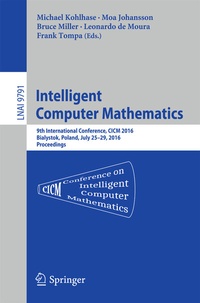
Intelligent Computer Mathematics
9th International Conference, CICM 2016, Bialystok, Poland, July 25-29, 2016, Proceedings
Published on 11. July 2016
XIV, 163 pages
978-3-319-42547-4 (ISBN)
Description

This book constitutes the refereed proceedings of the 9th International Conference on Intelligent Computer Mathematics, CICM 2016, held in Bialystok, Poland, in July 2016.
The 10 full papers and 2 short papers presented were carefully reviewed and selectedfrom a total of 41 submissions. The papers are organized in topical sections according to the five tracks of the conference: Calculemus; Digital Mathematics Libraries; Mathematical Knowledge Management; Surveys and Projects; and Systems and Data.
The 10 full papers and 2 short papers presented were carefully reviewed and selectedfrom a total of 41 submissions. The papers are organized in topical sections according to the five tracks of the conference: Calculemus; Digital Mathematics Libraries; Mathematical Knowledge Management; Surveys and Projects; and Systems and Data.
More details
Other editions
Additional editions
Michael Kohlhase | Moa Johansson | Bruce Miller
Intelligent Computer Mathematics
9th International Conference, CICM 2016, Bialystok, Poland, July 25-29, 2016, Proceedings
Book
07/2016
Springer
€44.94
Shipment within 10-15 days
Content
- Intro
- Preface
- Organization
- Contents
- CALCULEMUS
- Mathematical Theory Exploration in Theorema: Reduction Rings
- 1 Introduction
- 2 Gröbner Bases and Reduction Rings
- 2.1 Reduction Rings
- 2.2 Gröbner Bases
- 2.3 Contributions to the Theory
- 3 Buchberger's Algorithm
- 4 Structure of the Formalization
- 4.1 Elementary Theories
- 4.2 Reduction Ring Theory
- 5 New Tools
- 5.1 Interactive Proof Strategy
- 5.2 TheoryAnalyzer
- 6 Conclusion
- References
- Formalization of Bing's Shrinking Method in Geometric Topology
- 1 Introduction
- 2 Formalization
- 2.1 Bing Shrinking Criterion
- 2.2 Baire Category Theorem
- 3 Relation to Some Theorems in Geometric Topology
- 3.1 Proof Sketch of the GST Using Bing's Shrinking Method
- 3.2 Abstract Property of Disks Necessary for Shrinking Arguments
- 3.3 Future Plan
- 4 Conclusion
- References
- SC2: Satisfiability Checking Meets Symbolic Computation
- 1 Introduction
- 2 Background
- 2.1 Symbolic Computation and Computer Algebra Systems
- 2.2 Satisfiability Checking
- 3 Some Scientific Challenges and Opportunities
- 3.1 Symbolic Computation Techniques for Satisfiability Checking
- 3.2 Satisfiability Checking Techniques for Symbolic Computation
- 3.3 Standard Languages and Benchmarks
- 4 Project Actions
- 5 Conclusions and Future Work
- References
- Formalization of Normal Random Variables in HOL
- 1 Introduction
- 2 Preliminaries
- 2.1 Measure Theory
- 2.2 Lebesgue Integration Theory
- 2.3 Probability Theory
- 3 Formalization of Lebesgue-Borel Measure
- 3.1 Gauge Integral
- 3.2 Borel Measurable Sets
- 3.3 Lebesgue Measure
- 3.4 Lebesgue-Borel Measure
- 4 Formalization of Normal Random Variables
- 4.1 Radon Nikodym Theorem
- 4.2 Probability Density Function
- 4.3 Normal Random Variables
- 4.4 Properties of Normal Random Variables
- 5 Application: Probabilistic Clock Synchronization in Wireless Sensor Networks
- 5.1 Single-Hop Network
- 5.2 Multi-hop Network
- 5.3 Discussion
- 6 Conclusion
- References
- Digital Mathematics Libraries
- Progress of Self-Archiving Within the DML Corpus, with a View Toward Community Dynamics
- 1 Introduction
- 2 Matching the arXiv and zbMATH: Methodology and Precision
- 3 Time Lag Effect: Retroarchiving and Publication/Indexing Delay
- 4 General Coverage Figures and Dynamics
- 5 Submission Behavior: An Author-Based Analysis
- 6 Subject Specifics
- 7 Conclusions
- References
- Mathematical Knowledge Management
- Accessing the Mizar Library with a Weakly Strict Mizar Parser
- 1 Introduction
- 2 WS-Mizar Grammar Specification
- 3 Parser Implementation
- 4 Conclusions
- References
- Incorporating Quotation and Evaluation into Church's Type Theory: Syntax and Semantics
- 1 Introduction
- 2 Syntax
- 2.1 Types
- 2.2 Expressions
- 2.3 Constructions
- 2.4 Definitions and Abbreviations
- 3 Semantics
- 3.1 Frames
- 3.2 Interpretations
- 3.3 Models
- 4 Examples
- 4.1 Reasoning About Syntax
- 4.2 Quasiquotation
- 4.3 Schemas
- 4.4 Meaning Formulas
- 5 A Sketch of a Simple Proof System
- 6 Conclusion
- References
- Extracting Higher-Order Goals from the Mizar Mathematical Library
- 1 Introduction
- 2 Syntax of Higher-Order Logic
- 3 Idealized Mizar
- 4 Mapping Mizar to Higher-Order Logic
- 5 Experiments
- 6 Conclusion
- References
- Surveys and Projects
- Interoperability in the OpenDreamKit Project: The Math-in-the-Middle Approach
- 1 Introduction
- 2 The OPENDREAMKIT Project (2015--2019)
- 3 Integrating Mathematical Software Systems via the Math-in-the-Middle Approach
- 3.1 A Common Meaning Space for Interoperability
- 3.2 Realizing and Utilizing a MitM Ontology
- 4 LMFDB Knowledge and Interoperability
- 5 Distributed Collaboration with GAP/Sage
- 5.1 Semantics in the Sage Category System
- 5.2 Exporting the GAP Knowledge: Type System Documentation
- 6 Conclusion
- References
- Formal Dependability Modeling and Analysis: A Survey
- 1 Introduction
- 2 Dependability Modeling Techniques
- 2.1 Reliability Block Diagrams
- 2.2 Fault Trees
- 2.3 Markov Chain
- 3 Formal Dependability Analysis Techniques
- 3.1 Petri Nets
- 3.2 Model Checking
- 3.3 Higher-Order-Logic Theorem Proving
- 4 Comparison and Discussion
- 4.1 Comparison of Dependability Modeling Techniques
- 4.2 Comparison of Dependability Analysis Techniques
- 5 Conclusions
- References
- Systems and Data
- Extending E Prover with Similarity Based Clause Selection Strategies
- 1 Introduction
- 2 Clause Selection in E Prover
- 3 Similarity Based Clause Selection Strategies
- 4 Experimental Results and Evaluation
- 5 Conclusions and Future Work
- References
- Enhancement of MIZAR Texts with Transitivity Property of Predicates
- 1 Introduction
- 2 Transitivity
- 3 Experiments
- 4 Further Work
- 5 Conclusions
- References
- Erratum to: Formal Dependability Modeling and Analysis: A Survey
- Erratum to: Chapter "Formal Dependability Modeling and Analysis: A Survey" in: M. Kohlhase et al. (Eds.): Intelligent Computer Mathematics, LNAI, DOI: 10.1007/978-3-319-42547-4_10
- Author Index
