

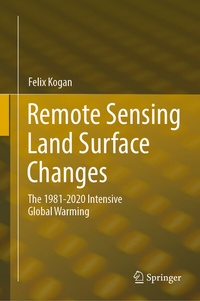
Remote Sensing Land Surface Changes
Description

This book discusses the detrimental consequences of climate-related land changes over a 40-year period between 1981 and 2020, and focuses on how climate warming is deteriorating the agricultural system due to excessive heat, lack of moisture and more intensive and widespread droughts leading to a reduction of agricultural production. Most of the existing literature on the unfavourable consequences of global warming for land are based on a relatively short period of weather station data, covering local land areas with limited networks and monitoring parameters. These concerns have led to the use of satellite data, whose measurements are controlled by such vegetation characteristics as chlorophyll, carotenoids, moisture contents in the plants and temperature inside the vegetation community. Therefore, the discussion of this book is completely based on high-resolution global land surface measurements by the sensors on the National Oceanic and Atmospheric Administration's (NOAA) operational afternoon polar-orbiting satellites.
The book also focuses on understanding climate change impacts on land changes where humans are living, and combines biophysically-grounded methods and the 40-year data to develop models for monitoring large-scale Earth warming impacts on land and for timely prediction of climate consequences for humans. These 40-year trends in land characteristics will help to better inform the assessment of potential changes in the future and how to reach human sustainability. The book will of interest to scientists using satellite remote sensing to track climate change impacts on land over time, as well as students and researchers in climatology and environmental sustainability.
Reviews / Votes
"The subject of the book is global warming and its impact on human life. Kogan analyses various technical aspects of this subject, and readers interested in various data analysis reports will find the book very useful. The book also serves as a survey with its many references. Time series analysis of various related parameters is explained. The book provides ample case studies for data science learners." (Maulik A. Dave, Computing Reviews, August 19, 2024)
More details
Other editions
Additional editions
Person
Dr. Felix Kogan is a physical scientist at NOAA/NESDIS, Center for Satellite Application and Research (STAR). He is a developer of satellite-based Vegetation Health (VH) method and VH applications. His research interests include drought detection and monitoring, VH-yield modeling, fire risk, malaria monitoring, vegetation stress assessment, climate and land cover change, VH data distribution, etc. He has authored around 170 publications including three books. He received his MS degree from USSR's Odessa Hydrometeorological Institute and his PhD from USSR's Hydrometeorological Center in Moscow.
