

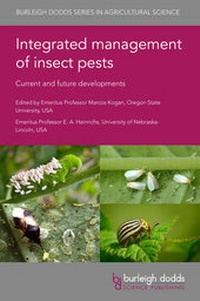
Integrated management of insect pests: Current and future developments
Published on 29. October 2019
1004 pages
978-1-78676-262-7 (ISBN)
Description

This volume summarises current developments in integrated pest management (IPM), focussing on insect pests.
Chapters discuss advances in understanding species and landscape ecology on which IPM is founded. The book then reviews advances in cultural, physical and, in particular, biological methods of control. Topics include developments in classical, conservation and augmentative biological control as well as the use of entomopathogenic fungi, viruses, nematodes and semiochemicals. The final parts of the book summarise current research on monitoring pesticide use as well as emerging classes of biopesticides.
Chapters discuss advances in understanding species and landscape ecology on which IPM is founded. The book then reviews advances in cultural, physical and, in particular, biological methods of control. Topics include developments in classical, conservation and augmentative biological control as well as the use of entomopathogenic fungi, viruses, nematodes and semiochemicals. The final parts of the book summarise current research on monitoring pesticide use as well as emerging classes of biopesticides.
More details
Series
Language
English
Place of publication
Cambridge
United Kingdom
Publishing group
Burleigh Dodds
Target group
Researchers in IPM in crop science departments, entomologists, companies involved in pesticides and crop pest management, government agencies monitoring and regulating pest management in agriculture.
Product notice
Reflowable
ISBN-13
978-1-78676-262-7 (9781786762627)
DOI
10.19103/AS.2019.0047
Schweitzer Classification
Other editions
Additional editions
Book
10/2019
Burleigh Dodds Science Publishing Limited
€226.50
Shipment within 3-4 weeks
Persons
Editor
Oregon State University
Dr Marcos Kogan is Emeritus Professor of Entomology and Director Emeritus of the Integrated Plant Protection Center at Oregon State University, USA. He is also Emeritus Professor of Agricultural Entomology at the University of Illinois. Professor Kogan is widely regarded as a pioneer in linking ecological theory with IPM practice. His numerous awards include Fellow of the Entomological Society of America as well the ESA's Founder Memorial Award. Dr Kogan is also Honorary Doctor at Universidade Federal Rural do Rio de Janeiro, Brazil
Dr Marcos Kogan is Emeritus Professor of Entomology and Director Emeritus of the Integrated Plant Protection Center at Oregon State University, USA. He is also Emeritus Professor of Agricultural Entomology at the University of Illinois. Professor Kogan is widely regarded as a pioneer in linking ecological theory with IPM practice. His numerous awards include Fellow of the Entomological Society of America as well the ESA's Founder Memorial Award. Dr Kogan is also Honorary Doctor at Universidade Federal Rural do Rio de Janeiro, Brazil
University of Nebraska-Lincoln
Dr E. A. "Short" Heinrichs is Emeritus Associate Director, University of Nebraska-Lincoln and Emeritus Adjunct Professor, Department of Entomology, University of Nebraska-Lincoln, USA. He is also Chair, Asia Rice Foundation USA (ARFUSA) and Secretary General, International Association for the Plant Protection Sciences (IAPPS). His specialty is rice entomology having served as Head of the Departments of Entomology at the International Rice Research Institute (IRRI), Los Baños, Philippines and Louisiana State University and Program Leader at the Africa Rice Center (AfricaRice), Côte d'Ivoire, West Africa.
Dr E. A. "Short" Heinrichs is Emeritus Associate Director, University of Nebraska-Lincoln and Emeritus Adjunct Professor, Department of Entomology, University of Nebraska-Lincoln, USA. He is also Chair, Asia Rice Foundation USA (ARFUSA) and Secretary General, International Association for the Plant Protection Sciences (IAPPS). His specialty is rice entomology having served as Head of the Departments of Entomology at the International Rice Research Institute (IRRI), Los Baños, Philippines and Louisiana State University and Program Leader at the Africa Rice Center (AfricaRice), Côte d'Ivoire, West Africa.
Contributions
University of Illinois
University of Arizona
Oregon State University
Oregon State University
formerly National Institute of Agricultural and Environmental Sciences
Ohio State University
USDA Forest Service (United States)
University of Minnesota
Louisiana State University Agricultural Centre (United States)
Professor Michael J. Stout is L. D. Newsom Professor of Integrated Pest Management at Louisiana State University, USA.
Professor Michael J. Stout is L. D. Newsom Professor of Integrated Pest Management at Louisiana State University, USA.
University of Nebraska-Lincoln
Dr E. A. "Short" Heinrichs is Emeritus Associate Director, University of Nebraska-Lincoln and Emeritus Adjunct Professor, Department of Entomology, University of Nebraska-Lincoln, USA. He is also Chair, Asia Rice Foundation USA (ARFUSA) and Secretary General, International Association for the Plant Protection Sciences (IAPPS). His specialty is rice entomology having served as Head of the Departments of Entomology at the International Rice Research Institute (IRRI), Los Baños, Philippines and Louisiana State University and Program Leader at the Africa Rice Center (AfricaRice), Côte d'Ivoire, West Africa.
Dr E. A. "Short" Heinrichs is Emeritus Associate Director, University of Nebraska-Lincoln and Emeritus Adjunct Professor, Department of Entomology, University of Nebraska-Lincoln, USA. He is also Chair, Asia Rice Foundation USA (ARFUSA) and Secretary General, International Association for the Plant Protection Sciences (IAPPS). His specialty is rice entomology having served as Head of the Departments of Entomology at the International Rice Research Institute (IRRI), Los Baños, Philippines and Louisiana State University and Program Leader at the Africa Rice Center (AfricaRice), Côte d'Ivoire, West Africa.
University of Nebraska-Lincoln
USDA-ARS
USDA-ARS
Agroscope
Cornell University
University of Nebraska-Lincoln
Michigan State University
Michigan State University
Agriculture Agri-Food Canada Saint-Jean-sur-Richelieu (Canada)
Phytosanitation, Oceanside (United States)
Gilat Research Center (Israel)
Gradignan (France)
The BHU Future Farming Centre (New Zealand)
Junior Enterprises (New Zealand)
University of California-Riverside
University of California-Riverside
Charles Sturt University
Charles Sturt University
Graham Centre (Australia)
Fujian Agriculture and Forestry University and Ministry of Education (China)
Wageningen University
Federal University of Lavras (Brazil)
University of Vermont
University of Vermont
University of Vermont
Bio-Protection Research Centre, Lincoln University (New Zealand)
Professor Travis Glare is Professor of Applied Entomology and Director of the Bio-Protection Research Centre at Lincoln University, New Zealand. He has an international reputation and has published widely in the field of entomopathogenic microbes and use of biopesticides. He has worked on a range of international projects to develop novel biopesticides.
Professor Travis Glare is Professor of Applied Entomology and Director of the Bio-Protection Research Centre at Lincoln University, New Zealand. He has an international reputation and has published widely in the field of entomopathogenic microbes and use of biopesticides. He has worked on a range of international projects to develop novel biopesticides.
La Trobe University
Rationale (United Kingdom)
Vineland Research and Innovation Centre (Canada)
Citrus Research International
Rhodes University (South Africa)
USDA-ARS
Adnan Menderes University (Turkey)
Agricultural Research Organization - Volcani Center (Israel)
Imperial College London
University of Melbourne
University of Melbourne
Pesticide Action Network UK (PAN UK) (United Kingdom)
Pesticide Action Network UK (PAN UK) (United Kingdom)
Pesticide Action Network UK (PAN UK) (United Kingdom)
Organisation Béninoise pour la Promotion de l'Agriculture Biologique (OBEPAB) (Benin)
University of Greenwich
University of Glasgow
University of Glasgow
University of Glasgow
North West University
North West University
University of Florida-Gainesville (United States)
University of Florida
University of Florida
University of Florida
University of Florida
Ordu University (Turkey)
University of Arizona
Oregon State University
Dr Marcos Kogan is Emeritus Professor of Entomology and Director Emeritus of the Integrated Plant Protection Center at Oregon State University, USA. He is also Emeritus Professor of Agricultural Entomology at the University of Illinois. Professor Kogan is widely regarded as a pioneer in linking ecological theory with IPM practice. His numerous awards include Fellow of the Entomological Society of America as well the ESA's Founder Memorial Award. Dr Kogan is also Honorary Doctor at Universidade Federal Rural do Rio de Janeiro, Brazil
Dr Marcos Kogan is Emeritus Professor of Entomology and Director Emeritus of the Integrated Plant Protection Center at Oregon State University, USA. He is also Emeritus Professor of Agricultural Entomology at the University of Illinois. Professor Kogan is widely regarded as a pioneer in linking ecological theory with IPM practice. His numerous awards include Fellow of the Entomological Society of America as well the ESA's Founder Memorial Award. Dr Kogan is also Honorary Doctor at Universidade Federal Rural do Rio de Janeiro, Brazil
Content
Part 1 Ecological foundations of IPM
1.Foundations of an IPM program: detection, identification, and quantification: Michael E. Irwin, University of Illinois, USA; and Wendy Moore, University of Arizona, USA;
2.Advances in understanding species ecology: phenological and life cycle modeling of insect pests: Leonard Coop and Brittany S. Barker, Oregon State University, USA;
3.Understanding agroecosystems and pest management: from chemical control to integrated biodiversity management: Keizi Kiritani, formerly National Institute of Agro-Environmental Sciences, Japan;
4.Advances in understanding agroecosystems ecology and its applications in integrated pest management: Casey Hoy, Ohio State University, USA;
5.Advances in understanding the ecology of invasive crop insect pests and their impact on IPM: Robert Venette, USDA Forest Service, USA; and Amy Morey, University of Minnesota, USA;
6.Plant-insect interactions, host-plant resistance, and integrated pest management: Michael J. Stout, Louisiana State University Agricultural Centre, USA;
Part 2 Cultural and physical methods in IPM
7.Advances in breeding crops resistant to insect pests: rice as a paradigm: E. A. Heinrichs and John E. Foster, University of Nebraska-Lincoln, USA;
8.The role and use of genetically engineered insect-resistant crops in integrated pest management systems: Steven E. Naranjo and Richard L. Hellmich, USDA-ARS, USA; Jörg Romeis, Agroscope, Switzerland; Anthony M. Shelton, Cornell University, USA; and Ana M. Vélez, University of Nebraska-Lincoln, USA;
9.Biotechnology applications for integrated pest management: Ruth Mbabazi and Karim Maredia, Michigan State University, USA;
10.Advances in physical control methods in IPM: Charles Vincent, Agriculture Agri-Food Canada Saint-Jeansur-Richelieu, Canada; Guy Hallman, Phytosanitation, Oceanside, USA; Phyllis Weintraub, Gilat Research Center, Israel; and Francis Fleurat-Lessard, Gradignan, France;
11.Robot-enhanced insect pest control: reality or fantasy?: Linton Winder, The BHU Future Farming Centre, New Zealand; and Rory Flemmer, Junior Enterprises, New Zealand;
Part 3 Biological methods in IPM
12.Advances in classical biological control to support IPM of perennial agricultural crops: Ivan Milosavljevic and Mark S. Hoddle, University of California-Riverside, USA;
13.Advances in conservation biological control and habitat management for IPM: Prisila A. Mkenda, Charles Sturt University, Australia and
The Nelson Mandela African Institution of Science and Technology, Tanzania; Sunita Pandey and Anne C. Johnson, Charles Sturt University, Australia and Graham Centre, Australia; and Geoff M. Gurr, Charles Sturt University, Australia, Graham Centre, Australia and Fujian Agriculture and Forestry University and Ministry of Education, China;
14.Advances in augmentative biological control in integrated pest management: Joop C. van Lenteren, Wageningen University, The Netherlands; and Vanda H. P. Bueno, Federal University of Lavras, Brazil;
15.Integrated pest management (IPM) in greenhouse and other protected environments: Margaret Skinner, Cheryl Frank Sullivan and Bruce L. Parker, University of Vermont, USA;
16.Advances in microbial control in integrated pest management: entomopathogenic fungi: Travis Glare and Aimee McKinnon, Lincoln University, New Zealand; Roma Gwynn, Rationale, UK; and Michael Brownbridge, Vineland Research and Innovation Centre, Canada;
17.Advances in microbial control in IPM: entomopathogenic viruses: Sean Moore, Citrus Research International and Rhodes University, South Africa; and Michael Jukes, Rhodes University, South Africa;
18.Advances in use of entomopathogenic nematodes in integrated pest management: David Shapiro-Ilan, USDA-ARS, USA; Selcuk Hazir, Adnan
Menderes University, Turkey; and Itamar Glazer, Volcani Center, Israel;
Part 4 Chemical methods in IPM
19.Chemical control in IPM systems: advances in selective pesticides and application systems: Graham Matthews, Imperial College London, UK;
20.Ecological impacts of pesticides and their mitigation within IPM systems: Linda J. Thomson and Ary A. Hoffmann, University of Melbourne, Australia;
21.Monitoring and minimizing health risks related to pesticides: Keith Tyrell, Pesticide Action Network UK (PAN UK), UK; Sheila Willis, Pesticide Action Network UK (PAN UK), UK and University of Cape Town, South Africa; Stephanie Williamson, Pesticide Action Network UK (PAN UK), UK; Davo Simplice Vodouhe, Organisation Béninoise pour la Promotion de l'Agriculture Biologique (OBEPAB) and Université d'Abomey-Calavi, Benin; and Anthony Youdeowei, Pesticide Action Network UK (PAN UK) and University of Greenwich, UK;
22.Peptide-based biopesticides: Shireen Davies, Rob Liskamp and Julian Dow, University of Glasgow, UK;
Part 5 Implementation
23.Integrated pest management (IPM) of nematodes: Hendrika Fourie and Dirk De Waele, North-West University, South Africa;
24.Integrated pest management of mites: Oscar E. Liburd, Lorena Lopez, Daniel Carrillo, Alexandra M. Revynthi and Omotola Olaniyi, University of Florida, USA; and Rana Akyazi, Ordu University, Turkey; 25.Economic assessment of integrated pest management (IPM) implementation: George B. Frisvold, University of Arizona, USA;
26.The synergism of biocontrol and plant resistance: a path to advance IPM to higher levels of integration: Marcos Kogan, Oregon State University, USA;
1.Foundations of an IPM program: detection, identification, and quantification: Michael E. Irwin, University of Illinois, USA; and Wendy Moore, University of Arizona, USA;
2.Advances in understanding species ecology: phenological and life cycle modeling of insect pests: Leonard Coop and Brittany S. Barker, Oregon State University, USA;
3.Understanding agroecosystems and pest management: from chemical control to integrated biodiversity management: Keizi Kiritani, formerly National Institute of Agro-Environmental Sciences, Japan;
4.Advances in understanding agroecosystems ecology and its applications in integrated pest management: Casey Hoy, Ohio State University, USA;
5.Advances in understanding the ecology of invasive crop insect pests and their impact on IPM: Robert Venette, USDA Forest Service, USA; and Amy Morey, University of Minnesota, USA;
6.Plant-insect interactions, host-plant resistance, and integrated pest management: Michael J. Stout, Louisiana State University Agricultural Centre, USA;
Part 2 Cultural and physical methods in IPM
7.Advances in breeding crops resistant to insect pests: rice as a paradigm: E. A. Heinrichs and John E. Foster, University of Nebraska-Lincoln, USA;
8.The role and use of genetically engineered insect-resistant crops in integrated pest management systems: Steven E. Naranjo and Richard L. Hellmich, USDA-ARS, USA; Jörg Romeis, Agroscope, Switzerland; Anthony M. Shelton, Cornell University, USA; and Ana M. Vélez, University of Nebraska-Lincoln, USA;
9.Biotechnology applications for integrated pest management: Ruth Mbabazi and Karim Maredia, Michigan State University, USA;
10.Advances in physical control methods in IPM: Charles Vincent, Agriculture Agri-Food Canada Saint-Jeansur-Richelieu, Canada; Guy Hallman, Phytosanitation, Oceanside, USA; Phyllis Weintraub, Gilat Research Center, Israel; and Francis Fleurat-Lessard, Gradignan, France;
11.Robot-enhanced insect pest control: reality or fantasy?: Linton Winder, The BHU Future Farming Centre, New Zealand; and Rory Flemmer, Junior Enterprises, New Zealand;
Part 3 Biological methods in IPM
12.Advances in classical biological control to support IPM of perennial agricultural crops: Ivan Milosavljevic and Mark S. Hoddle, University of California-Riverside, USA;
13.Advances in conservation biological control and habitat management for IPM: Prisila A. Mkenda, Charles Sturt University, Australia and
The Nelson Mandela African Institution of Science and Technology, Tanzania; Sunita Pandey and Anne C. Johnson, Charles Sturt University, Australia and Graham Centre, Australia; and Geoff M. Gurr, Charles Sturt University, Australia, Graham Centre, Australia and Fujian Agriculture and Forestry University and Ministry of Education, China;
14.Advances in augmentative biological control in integrated pest management: Joop C. van Lenteren, Wageningen University, The Netherlands; and Vanda H. P. Bueno, Federal University of Lavras, Brazil;
15.Integrated pest management (IPM) in greenhouse and other protected environments: Margaret Skinner, Cheryl Frank Sullivan and Bruce L. Parker, University of Vermont, USA;
16.Advances in microbial control in integrated pest management: entomopathogenic fungi: Travis Glare and Aimee McKinnon, Lincoln University, New Zealand; Roma Gwynn, Rationale, UK; and Michael Brownbridge, Vineland Research and Innovation Centre, Canada;
17.Advances in microbial control in IPM: entomopathogenic viruses: Sean Moore, Citrus Research International and Rhodes University, South Africa; and Michael Jukes, Rhodes University, South Africa;
18.Advances in use of entomopathogenic nematodes in integrated pest management: David Shapiro-Ilan, USDA-ARS, USA; Selcuk Hazir, Adnan
Menderes University, Turkey; and Itamar Glazer, Volcani Center, Israel;
Part 4 Chemical methods in IPM
19.Chemical control in IPM systems: advances in selective pesticides and application systems: Graham Matthews, Imperial College London, UK;
20.Ecological impacts of pesticides and their mitigation within IPM systems: Linda J. Thomson and Ary A. Hoffmann, University of Melbourne, Australia;
21.Monitoring and minimizing health risks related to pesticides: Keith Tyrell, Pesticide Action Network UK (PAN UK), UK; Sheila Willis, Pesticide Action Network UK (PAN UK), UK and University of Cape Town, South Africa; Stephanie Williamson, Pesticide Action Network UK (PAN UK), UK; Davo Simplice Vodouhe, Organisation Béninoise pour la Promotion de l'Agriculture Biologique (OBEPAB) and Université d'Abomey-Calavi, Benin; and Anthony Youdeowei, Pesticide Action Network UK (PAN UK) and University of Greenwich, UK;
22.Peptide-based biopesticides: Shireen Davies, Rob Liskamp and Julian Dow, University of Glasgow, UK;
Part 5 Implementation
23.Integrated pest management (IPM) of nematodes: Hendrika Fourie and Dirk De Waele, North-West University, South Africa;
24.Integrated pest management of mites: Oscar E. Liburd, Lorena Lopez, Daniel Carrillo, Alexandra M. Revynthi and Omotola Olaniyi, University of Florida, USA; and Rana Akyazi, Ordu University, Turkey; 25.Economic assessment of integrated pest management (IPM) implementation: George B. Frisvold, University of Arizona, USA;
26.The synergism of biocontrol and plant resistance: a path to advance IPM to higher levels of integration: Marcos Kogan, Oregon State University, USA;
