

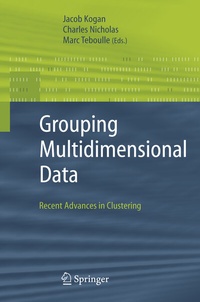
Grouping Multidimensional Data
Description

Clustering is one of the most fundamental and essential data analysis techniques. Clustering can be used as an independent data mining task to discern intrinsic characteristics of data, or as a preprocessing step with the clustering results then used for classification, correlation analysis, or anomaly detection.
Kogan and his co-editors have put together recent advances in clustering large and high-dimension data. Their volume addresses new topics and methods which are central to modern data analysis, with particular emphasis on linear algebra tools, opimization methods and statistical techniques. The contributions, written by leading researchers from both academia and industry, cover theoretical basics as well as application and evaluation of algorithms, and thus provide an excellent state-of-the-art overview.
The level of detail, the breadth of coverage, and the comprehensive bibliography make this book a perfect fit for researchers and graduate students in data mining and in many other important related application areas.
More details
Other editions
Additional editions
Persons
Jacob Kogan is an Associate Professor in the Department of Mathematics and Statistics at the University of Maryland Baltimore County. Dr. Kogan received his Ph.D. in Mathematics from Weizmann Institute of Science, and has held teaching and research positions at the University of Toronto and Purdue University. His research interests include Text and Data Mining, Optimization, Calculus of Variations, Optimal Control Theory, and Robust Stability of Control Systems. From 2001 he has also been affiliated with the Department of Computer Science and Electrical Engineering, University of Maryland Baltimore County.
Charles Nicholas is currently a Professor of Computer Science and Chair of the Computer Science and Electrical Engineering Department at UMBC, where he has been since 1988. He received his Ph.D. from The Ohio State University in 1988. Dr. Nicholas' research interestsinclude electronic document processing, information retrieval, and software engineering. Dr. Nicholas has served five times as the General Chair of the ACM Conference on Information and Knowledge Management (CIKM), most recently in 2002. He also twice chaired the Workshop on Digital Document Processing, PODP'96 and PODDP'98.
Marc Teboulle is a Professor in the School of Mathematical Sciences, Tel-Aviv University. He received his D.Sc. from the Technion, Israel Institute of Technology in 1985, and has held positions at the Israel Aircraft Industries, Dalhousie University, the University of Maryland, and visiting positions in various academic institutions in France and the USA. His main research interests are in the area of nonlinear optimization: theory , algorithmic analysis and its applications. He is on the editorial board of the journals: Mathematics of Operations Research and the European Series in Applied and Industrial Mathematics, Control, Optimisation and Calculus of Variations. He served as chairman of the Department of Statistics and Operations Researchat the School of Mathematical Sciences of Tel-Aviv University during 1999-2002.
