

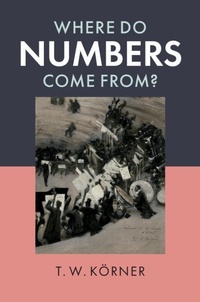
Where Do Numbers Come From?
Published on 31. October 2019
978-1-108-78181-7 (ISBN)
Description

Why do we need the real numbers? How should we construct them? These questions arose in the nineteenth century, along with the ideas and techniques needed to address them. Nowadays it is commonplace for apprentice mathematicians to hear 'we shall assume the standard properties of the real numbers' as part of their training. But exactly what are those properties? And why can we assume them? This book is clearly and entertainingly written for those students, with historical asides and exercises to foster understanding. Starting with the natural (counting) numbers and then looking at the rational numbers (fractions) and negative numbers, the author builds to a careful construction of the real numbers followed by the complex numbers, leaving the reader fully equipped with all the number systems required by modern mathematical analysis. Additional chapters on polynomials and quarternions provide further context for any reader wanting to delve deeper.
Reviews / Votes
'Clearly this book is probing the fundamentals of mathematical analysis and will be useful as an extra reading for an introductory calculus course. It will certainly satisfy those readers who are looking for abstraction and who want to extract the maximal number of results from the minimal set of axioms. The historical elements on the side are entertaining ... It is an excellent way to get in touch with the foundations of mathematics at a relatively elementary level.' Adhemar Bultheel, European Mathematical Society 'Koerner begins with historical anecdotes that illustrate how numbers have been used. He then proceeds to develop number systems axiomatically with careful definitions, theorems and proofs. His characteristic humor, digressions and historical insights are present throughout, but this is a rigorous treatment that seems - in some measure - to follow Dedekind's original approach.' Bill Satze, MAA Reviews 'This is a comfortably paced introduction to the various notions of numbers ... The relatively high level of abstraction of the second and third parts suggests that the ideal readership for this book is students who have taken at least some advanced undergraduate classes in mathematics. Classroom use would be possible in a philosophy of mathematics course ...' M. Bona, Choice 'The text is peppered with quotes from classical (ancient civilizations), modern (nineteenth and early twentieth centuries), and contemporary mathematical texts; classical, modern and current approaches to most of the subjects covered are offered; and practical applications of most of the materials introduced are carefully explained. As a consequence, there is a constant dialogue between past and present from both a theoretical and a practical point of view, which makes this book interesting from a conceptual point of view and useful as an introductory working tool.' Capi Corrales-Rodriganez, Mathematical Reviews 'Fans of Koerner's other books, like The Pleasures of Counting, will appreciate the conversational style of this book, which provides plenty of amusing footnotes, historical context, quotations and poems, while never relenting on the rigour of the mathematics.' Julia Collins, London Mathematical Society Newsletter 'Where Do Numbers Come From? certainly adds to the pleasure of mathematics as well as narrating a journey that surely every mathematician should undertake at some stage. As such, I enthusiastically recommend it to all Gazette readers.' Nick Lord, The Mathematical GazetteMore details
Language
English
Place of publication
Cambridge
United Kingdom
Target group
College/higher education
Professional and scholarly
Illustrations
Worked examples or Exercises; 1 Halftones, black and white
File size
2,31 MB
ISBN-13
978-1-108-78181-7 (9781108781817)
Copyright in bibliographic data and cover images is held by Nielsen Book Services Limited or by the publishers or by their respective licensors: all rights reserved.
Schweitzer Classification
Other editions
Additional editions
T. W. Koerner
Where Do Numbers Come From?
Book
10/2019
Cambridge University Press
€97.10
Shipment within 15-20 days
T. W. Koerner
Where Do Numbers Come From?
Book
10/2019
Cambridge University Press
€54.60
Shipment within 15-20 days
Person
Content
Introduction; Part I. The Rationals: 1. Counting sheep; 2. The strictly positive rationals; 3. The rational numbers; Part II. The Natural Numbers: 4. The golden key; 5. Modular arithmetic; 6. Axioms for the natural numbers; Part III. The Real Numbers (and the Complex Numbers): 7. What is the problem?; 8. And what is its solution?; 9. The complex numbers; 10. A plethora of polynomials; 11. Can we go further?; Appendix A. Products of many elements; Appendix B. nth complex roots; Appendix C. How do quaternions represent rotations?; Appendix D. Why are the quaternions so special?; References; Index.
