

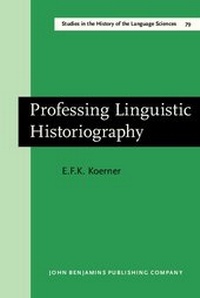
Professing Linguistic Historiography
1st Edition
Published on 24. November 1995
VIII, 274 pages
978-90-272-8438-9 (ISBN)
Description

The volume brings together recent papers by the author, selected to form a broad picture of his teachings, all of them revised and updated, either addressing particular topics in the Histor(iograph)y of Linguistics (Part I) or offering historical accounts of linguistic subfields (Part II), in altogether 10 chapters: 1, Persistent Issues in Linguistic Historiography; 2, Metalanguage in Linguistic Historiography; 3, The Natural Science Impact on Theory Formation in 19th and 20th Century Linguistics; 4, Saussure and the Question of the Sources of his Linguistic Theory; 5, Chomsky's Readings of the Cours de linguistique générale; 6, Toward a History of Modern Sociolinguistics; 7, Toward a History of Americanist Linguistics; 8, Toward a History of Linguistic Typology; 9, History and Historiography of Phonetics: A state-of-the-art account, and 10, The 'Sapir-Whorf Hypothesis': An historico-bibliographical essay. Index of authors; index of subjects & terms.
More details
Other editions
Additional editions
E.F.K. Koerner
Professing Linguistic Historiography
Book
11/1995
John Benjamins Publishing Co
€116.60
Shipment within 10-15 days
Person
Content
- PROFESSING LINGUISTIC HISTORIOGRAPHY
- Editorial page
- Title page
- Copyright page
- PREFATORY REMARKS
- Table of contents
- BOOKS BY THE SAME AUTHOR
- PARTI. TOPICS IN THE HISTOR(IOGRAPH)Y OF LINGUISTICS
- CHAPTER 1. PERSISTENT ISSUES IN LINGUISTIC HISTORIOGRAPHY
- 0. Introductory observations
- 1. Approaches to linguistic historiography
- 2. Developing principles for linguistic historiography
- 3. Conclusion: Tasks for the historiography of linguistics
- REFERENCES
- CHAPTER 2. 'METALANGUAGE' IN LINGUISTIC HISTORIOGRAPHY
- 0. Introduction
- 1. Illustration of pitfalls in the handling of 'metalanguage'
- 2. Toward an adequate treatment of 'metalanguage'
- REFERENCES
- CHAPTER 3. THE NATURAL SCIENCE IMPACT ON THEORY FORMATION IN 19TH AND 20TH CENTURY LINGUISTICS
- 0. Introductory observations
- 1. The impact of the natural sciences on 19th-century linguistics
- 2. Instances of natural-science influence on linguistic thinking
- 3. Concluding remarks: - from 'pirate' to 'pilot' discipline
- REFERENCES
- CHAPTER 4. SAUSSURE AND THE QUESTION OF THE SOURCES OF HIS LINGUISTIC THEORY
- 0. Introductory remarks
- 1. 'Influence' in linguistic historiography, with illustrations from modern scholarship concerning Saussure
- 2. Concluding remarks
- REFERENCES
- CHAPTER 5. CHOMSKY'S READINGS OF THE COURS DE LINGUISTIQUE GÉNÉRALE
- 0. Introductory observations
- 1. Chomsky's readings of Saussure
- 2. Concluding remarks
- REFERENCES
- PARt II. HIStORICAL ACCOUNtS OF LINGUISTIC SUBFIELDS
- CHAPTER 6. TOWARd A HIStORY OF MODERN SOCIOLINGUISTICS
- 0. Introductory observations
- 1. the sources of modern sociolinguistics
- 2. Concluding observations
- BIBLIOGRAPHY
- CHAPTER 7. TOWARD A HISTORY OF AMERICANIST LINGUISTICS
- 0. Preliminary remark
- 1. Toward a historiography of Amerindian linguistics
- 2. Concluding remarks: Desiderata for a history of pre-19th century history of American linguistics
- REFERENCES
- CHAPTER 8. TOWARD A HISTORY OF LINGUISTIC TYPOLOGY
- 0. Introductory remarks
- 1. The pre-history of linguistic classification and typology
- 2. 'Classical' language typology and classificatory schemes
- 3. Implicational typology and the search for unixersah
- 4. Typology and historical linguistics
- 5. Concluding observations
- REFERENCES
- CHAPTER 9. HISTORY AND HISTORIOGRAPHY OF PHONETICSA STATE-OF-THE-ART ACCOUNT
- 0. Introductory observations
- 1. Pioneer historians of phonetics
- 2. Historiography of phonetics in the 20th century
- 3. Prospects for the history and historiography of phonetics
- BIBLIOGRAPHY
- CHAPTER 10. THE 'SAPIR-WHORF HYPOTHESIS' AN HISTORICO-BIBLIOGRAPHICAL ESSAY
- 0. Introductory remarks
- 1. Humboldtian ethnolinguistics in North America and the 'Sapir-Whorf Hypothesis'
- 2. Concluding remarks
- BIBLIOGRAPHY
- APPENDIX
- INDEX OF AUTHORS
- INDEX OF SUBJECTS
